*Disclosure: This article contains affiliate links. If you purchase through these links, we may earn a commission at no additional cost to you. We only recommend books we genuinely believe in.
Quick Overview
I first encountered Dave Ramsey's system in 2019 when a coworker mentioned she had paid off $42,000 in consumer debt using his Baby Steps. She was not a finance person. She was a receptionist who had simply followed the plan. That conversation sent me to The Total Money Makeover, and I have been thinking critically about it ever since.
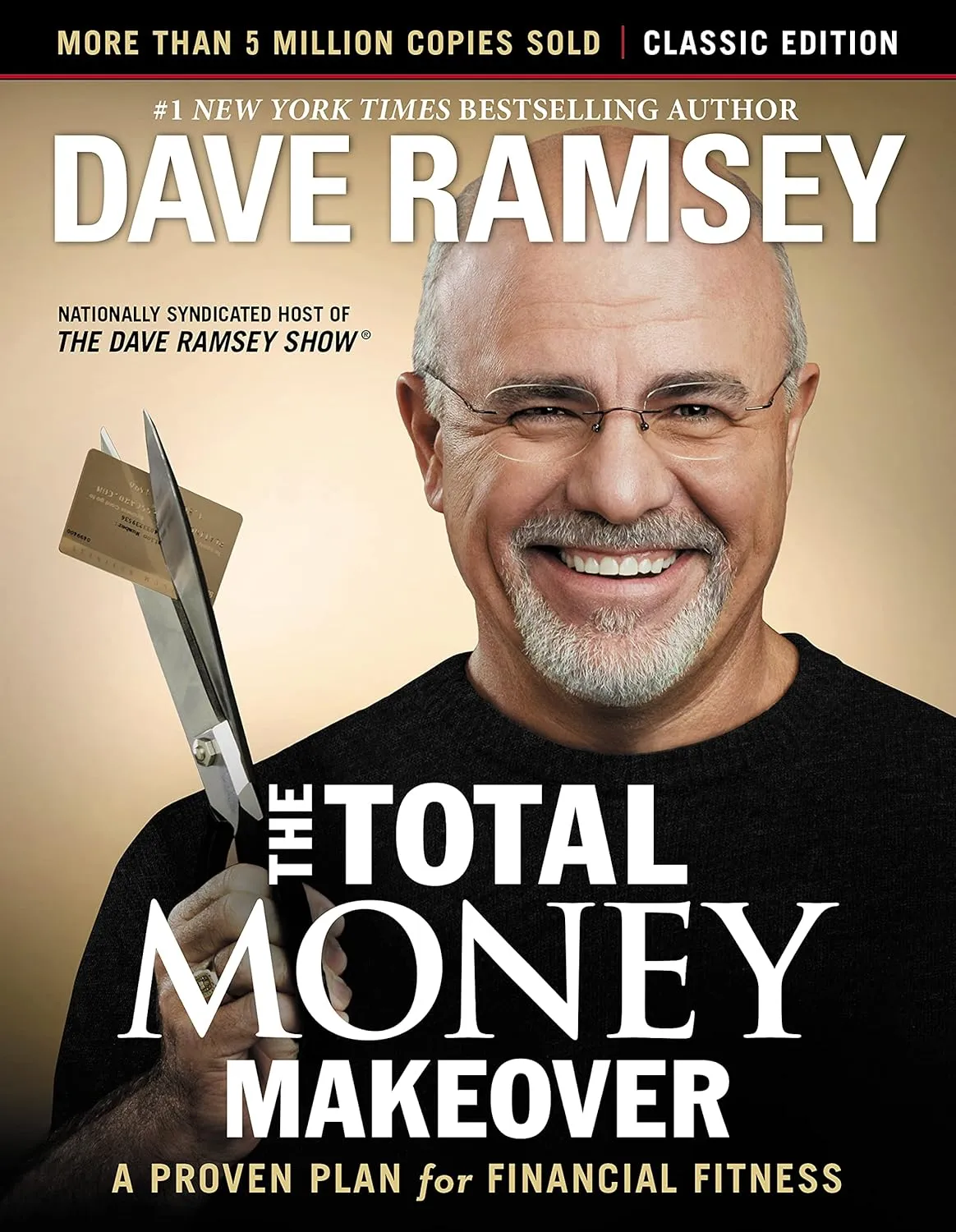
Ramsey went bankrupt in his late 20s after building and losing a real estate portfolio financed entirely with borrowed money. He spent the following decade studying why people fail financially and developed a seven-step system to get out of debt, build an emergency fund, invest for retirement, and eventually give generously. The book has sold over 10 million copies and spent more than 1,000 weeks on bestseller lists. Ramsey Solutions claims followers have paid off over $100 billion in debt using the plan.
The book is not financially sophisticated. It is behavioral. Ramsey himself says personal finance is 20% knowledge and 80% behavior, and every page is engineered around that belief. For people buried in credit card debt who need a plan they will actually follow, this may be the most important finance book they ever read. For people who are already debt-free and optimizing returns, large portions of it will be frustrating.
Book Details
| Attribute | Details |
|---|---|
| Title | The Total Money Makeover |
| Author | Dave Ramsey |
| Publisher | Thomas Nelson (updated and expanded edition) |
| Published | 2003 (20th anniversary edition, 2024) |
| Pages | 288 |
| Reading Level | Beginner |
| Amazon Rating | 4.8/5 stars |
Get Your Copy
Hardcover: Buy on Amazon
Kindle: Buy on Amazon
Audiobook: Buy on Amazon
About the Author
Dave Ramsey is a personal finance author, radio host, and entrepreneur based in Franklin, Tennessee. His show, The Ramsey Show, reaches approximately 18 million listeners weekly across radio and podcast platforms. He built a real estate business in his 20s using borrowed money, went bankrupt at 26 when creditors called their loans, and spent the following decade developing the debt elimination philosophy that became Financial Peace University and this book.
Ramsey Solutions, his company, has grown to over 1,000 employees. It has also faced significant legal scrutiny. As of early 2026, at least three employment lawsuits remain active in the Middle District of Tennessee, centered on claims of wrongful termination and religious discrimination. A separate strand of litigation targets the SmartVestor Pro program, alleging that Ramsey Solutions misled consumers about paid endorsements and referral arrangements presented as objective recommendations. Ramsey Solutions defends its policies as protected religious expression and has denied wrongdoing.
These lawsuits matter for readers because the SmartVestor Pro program is the investment advice pipeline Ramsey directs his followers toward. Understanding the financial incentives behind that pipeline is essential before following the investment guidance in the book's later chapters.
The Seven Baby Steps
Ramsey's system is organized into seven sequential steps, taken in order, never simultaneously (with minor exceptions). The structure has not changed since the book's first publication in 2003, and the 20th anniversary edition released in 2024 keeps the same framework with updated examples and testimonials.
Baby Step 1: $1,000 Starter Emergency Fund
Before anything else, save $1,000 in cash as a starter emergency fund. This provides a buffer against minor emergencies that would otherwise go on a credit card and undermine the debt payoff process.
Why $1,000 first:
Ramsey is emphatic: do not invest, do not pay extra on debt, do not fund retirement beyond the 401(k) match until Baby Step 1 is complete.
2026 critique: $1,000 was already tight when the book was published in 2003. It is woefully inadequate in 2026. The average car repair now costs $500 to $2,500. A single emergency room visit with insurance can run $400 to $1,200. The Federal Reserve's most recent Survey of Household Economics and Decisionmaking found that 37% of adults could not cover a $400 expense with cash. For those households, $1,000 is a meaningful start. For anyone with a family, a home, or a chronic condition, $1,500 to $2,000 is more realistic. Ramsey's own organization has quietly acknowledged this in blog posts while keeping the $1,000 figure in the book itself.
Baby Step 2: The Debt Snowball
Pay off all non-mortgage debt using the debt snowball method: list debts smallest to largest by balance, pay minimums on everything, and throw every extra dollar at the smallest balance first.
The Debt Snowball in action:
| Debt | Balance | Minimum Payment | Priority |
|---|---|---|---|
| Credit Card A | $800 | $25 | #1 (smallest balance) |
| Medical Bill | $1,200 | $35 | #2 |
| Auto Loan | $4,500 | $175 | #3 |
| Student Loan | $12,000 | $200 | #4 |
| Credit Card B | $18,000 | $350 | #5 |
Process:
The psychological power vs. the mathematical argument:
The mathematically optimal approach is the debt avalanche (highest interest rate first). Ramsey explicitly rejects this for behavioral reasons:
| Method | Optimizes For | Best For |
|---|---|---|
| Debt Avalanche (highest rate first) | Total interest paid | People with strong financial discipline |
| Debt Snowball (smallest balance first) | Psychological momentum | People who need motivation and wins |
Research backs Ramsey on this. A 2016 study in the Journal of Marketing Research found that consumers who used the debt snowball method were more likely to complete debt payoff than those using the avalanche, even though they paid more in interest. The quick wins from eliminating small debts create a sense of progress that sustains the process. This is not a marginal effect. The snowball group paid off 15% more of their debt over the study period.
That said, if you have a $20,000 credit card at 29% APR and a $1,200 medical bill at 0%, the avalanche saves you thousands. The snowball's advantage is motivation, not math. Use our debt payoff calculator to compare both methods with your actual balances and rates. For a deeper comparison, read our breakdown of debt avalanche vs. debt snowball.
2026 context: The average U.S. household carries approximately $21,800 in non-mortgage debt as of early 2026. Credit card APRs average 24% to 28% for existing accounts, with subprime cards exceeding 30%. The debt snowball matters more when rates are this high because the cost of carrying any balance is enormous. Getting started fast matters more than optimizing the order.
Baby Step 3: 3-6 Month Full Emergency Fund
After eliminating all non-mortgage debt, build the emergency fund to 3-6 months of expenses. This is the financial foundation that allows you to handle any crisis without going back into debt.
Target emergency fund by monthly expenses:
| Monthly Expenses | 3-Month Fund | 6-Month Fund |
|---|---|---|
| $2,500 | $7,500 | $15,000 |
| $3,500 | $10,500 | $21,000 |
| $5,000 | $15,000 | $30,000 |
| $7,500 | $22,500 | $45,000 |
Ramsey recommends keeping this in a high-yield savings account. In 2026, the best high-yield accounts pay 4% to 5% APY, which means a $30,000 emergency fund generates $1,200 to $1,500 per year in interest while remaining fully accessible. Use our emergency fund calculator to determine your target based on actual expenses.
Baby Step 4: Invest 15% of Income for Retirement
Invest 15% of gross household income into retirement accounts, prioritizing:
Ramsey's investment recommendation: Growth stock mutual funds divided across four categories:
This is where the book runs into serious trouble.
The 12% return claim: Ramsey repeatedly tells audiences that the stock market averages 12% annually and that his recommended mutual funds can achieve this. The S&P 500's long-run nominal average is approximately 10% before inflation, or about 7% real. Over the past 20 years (2006 through 2025), the S&P 500 returned approximately 9.8% annually with dividends reinvested. The 12% figure is not impossible in any given year, but using it as a planning assumption leads to dangerously optimistic projections. A 30-year retirement plan built on 12% instead of 8% overestimates the final balance by roughly 250%.
Active funds vs. index funds: SPIVA (S&P Indices Versus Active) scorecards consistently show that 85% to 90% of actively managed U.S. large-cap funds underperform the S&P 500 over 15-year periods. The expense ratios on Ramsey-recommended funds typically run 1% to 1.5% annually, compared to 0.03% for broad index funds like VTI. Over 30 years, that 1% difference consumes approximately $230,000 on a $500,000 portfolio.
The SmartVestor Pro problem: Ramsey directs followers to SmartVestor Pros (formerly Endorsed Local Providers), a paid referral network. SmartVestor Pros pay Ramsey Solutions for leads. The program has faced consumer protection lawsuits alleging that the referral arrangement was not adequately disclosed to followers who believed they were receiving objective recommendations. Regardless of the legal outcome, the conflict of interest is clear. A fiduciary who is paid by the client, not by a referral network, has fewer structural incentives to recommend high-fee products.
Practical modification: Use Ramsey's 15% savings rate guidance, which is excellent. Implement it through low-cost index funds (VTI, VXUS, BND) rather than the actively managed funds his SmartVestor Pros typically recommend. Open your Roth IRA directly at Fidelity, Vanguard, or Schwab. For help projecting your retirement trajectory, use our compound interest calculator.
Baby Step 5: College Funding for Children
Save for children's education using Education Savings Accounts (ESA/Coverdell) or 529 plans. Ramsey is clear: this step comes after retirement funding. The airline oxygen mask principle applies. Secure your own oxygen first.
529 vs. Coverdell comparison:
| Feature | 529 Plan | Coverdell ESA |
|---|---|---|
| Annual contribution limit | No federal limit (gift tax applies above $18,000 in 2026) | $2,000/year |
| Income limits for contributions | None | Yes (phased out above $95K-$110K single) |
| Investment options | State-specific menu | Broader (can hold individual ETFs) |
| Qualified expenses | College + K-12 (up to $10,000/year) | College + K-12 |
| Best for | Most families | High-income families wanting more control |
Baby Step 6: Pay Off the Mortgage Early
Apply every available dollar above 15% retirement savings and college funding to eliminating the mortgage.
The mortgage payoff debate:
| Argument For Early Payoff | Argument Against |
|---|---|
| Guaranteed risk-free return equal to mortgage rate | Expected stock returns exceed most mortgage rates |
| Psychological freedom and security | Lost tax deduction (for itemizers) |
| Reduces sequence of returns risk in retirement | Opportunity cost of foregone investment returns |
| Aligns with behavioral finance (certainty preference) | Inflation erodes real value of fixed-rate debt over time |
Ramsey's answer is behavioral: the guaranteed, risk-free, tax-free equivalent return of paying off your mortgage is compelling for most households. The mathematical argument for carrying mortgage debt and investing the difference is valid but requires discipline and assumes strong future returns.
2026 context: Mortgage rates remain elevated compared to the 2020-2021 era. Someone who refinanced at 2.75% in 2021 should not rush to pay off that loan early when safe investments yield 4% to 5%. Someone who bought in 2024 at 7% should consider aggressive principal paydown, because the guaranteed return of paying off a 7% loan is difficult to beat in any risk-comparable investment. Use our mortgage payoff calculator to run the numbers with your actual rate and balance.
Baby Step 7: Build Wealth and Give Generously
With no debt and a paid-off home, all income can be directed toward building wealth and generous giving. Ramsey frames this as the ultimate financial goal. Not accumulation for its own sake but the freedom to help others.
This step is where Ramsey's philosophy aligns with research on financial satisfaction. Studies consistently show that spending money on others produces more lasting happiness than spending on oneself. Ramsey did not invent this insight, but he packages it effectively as the capstone of a multi-year financial journey.
The Zero-Based Budget
Ramsey's budgeting system assigns every dollar a job before the month begins:
Income - All Expenses and Savings = $0Every dollar is either spent on a specific category or assigned to a savings goal. Nothing is leftover and available to drift toward impulse purchases.
The zero-based budget template:
| Category | % of Take-Home | Example ($5,000/month) |
|---|---|---|
| Housing (rent/mortgage) | 25-35% | $1,500 |
| Food | 10-15% | $600 |
| Transportation | 10-15% | $600 |
| Utilities | 5-10% | $350 |
| Healthcare | 5-10% | $300 |
| Insurance | 10-25% | $400 |
| Personal spending | 5-10% | $300 |
| Debt payments (Baby Step 2) | Remaining | $950 |
The specific percentages are guidelines. The zero-based principle is non-negotiable in Ramsey's system. I have used this method for three years and it works. The act of assigning every dollar before the month starts forces decisions about priorities that otherwise get made impulsively at the point of purchase. For a practical tool, try our budget calculator to build your own zero-based budget.
What Ramsey Gets Right
The behavioral focus is the book's greatest strength. Ramsey explicitly states that personal finance is 20% knowledge and 80% behavior. The debt snowball's psychological momentum, the zero-based budget's intentionality, and the Baby Steps' sequential simplicity are all designed around human psychology, not mathematical optimization. This is not a gimmick. Behavioral economists have spent decades documenting that humans do not make financially optimal decisions even when they know what the optimal decision is. Ramsey built a system around that reality.
The debt emergency tone is appropriate. Someone with $50,000 in consumer debt needs urgency and motivation, not nuanced discussion of optimal asset allocation. Ramsey provides that urgency effectively. His language is blunt, his examples are real, and his testimonials are verifiable. The tone will grate on some readers. For the target audience, it is exactly what is needed.
The community aspect amplifies results. Financial Peace University small groups meeting weekly to discuss progress create accountability that books alone cannot provide. Ramsey Solutions reports that the average FPU graduate pays off $5,300 in debt and saves $2,700 within 90 days of completing the course. Whether those numbers are perfectly accurate or not, the community structure clearly helps people who have failed alone.
Where Ramsey Oversimplifies or Misses
The investment advice is suboptimal and potentially harmful. This is the most important criticism of the book. Actively managed mutual funds recommended by SmartVestor Pros typically charge 1% to 1.5% annually and underperform index funds over time. The 12% expected return assumption is too high. For debt elimination, this does not matter. For the wealth-building phase, it costs hundreds of thousands of dollars over an investing lifetime.
The mortgage payoff advice ignores interest rate context. Paying off a 2.75% mortgage while foregoing 10% stock market returns is mathematically suboptimal. At higher rates (6% or above), the advice becomes far more defensible. Ramsey does not distinguish between these scenarios. He treats all mortgage debt as equally urgent regardless of rate, which is a significant oversight.
The no-credit-card absolutism. Ramsey advises destroying all credit cards and never using them. The evidence for the psychological benefits of cash spending exists. People do spend less with cash. But credit cards with zero balance carry no interest charges and provide significant consumer protections including extended warranties, fraud protection, and dispute resolution. Disciplined users of no-fee credit cards are not harmed by them and may benefit from the protections. For more on the psychology behind spending, read our post on why budgets fail and what actually works.
Ignores HSA as an investment vehicle. The Health Savings Account, the only triple-tax-advantaged account available in the U.S. tax code, is not mentioned anywhere in the book. For eligible participants with high-deductible health plans, it is the best investment account available. Contributions are tax-deductible, growth is tax-free, and withdrawals for qualified medical expenses are tax-free. This is a significant omission for a book that covers retirement investing in detail.
Strengths & Weaknesses
What We Loved
Areas for Improvement
Who Should Read This Book
Highly Recommended For
Probably Not For
How to Combine Ramsey With Index Investing
The optimal approach for most people is a hybrid:
Use Ramsey for:
Use evidence-based investing for:
This combination gives you Ramsey's behavioral framework for getting out of debt with the evidence-based investment approach for building wealth. It is what most Ramsey followers who understand the investing literature eventually arrive at anyway.
Comparison to Similar Books
| Book | Debt Focus | Investment Quality | Accessibility |
|---|---|---|---|
| The Total Money Makeover | Very High | Medium (flawed) | Very High |
| Your Money or Your Life | Medium | High | High |
| I Will Teach You to Be Rich | Medium | High | Very High |
| The Simple Path to Wealth | Low | Very High | High |
Frequently Asked Questions
Q: Is the debt snowball or debt avalanche actually better?
A: Mathematically, the debt avalanche (highest rate first) saves more interest. Behaviorally, a 2016 Journal of Marketing Research study shows the debt snowball produces more completions. If you have strong discipline, use the avalanche. If you need wins to stay motivated, use the snowball. Try both with your actual numbers using our debt payoff calculator.
Q: Can I do Baby Steps 4 and 5 simultaneously with Baby Step 6?
A: Yes. Ramsey allows this. The key constraint is completing Baby Steps 1 through 3 before starting 4 through 6.
Q: Why does Ramsey recommend active mutual funds when index funds are proven better?
A: The SmartVestor Pro program is a revenue source for Ramsey Solutions. SmartVestor Pros pay for leads, and the investment advice in the book aligns with products sold through that network. This does not invalidate the debt elimination system, but the investment advice should not be followed uncritically.
Q: Is the $1,000 starter emergency fund still adequate in 2026?
A: No. Inflation has eroded its purchasing power significantly since 2003. I recommend $1,500 to $2,000 as a more realistic starting point, especially for households with children, vehicles, or ongoing medical needs.
Final Verdict
Rating: 4.5/5
The Total Money Makeover is the best book ever written for the specific problem of consumer debt elimination. Its Baby Steps, debt snowball, and behavioral focus are genuinely effective and have helped millions of people. The investment advice should be replaced with low-cost index fund guidance from Bogle or Collins. The $1,000 emergency fund should be adjusted upward for inflation. Used correctly, meaning great debt system plus index fund investing, it is a complete financial recovery program.
Get Your Copy
Hardcover: Buy on Amazon
Kindle: Buy on Amazon
Audiobook: Buy on Amazon
Prices current as of publication date. Free shipping available with Prime.