*Disclosure: This article contains affiliate links. If you purchase through these links, we may earn a commission at no additional cost to you. We only recommend books we genuinely believe in.
Quick Overview
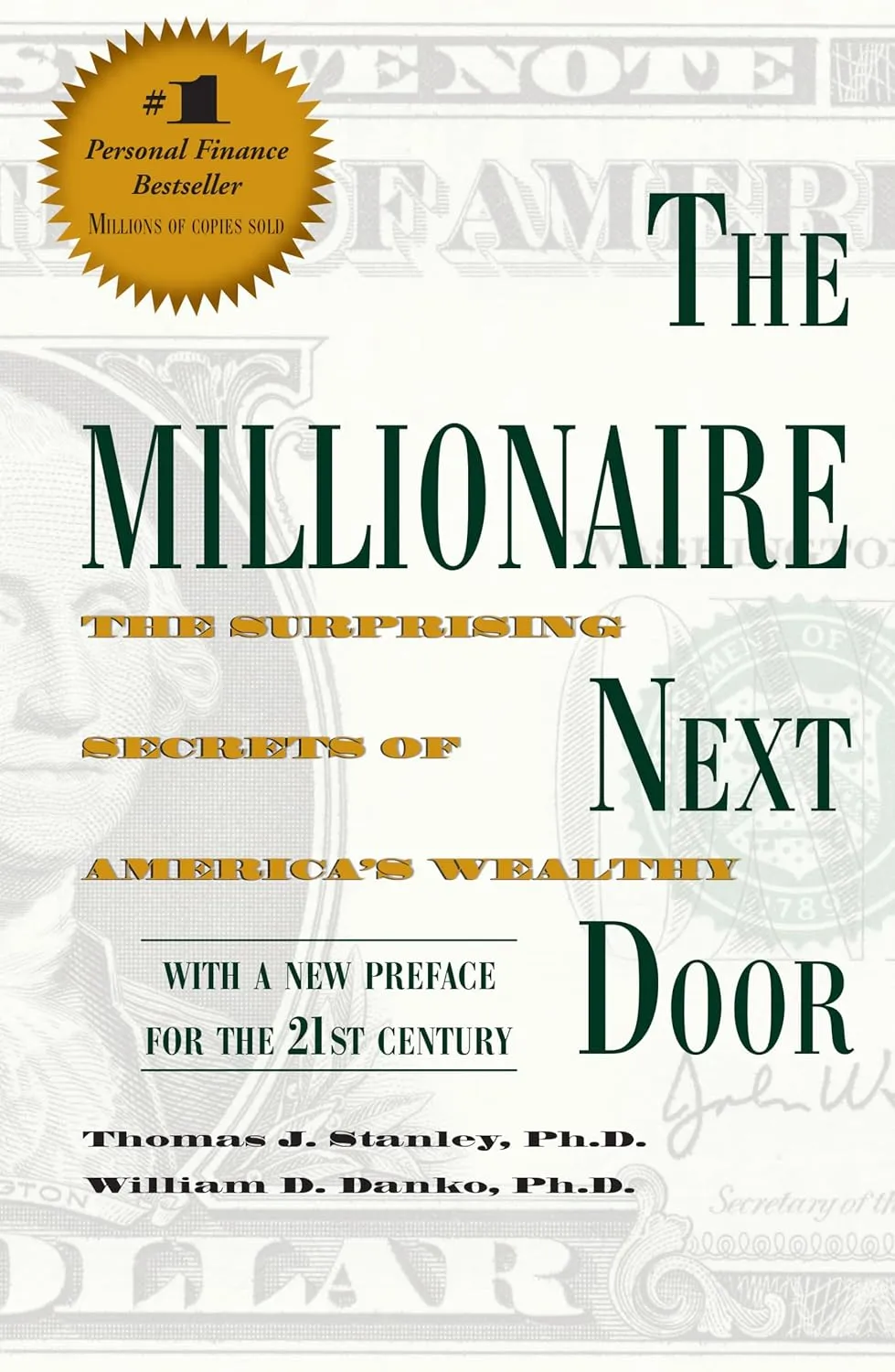
What if everything you thought about wealth was wrong? Thomas Stanley and William Danko spent 20 years studying American millionaires, and their finding upended popular assumptions: the typical American millionaire does not drive a luxury car, live in a mansion, or wear expensive watches. They live in modest homes, drive used cars, and built wealth through disciplined saving and consistent investing.
As of 2026, there are approximately 24.5 million millionaires in the United States, representing 8.8% of American adults, roughly 1 in 11 people. Yet 79-80% are first-generation rich, and 64% drive Toyota, Honda, or Ford. The behavioral patterns Stanley and Danko identified in 1996 have not just held up. They have intensified as social media and lifestyle inflation create more pressure to spend. This book is the research report that proves it, with enough data to be convincing and enough storytelling to be readable.
Book Details
| Attribute | Details |
|---|---|
| Title | The Millionaire Next Door |
| Authors | Thomas J. Stanley & William D. Danko |
| Publisher | Taylor Trade Publishing |
| Published | 1996 |
| Pages | 258 |
| Reading Level | Beginner |
| Amazon Rating | 4.6/5 stars |
Get Your Copy
Paperback: Buy on Amazon
Kindle: Buy on Amazon
Audiobook: Buy on Amazon
About the Authors
Thomas J. Stanley (1944-2015) was a professor of marketing and a researcher who dedicated his career to studying the affluent. He conducted surveys of thousands of American millionaires over two decades, producing the most comprehensive empirical profile of wealth accumulation in the United States. His follow-up books (The Millionaire Mind, Stop Acting Rich) extended the research. His daughter, Sarah Stanley Fallaw, continued the work with The Next Millionaire Next Door, which updated the research with a broader, more diverse sample and found that the core habits had not changed.
William D. Danko is a professor of marketing at the University at Albany who collaborated with Stanley on the original research.
The Core Research Finding
Stanley and Danko surveyed 733 millionaires (defined as having a net worth of $1 million or more) and conducted in-depth interviews with many of them. Their central finding:
Wealth is not income. Wealth is what you keep.
The typical American millionaire in their study:
These are not the people you picture when you think of millionaires. The visible wealthy in expensive neighborhoods, luxury cars, and designer clothes are often not wealthy at all. They have high incomes and high consumption, leaving little for actual net worth accumulation.
PAW vs. UAW: The Core Framework
Stanley and Danko introduce two categories that define their research:
| Category | Name | Description |
|---|---|---|
| PAW | Prodigious Accumulator of Wealth | Net worth significantly above expected for income/age |
| UAW | Under Accumulator of Wealth | Net worth significantly below expected for income/age |
The wealth accumulation formula:
Expected Net Worth = (Age × Annual Pre-Tax Income) / 10For a 45-year-old earning $100,000:
PAW characteristics:
| Trait | PAW | UAW |
|---|---|---|
| Household budget | Yes, detailed | Rarely |
| Knows monthly expenses | Yes | No |
| Investment time spent weekly | 8.4 hours | 4.6 hours |
| Occupation | Often self-employed or business owner | Often high-income professional |
| Lifestyle vs. income | Well below | At or above |
The Seven Factors of Wealth Building
Stanley and Danko identify seven common factors among PAWs:
1. They Live Well Below Their Means
PAWs maintain a significant gap between income and spending. This gap is invested, not consumed. The typical PAW saves 15-20% of income annually; UAWs save less than 5%.
Fidelity's 2025 data confirms this pattern persists. Only 1 in 38 Fidelity 401(k) participants reaches $1 million, and those who do almost always have 30 years of consistent 15% savings behind them. The average employee defers 9.5%, with employers adding 4.7%, for a total of 14.2%, just under Fidelity's 15% guideline. Meanwhile, 37% of workers have taken an early or hardship withdrawal from a retirement account, and the national savings rate fell from 6.2% in Q1 2024 to 3.7% in Q1 2026. The behavior gap Stanley identified is alive and well.
Annual savings rate and 30-year outcomes ($80,000 income, 8% return):
| Savings Rate | Annual Amount | 30-Year Portfolio |
|---|---|---|
| 5% | $4,000 | $489,000 |
| 10% | $8,000 | $978,000 |
| 15% | $12,000 | $1,467,000 |
| 20% | $16,000 | $1,956,000 |
The difference between 5% and 20% savings rates is $1.47 million over 30 years on the same income. Use our savings rate calculator to see where you stand.
2. They Allocate Time, Energy, and Money Efficiently
PAWs spend more time planning their finances than UAWs. They understand their monthly expenses, their net worth, and their investment allocation. This is not obsession. It is competence applied to one of the most important areas of life.
3. They Believe Financial Independence Is More Important Than Displaying Status
This is the most counterintuitive finding. High-income professionals who drive luxury cars, live in expensive zip codes, and wear designer clothes are often UAWs with minimal savings. Their income is consumed by the social environment they have placed themselves in. Social media has amplified this effect dramatically since the book's publication. A 2025 Intuit Credit Karma survey found that 44% of high-earning millennials rely on "vibe-based budgeting" while 61% cite money as their primary source of stress. Gen Z and millennial credit card balances have risen 62% and 50% respectively. The pressure to display wealth has never been greater, and the cost of yielding to it has never been higher.
The authors call this "economic outpatient care" when applied to adult children: high-income parents who subsidize children's luxury lifestyles are actively preventing their children from building wealth.
4. Their Parents Did Not Provide Economic Outpatient Care
PAWs more often grew up in households where money was tight and self-reliance was expected. They developed the habits of frugality and investment early because there was no alternative.
UAWs more often received financial support from parents well into adulthood, which prevented the development of independent wealth-building habits.
5. Their Adult Children Are Economically Self-Sufficient
PAWs raise children who can support themselves. UAWs raise children who receive ongoing financial support that drains parental wealth.
6. They Are Proficient at Targeting Market Opportunities
Most millionaires in the study own businesses or have expertise in specific industries. They build wealth through productive economic activity, not passive income alone.
7. They Chose the Right Occupation
Self-employment and business ownership appear disproportionately among PAWs. The most common occupations among American millionaires in the study were not doctors and lawyers (high income, high consumption) but business owners in unglamorous industries: welding contractors, pest control operators, coin dealers, farmers, and small manufacturers.
The Income-Wealth Paradox
One of the book's most striking findings: high income does not reliably produce high wealth.
The high-income UAW profile:
A physician earns $350,000 per year. They live in a wealthy neighborhood that costs $1.2 million (mortgage plus property tax drains $80,000/year). They drive two luxury cars ($18,000/year in payments, insurance, and maintenance). Private school for three children ($45,000/year). Country club membership ($15,000/year). Vacations, dining, clothing ($40,000/year).
After taxes and these expenses, they save approximately $15,000-$20,000 per year. Over 30 years at 8% returns: approximately $1.8 million. For an income that might suggest $3-5 million in net worth.
A plumber earning $120,000 per year who lives in a modest home, drives a paid-off truck, and saves 25% of income saves $30,000 per year. Over 30 years at 8% returns: approximately $3.4 million. Twice the wealthy neighborhood physician.
The key variable is not income. It is lifestyle inflation relative to income.
The FIRE (Financial Independence, Retire Early) movement has breathed new life into Stanley and Danko's philosophy. Across Reddit threads, YouTube channels, and local meetups, a global tribe of modern millionaires applies the same principles: spend intentionally, invest consistently, and avoid lifestyle inflation. The tools have improved since 1996, but the behavior remains the deciding factor.
The Neighborhood Effect
Stanley and Danko make a counterintuitive argument about where to live:
Living in a wealthy neighborhood makes you poorer.
The social environment of an expensive zip code generates consumption pressure: keeping up with neighbors' cars, vacations, schools, and home renovations. Your peer group defines your spending norms. Most millionaires deliberately chose neighborhoods where their income was above average, not below it.
This does not mean living poorly. It means calibrating your neighborhood to your wealth, not to the income level you aspire to. The 2026 millionaire data confirms this: the average millionaire's home is worth $420,000, comfortable but unremarkable. Use our house affordability calculator to check whether your housing costs align with wealth-building rather than status-seeking.
Hyperspending vs. Frugal Profiling
The book profiles two types of high-income households in detail:
The Frugal Profile (condensed):
The Hyperspender Profile:
After 30 years of identical income trajectories, the frugal profile accumulates 3-5x the net worth of the hyperspender.
What the Book Gets Right
Behavioral over tactical. The book does not tell you which stocks to buy. It shows you who builds wealth and why. The behavioral profile is more durable than any investment strategy.
Research-based, not anecdotal. 733 surveys plus in-depth interviews produce a statistically meaningful picture that intuition or individual stories cannot.
The status consumption critique is data-driven and important. Most books acknowledge consumption psychology abstractly; Stanley and Danko quantify its exact cost in wealth accumulation.
Strengths & Weaknesses
What We Loved
Areas for Improvement
Who Should Read This Book
Highly Recommended For
Probably Not For
Frequently Asked Questions
Q: Is the $1 million threshold still meaningful in 2026?
A: Adjusted for inflation since 1996, $1 million in 1996 is approximately $2 million today. The behavioral patterns remain valid even if the dollar threshold needs updating. As of 2026, approximately 24.5 million Americans have reached $1 million in net worth, representing 8.8% of adults. Fidelity counted 654,000 401(k) millionaires on its platform at the end of Q3 2025, out of 24.8 million participants, roughly 1 in 38. Stanley's later work (Stop Acting Rich, 2009) and Sarah Stanley Fallaw's The Next Millionaire Next Door (2018) update the research with broader samples.
Q: Does the PAW formula work for all income levels?
A: The formula provides a benchmark, not a law. At very low incomes, building 2x the expected wealth is nearly impossible. At very high incomes, the baseline is easy to exceed. Use it as a directional guide, and check your progress with our net worth calculator.
Q: What about high earners in expensive cities?
A: Cost of living differences are real. A $150,000 income in San Francisco has different savings potential than in rural Tennessee. The framework applies to the gap between income and spending, not the absolute dollar amounts. The national savings rate falling to 3.7% in Q1 2026 (down from 6.2% in Q1 2024) suggests the behavior problem is getting worse, not better.
Final Verdict
Rating: 4.6/5
The Millionaire Next Door changed how many readers think about wealth because its data is so specific and so surprising. The lesson is simple: wealth is built by spending less than you earn and investing the difference consistently for decades. The book proves this with survey data on hundreds of actual millionaires. Every high-income earner who drives a leased luxury car while under-saving should read it.
Thirty years later, the data still tells the same story. The 24.5 million American millionaires in 2026 got there the same way Stanley's 733 survey subjects did in 1996: by living below their means, investing consistently, and ignoring the pressure to display wealth. The pressure has only intensified with social media. The book's message matters more now, not less.
Get Your Copy
Paperback: Buy on Amazon
Kindle: Buy on Amazon
Audiobook: Buy on Amazon
Prices current as of publication date. Free shipping available with Prime.