*Disclosure: This article contains affiliate links. If you purchase through these links, we may earn a commission at no additional cost to you. We only recommend books we genuinely believe in.
Quick Overview
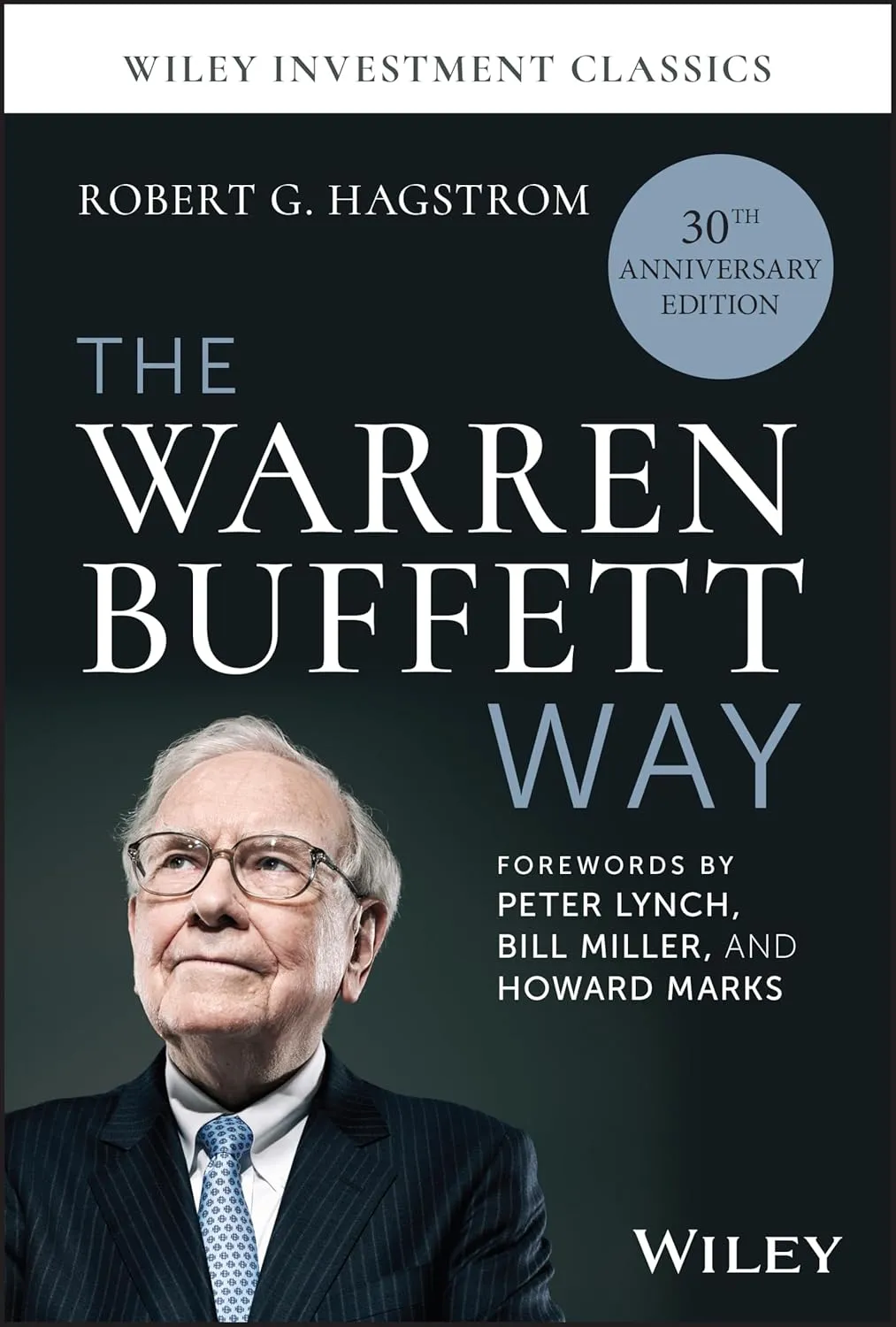
I first read The Warren Buffett Way in 2018, after reading The Intelligent Investor and feeling like I understood the theory of value investing but not how Buffett actually applied it in practice. Hagstrom's book filled that gap. He has written the most thorough systematic account of Buffett's investment methodology, organizing principles scattered across decades of Berkshire Hathaway shareholder letters into a coherent analytical framework covering business tenets, management tenets, financial tenets, and value tenets.
The 30th Anniversary Edition, published in April 2026, is a significant update. Hagstrom added new case studies covering Buffett's Apple investment (2016 to 2024), the Alphabet position initiated in 2025, and the Domino's Pizza acquisition. He also added a chapter on the Greg Abel era, examining what Buffett's retirement as CEO means for the future of Berkshire's investment approach and whether Abel's capital allocation philosophy will differ from Buffett's. The new edition covers Berkshire's portfolio through early 2026.
Book Details
| Attribute | Details |
|---|---|
| Title | The Warren Buffett Way |
| Author | Robert G. Hagstrom |
| Publisher | Wiley |
| First Published | 1994 |
| 30th Anniversary Edition | April 2026 |
| Pages | 320 |
| Reading Level | Intermediate |
| Amazon Rating | 4.5/5 stars |
Get Your Copy
Hardcover: Buy on Amazon
Kindle: Buy on Amazon
About the Author
Robert Hagstrom is a senior portfolio manager at EquityCompass Strategies and previously managed the Legg Mason Growth Trust. He has written extensively about Buffett's approach and is one of the most respected secondary analysts of Buffett's methodology. His other books include Investing: The Last Liberal Art and The Detective and the Investor. The 30th anniversary edition of The Warren Buffett Way represents his fourth major revision of the text, and the first to address Buffett's retirement from the CEO role.
Buffett's Intellectual Lineage
Hagstrom traces the intellectual influences that shaped Buffett's approach:
Benjamin Graham: The margin of safety concept, quantitative analysis of cheapness, treating stocks as ownership in businesses.
Philip Fisher: Qualitative business analysis, management evaluation, the scuttlebutt method, holding wonderful businesses forever.
Charlie Munger: Paying fair prices for exceptional businesses rather than cheap prices for mediocre ones, mental models across disciplines. Munger's influence pushed Buffett away from pure Graham-style cigar-butt investing toward paying up for quality.
John Burr Williams: Dividend discount model and the concept that intrinsic value is the present value of future cash flows.
Buffett's synthesis: Graham's price discipline plus Fisher's quality analysis plus Williams's intrinsic value framework equals buying exceptional businesses at fair prices. This synthesis is the core of what Hagstrom calls "the Warren Buffett way."
The Four Groups of Investment Tenets
Group 1: Business Tenets
Tenet 1: Is the business simple and understandable?
Buffett famously operates within his "circle of competence." He does not invest in businesses he cannot fully understand after reading the annual report. This is not anti-intellectual. It is recognition that understanding a business deeply enough to predict its future cash flows is genuinely difficult, and attempting to do so for complex businesses beyond one's expertise introduces error.
His circle of competence (historical):
2026 update: The 30th anniversary edition notes that Buffett's circle expanded late in his career to include Apple and Alphabet, both of which he analyzed as consumer-facing businesses with durable economic moats rather than as technology companies. This is an important distinction. He was not investing in technology. He was investing in consumer ecosystems with massive installed bases and switching costs. The Alphabet position, initiated in 2025, was analyzed through the same lens: dominant search franchise, advertising pricing power, and AI-driven cost efficiencies.
Outside his circle (historically avoided):
Tenet 2: Does the business have a consistent operating history?
Buffett looks for businesses that have delivered consistent, predictable results over 10+ years. Consistency suggests a durable competitive advantage, not a temporary product cycle. Companies that frequently change strategy, have experienced leadership turmoil, or operate in volatile industries rarely meet this test.
10-year earnings consistency test:
| Pattern | Interpretation |
|---|---|
| Rising earnings every year, minor variation | Strong consistency; passes test |
| Earnings rising but with occasional setbacks | Good consistency with some cyclicality |
| Highly variable earnings | Cyclical business; requires cyclical analysis |
| Declining earnings | Failing business or secular headwinds |
Tenet 3: Does the business have favorable long-term prospects?
Buffett distinguishes between businesses in secular growth industries and those in secular decline. He is willing to own a slow-growing business in a mature industry if the competitive position is impregnable. He avoids businesses facing structural disruption regardless of how cheap they appear.
The franchise business criterion:
A franchise business:
A franchise business can regularly raise prices without losing customers. Toll bridges, dominant brands, and essential software are franchise businesses. Commodity producers and airlines are not.
Group 2: Management Tenets
Tenet 4: Is management rational?
Buffett focuses on how management allocates capital. A rational management team deploys retained earnings only when returns on reinvestment exceed the cost of capital. When they cannot find attractive reinvestment opportunities, they return capital to shareholders through dividends or buybacks rather than making empire-building acquisitions.
Capital allocation scorecards:
| Action | Rational When | Irrational When |
|---|---|---|
| Reinvest in the business | ROIC > Cost of capital | Returns below cost of capital |
| Make acquisitions | Price below intrinsic value, strategic fit | Overpaying; diversifying for diversification's sake |
| Pay dividends | No better reinvestment opportunities | Always possible if above-average returns available |
| Buy back shares | Price below intrinsic value | Price above intrinsic value |
Tenet 5: Is management candid with shareholders?
Buffett values managers who communicate honestly about failures as well as successes. He is particularly critical of managers who obscure bad results with complex accounting, announce "one-time" charges repeatedly, or attribute failures entirely to external factors.
The honesty test:
Tenet 6: Does management resist the institutional imperative?
The "institutional imperative" is Buffett's term for the pressure on CEOs to follow industry peers, maintain growth at any cost, and perpetuate current strategy regardless of whether it is working. The best managers resist this pressure and act in shareholders' long-term interests regardless of short-term criticism.
Group 3: Financial Tenets
Tenet 7: Focus on return on equity, not earnings per share
Earnings per share (EPS) growth can be manufactured through retained earnings reinvestment even if the reinvestment earns poor returns. Return on equity (ROE) measures how efficiently the business uses shareholder capital.
The ROE formula:
ROE = Net Income / Shareholders' EquityBuffett's ROE targets:
| ROE | Assessment |
|---|---|
| Below 10% | Below cost of capital; value-destroying |
| 10-15% | Average business |
| 15-20% | Good business |
| Above 20% | Excellent franchise |
| Above 25% | Exceptional (Coca-Cola, See's Candies) |
Tenet 8: Calculate "owner earnings"
Buffett uses "owner earnings" rather than reported earnings or cash flow from operations:
Owner Earnings = Net Income
                + Depreciation and Amortization
                - Capital Expenditures (maintenance capex, not growth capex)
                ± Changes in Working Capital
This represents the cash that can actually be distributed to owners without impairing the business's competitive position. It is the closest approximation to true economic earnings.
Distinguishing maintenance from growth capex:
| Type | Purpose | Treatment |
|---|---|---|
| Maintenance capex | Keep existing equipment functioning | Subtract from owner earnings |
| Growth capex | Build new capacity for future growth | Optional; funded from retained earnings or debt |
Tenet 9: Look for companies with high profit margins
High profit margins indicate either pricing power (franchise businesses) or operational efficiency. Both are valuable.
Buffett's historical investments, profit margins:
| Company | Gross Margin | Operating Margin | Why Attractive |
|---|---|---|---|
| Coca-Cola | ~60% | ~25% | Brand franchise |
| See's Candies | ~55% | ~20% | Regional brand loyalty |
| GEICO | N/A (insurance) | ~15% combined ratio advantage | Cost efficiency |
| Washington Post | ~50% | ~20% | Local monopoly |
Group 4: Value Tenets
Tenet 10: What is the value of the business?
Buffett's intrinsic value framework uses the John Burr Williams dividend discount model:
Intrinsic Value = Present Value of All Future Owner EarningsIn practice, this requires:
Buffett's practical simplification:
For businesses with predictable, growing cash flows, Buffett uses a two-stage model:
Tenet 11: Can the business be purchased at a significant discount to its value?
Buffett requires a margin of safety even for exceptional businesses. He would rather pay a fair price for a wonderful business than a cheap price for a mediocre one, but "fair price" still means below intrinsic value.
Buffett's margin of safety by business quality:
| Business Quality | Required Discount to Intrinsic Value |
|---|---|
| Exceptional franchise (Coca-Cola) | 15-25% |
| Very good business (Wells Fargo) | 20-30% |
| Good business | 30-40% |
| Average business | Would not buy regardless of discount |
Portfolio Construction: The Focus Investor
Hagstrom dedicates significant attention to Buffett's portfolio approach, which he calls "focus investing," the antithesis of modern portfolio theory.
Buffett on diversification:
"Diversification is protection against ignorance. It makes little sense if you know what you are doing."
The focus portfolio vs. diversified portfolio:
| Characteristic | Focus Portfolio | Diversified Portfolio |
|---|---|---|
| Number of holdings | 5-15 | 50-500+ |
| Research per holding | Very deep | Shallow |
| Expected alpha from selection | High (if analysis is correct) | Low |
| Risk of individual error | High | Low |
| Risk of systematic error | Low | High |
Buffett argues that owning 15 thoroughly researched businesses reduces the risk of being wrong on any single one while maintaining the return potential of genuine insights. Owning 500 businesses eliminates individual stock risk but also eliminates the ability to earn above-market returns.
2026 context: Berkshire's equity portfolio in early 2026 is remarkably concentrated. The top five positions (Apple, Bank of America, American Express, Chevron, and Alphabet) represent approximately 70% of the equity portfolio. This is focus investing in practice, not just in theory. Hagstrom's new chapter notes that Abel is expected to maintain this concentration approach, though he may be more conservative on position sizing given his more risk-aware posture.
The Kelly criterion applied to focus investing:
Optimal position size = (Probability of win × Win amount - Probability of loss × Loss amount) / Win amountFor a position with 70% probability of doubling and 30% probability of losing 50%, Kelly suggests:
(0.70 × 1.00 - 0.30 × 0.50) / 1.00 = (0.70 - 0.15) / 1.00 = 55%Putting 55% of capital in one investment is too aggressive for psychological comfort. Most practitioners use "half Kelly" (27.5%), which is still a very large position by conventional standards.
Case Studies: Buffett's Major Investments
GEICO (1976 purchase)
The situation: GEICO had nearly gone bankrupt after writing too much high-risk business. The new CEO (Jack Byrne) had a clear turnaround plan.
Why Buffett bought:
The result: Buffett's $45 million investment grew to represent $1.7 billion at the time of Berkshire's full acquisition in 1996.
Coca-Cola (1988-1989)
The situation: Coca-Cola had recovered from the New Coke disaster of 1985. New management under Roberto Goizueta was aggressively expanding internationally and focused on return on equity.
Why Buffett bought (one-third of Berkshire's equity portfolio):
Owner earnings growth rate Buffett used: 15% for first 10 years, then 5% perpetuity
Result: $1.3 billion investment grew to $13+ billion at peak; still held as of 2026.
Apple (2016-2024)
New in the 30th anniversary edition.
The situation: In 2016, Berkshire began buying Apple at approximately $25 to $30 per share (split-adjusted). At the time, many value investors considered Apple a hardware company facing smartphone saturation.
Why Buffett bought:
Result: Berkshire's Apple position grew to approximately $174 billion at its peak in early 2024. Buffett reduced the position significantly in 2024, locking in extraordinary gains. The 30th anniversary edition uses this case study to illustrate how Buffett's circle of competence expanded without abandoning his core principles.
Alphabet (2025)
New in the 30th anniversary edition.
The situation: In 2025, Berkshire initiated a position in Alphabet (Google) after years of avoiding technology. This was one of Buffett's last major investment decisions before retiring as CEO.
Why Buffett bought:
Result: The position is still being built as of early 2026. Hagstrom uses it to demonstrate that Buffett's framework remains applicable to modern businesses when analyzed through the right lens.
The Greg Abel Era
New chapter in the 30th anniversary edition.
Buffett officially retired as CEO of Berkshire Hathaway at the start of 2026. Greg Abel, formerly vice chairman of non-insurance operations, took over as CEO. Buffett remains Chairman of the Board.
Hagstrom examines several key questions about the transition:
Will Abel maintain the focus investing approach? Early signals suggest yes. Abel has emphasized continuity and disciplined capital allocation. He views Berkshire's massive cash pile, which exceeded $300 billion in late 2025, as "dry powder" for future opportunities.
What about portfolio changes? Under Buffett's final decisions, Berkshire reduced its Apple stake significantly in 2024, sold its Amazon and Domino's positions, and increased the Alphabet stake. These moves suggest a shift toward concentration in fewer, higher-conviction positions.
Will Berkshire's economic moat survive without Buffett? Hagstrom argues that Berkshire's moat is not Buffett personally but the culture of patient, disciplined capital allocation he built over 60 years. The test will be whether Abel can deploy capital as effectively during market dislocations, which is when Berkshire has historically made its best investments.
Buffett's accelerated giving: Buffett accelerated his charitable donations in 2025 and 2026, transferring additional Berkshire shares to the Gates Foundation and related charities. His estate plan specifies that the remainder of his Berkshire shares will fund a charitable trust after his death, with Abel and the board overseeing the wind-down.
Strengths & Weaknesses
What We Loved
Areas for Improvement
Who Should Read This Book
Highly Recommended For
Probably Not For
Frequently Asked Questions
Q: Is this better than The Essays of Warren Buffett for understanding his approach?
A: Different purposes. The Essays of Warren Buffett is primary source material, Buffett's own words. The Warren Buffett Way is systematic analysis, Hagstrom's organization of those principles. Read both for the complete picture.
Q: Can individual investors replicate Buffett's approach?
A: The principles (identify franchise businesses, evaluate management, calculate owner earnings, require margin of safety) are fully applicable to individual investors. Buffett's informational and capital advantages are not replicable, but his analytical framework is. For most investors who cannot dedicate 20+ hours per week to research, low-cost index funds remain the better choice.
Q: Is the 30th anniversary edition worth buying if I already own the third edition?
A: Yes, if you want the Apple and Alphabet case studies and the Greg Abel chapter. The core tenets framework is unchanged, but the new edition adds approximately 80 pages of new material covering Buffett's final decade as CEO. If you are primarily interested in the framework itself, the third edition remains sufficient.
Final Verdict
Rating: 4.6/5
The Warren Buffett Way is the most systematic account of Buffett's investment methodology available. Its four-tenet framework, owner earnings concept, and focus investing philosophy provide a complete toolkit for fundamental stock analysis. The 30th anniversary edition's new case studies (Apple, Alphabet) and Greg Abel chapter make it the most relevant edition yet. Essential reading alongside The Intelligent Investor and Common Stocks and Uncommon Profits.
Get Your Copy
Hardcover: Buy on Amazon
Kindle: Buy on Amazon
Prices current as of publication date. Free shipping available with Prime.