*Disclosure: This article contains affiliate links. If you purchase through these links, we may earn a commission at no additional cost to you. We only recommend books we genuinely believe in.
Quick Overview
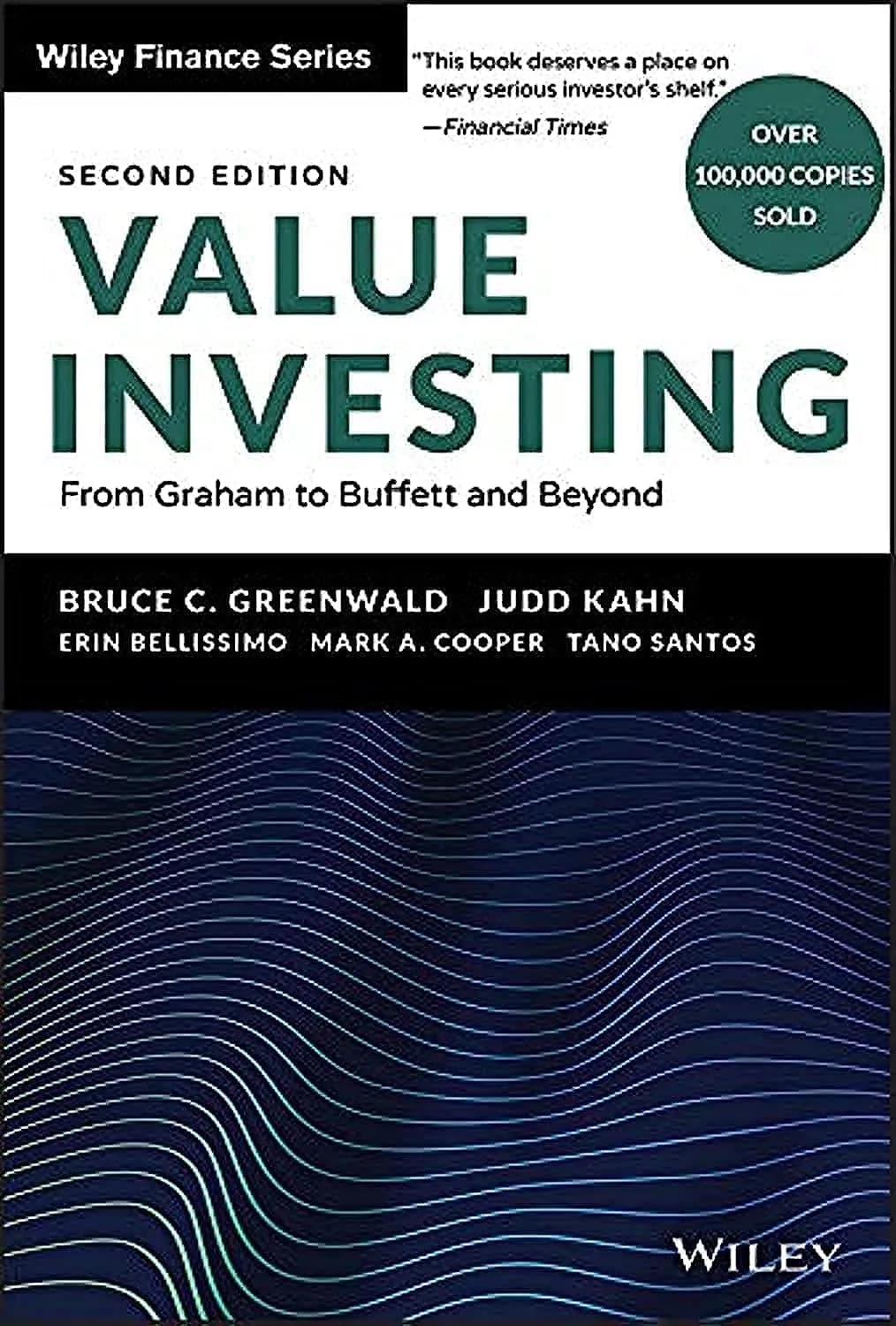
Bruce Greenwald taught the value investing course at Columbia Business School for nearly 25 years, inheriting the tradition established by Benjamin Graham and David Dodd in the 1930s. This book is the systematic presentation of his framework: a three-layer valuation system that starts with what a company's assets are worth, moves to what its current earnings power is worth, and only then considers whether competitive advantages justify paying for growth. The second edition (2020) adds new chapters on valuing growth stocks, new practitioner profiles, and extended discussion of risk management. For serious students of value investing, this is the bridge between Graham's original framework and modern practice.
Book Details
| Attribute | Details |
|---|---|
| Title | Value Investing: From Graham to Buffett and Beyond |
| Authors | Bruce C. Greenwald, Judd Kahn, Erin Bellissimo, Mark A. Cooper, Tano Santos |
| Publisher | Wiley |
| 1st Edition | 2001 |
| 2nd Edition | November 2020 |
| Pages | 320 |
| ISBN-13 | 978-0470116739 |
| Reading Level | Advanced |
| Amazon Rating | 4.5/5 stars |
Get Your Copy
Hardcover: Buy on Amazon
Kindle: Buy on Amazon
About the Authors
Bruce C. Greenwald was the Founding Director of the Heilbrunn Center for Graham and Dodd Investing at Columbia Business School from 2001 until his retirement in 2019. According to Wiley, he trained thousands of students in value investing and taught oversubscribed courses on the economics of business strategy and globalization. He has been Chairman of Paradigm Capital Management since 2007 and served as Director of Research at First Eagle Funds from 2007-11. He is often called "the guru to Wall Street's gurus."
Tano Santos is the David L. and Elsie M. Dodd Professor of Finance and Faculty Director of Columbia's Heilbrunn Center. He succeeded Greenwald as the professor teaching the value investing course and holds a doctorate in economics from the University of Chicago. He is a co-author of the second edition.
The second edition also added Erin Bellissimo and Mark A. Cooper as co-authors, who contributed the new chapters on growth stock valuation and risk management.
The Three-Layer Valuation Framework
Greenwald's central innovation is a valuation system that builds value in layers, starting from the most reliable (assets) and moving toward the most speculative (growth). This is the opposite of traditional DCF analysis, which projects cash flows years into the future and discounts them back.
Layer 1: Asset Value (Replacement Cost)
The concept: What would it cost to reproduce this company's assets from scratch?
| Asset Category | Estimation Method |
|---|---|
| Cash and securities | Face value |
| Receivables | Face value minus bad debt provision |
| Inventory | Current cost (not historical cost) |
| PP&E | Replacement cost (not book value) |
| Intangible assets | Cost to recreate brand, distribution, technology |
The insight: If a company's market capitalization is below its replacement cost, it is trading below the cost to recreate its business. This is a strong indicator of undervaluation. Either the market is wrong, or the industry is in secular decline (in which case assets should be valued at liquidation, not replacement).
Layer 2: Earnings Power Value (EPV)
The concept: What is the value of the company's current sustainable earnings, assuming no growth?
The formula:
EPV = Adjusted Earnings / Cost of CapitalKey adjustments to earnings:
The critical comparison:
| Relationship | Interpretation |
|---|---|
| EPV > Asset Value | Company has a franchise (competitive advantage) |
| EPV = Asset Value | Company earns normal returns; no franchise |
| EPV < Asset Value | Company earns below cost of capital; assets overvalued or poorly managed |
When EPV exceeds asset value, the difference is franchise value: the premium created by durable competitive advantages that allow the company to earn above-normal returns.
Layer 3: Growth Value
The concept: What is the value of future growth, above and beyond current earnings power?
Greenwald's critical warning: Growth only creates value if the company can reinvest earnings at returns above its cost of capital. Otherwise, growth destroys value.
| Condition | Growth Impact |
|---|---|
| ROIC > Cost of Capital | Growth creates value |
| ROIC = Cost of Capital | Growth is neutral |
| ROIC < Cost of Capital | Growth destroys value |
As Greenwald explained in a November 2020 interview: "If you're going to buy growth, you must not say, 'This is what it's worth,' because you'll get those inaccuracy problems. What you must say is, 'If I buy at this price, what kind of return will I earn?'"
The DCF Problem Greenwald Solves
Traditional DCF analysis for growth stocks is dominated by terminal value, which is extremely sensitive to assumptions about growth rate and cost of capital:
| Growth Rate | Cost of Capital | Terminal Multiple | Sensitivity |
|---|---|---|---|
| 4% | 8% | 25x | Base case |
| 3% | 8% | 20x | -20% |
| 4% | 9% | 16.7x | -33% |
| 5% | 8% | 33x | +32% |
| 5% | 7% | 50x | +100% |
A 1% change in either growth rate or cost of capital can produce a 3:1 variation in the terminal multiple. Since terminal value often represents 80%+ of a growth stock's DCF value, the entire valuation is built on assumptions that are nearly impossible to estimate accurately.
Greenwald's solution: use return-based thinking instead. Ask "What return will I earn at this price under plausible scenarios?" rather than "What is this stock worth?"
Franchise Value and Competitive Advantage
What Creates a Franchise?
A franchise exists when a company can earn returns above its cost of capital and sustain those returns over time. This requires barriers to entry that prevent competitors from eroding excess returns.
| Barrier Type | Description | Example |
|---|---|---|
| Customer captivity | Customers cannot or will not switch | Microsoft Office, enterprise software with switching costs |
| Economies of scale | Larger producers have cost advantages | Walmart, Amazon logistics |
| Proprietary technology | Patents or trade secrets protect margins | Pharmaceutical patents, Intel chip designs |
| Network effects | Value increases with more users | Visa payment network, social platforms |
| Regulatory barriers | Licenses, permits, or legal monopolies | Utility companies, pharmaceutical approvals |
The Greenwald Test for Franchise Durability
As Find My Moat's analysis noted: "Competitive markets tend to push ROIC toward the cost of capital; persistent excess returns imply barriers to entry (a franchise)." Without barriers, excess returns attract competition, which drives prices and margins down toward the cost of capital.
Practitioner Profiles
The second edition includes profiles of several successful value investors, showing how the framework is applied in practice:
Mario Gabelli (Gamco Investors)
Approach: Gabelli applies the framework to media and telecommunications companies, focusing on asset value and earnings power with attention to regulatory changes and spectrum licenses.
Seth Klarman (Baupost Group)
Approach: Klarman emphasizes absolute returns and capital preservation. He uses the framework to identify situations where market price is significantly below even conservative asset value estimates, providing a margin of safety.
Michael Price
Approach: Price focuses on identifying companies where the sum of the parts exceeds the whole. He uses asset-based valuation to identify holding companies and conglomerates trading at a discount to their component values.
New Profiles in the 2nd Edition
Tom Russo: Focuses on global consumer brands with durable franchises. His approach emphasizes the franchise value layer, looking for companies with strong brands and distribution networks that can reinvest earnings at high rates in international markets.
Paul Hilal: Specializes in event-driven value investing, identifying situations where corporate actions (spin-offs, mergers, activism) will close the gap between market price and intrinsic value.
Andrew Weiss: Applies the framework to financial services companies, focusing on earnings power and franchise value in banking and insurance.
The Research Process
Greenwald argues that where you spend your research time is itself a competitive advantage. The book outlines a systematic research approach:
Step 1: Start with the [Balance Sheet](/glossary/balance-sheet)
| Item | What to Look For |
|---|---|
| Assets | Are they recorded at realistic values? |
| Liabilities | Are all obligations visible (leases, pensions, off-balance-sheet)? |
| Goodwill | Is it justified by post-acquisition performance? |
| Inventory | Is it growing faster than sales (a red flag)? |
| Receivables | Are they growing faster than sales (channel stuffing)? |
Step 2: Move to the [Income Statement](/glossary/income-statement)
| Item | What to Look For |
|---|---|
| Revenue growth | Is it driven by volume or price? |
| Gross margins | Are they stable, expanding, or compressing? |
| Operating margins | How do they compare to competitors? |
| One-time items | What do "restructuring charges" really represent? |
| Earnings quality | Do earnings convert to cash flow? |
Step 3: Read the [10-K](/glossary/10-k) and Proxy
| Item | What to Look For |
|---|---|
| Risk factors | What does management identify as key risks? |
| Related party transactions | Are there conflicts of interest? |
| Executive compensation | Is it aligned with shareholder returns? |
| Segment data | Where is the company actually making money? |
Step 4: Apply the Three-Layer Framework
Step 5: Assess Risk of Permanent Loss
| Risk Type | Assessment |
|---|---|
| Business risk | Is the franchise eroding? |
| Financial risk | Can the company service its debt? |
| Valuation risk | Is the price below EPV or at least below franchise value? |
| Information risk | Are the financials reliable and complete? |
The 2025 International Value Revival
The years 2020-2025 have seen a dramatic revival of value investing, particularly in international markets. This resurgence validates Greenwald's framework and provides real-world evidence for the persistence of the value premium.
The Data
According to Verdad Capital research, since July 2020, value has outperformed growth by 11.6% annualized in developed international markets. This has restored the five-year rolling value premium to positive territory for the first time since the financial crisis.
| Region | Value vs. Growth (5-Year Annualized) | Key Driver |
|---|---|---|
| Developed International | +11.6% value outperformance | Corporate governance reforms (Japan), European recovery |
| US Large Cap | Value lagging growth | Magnificent Seven dominance |
| US Small Cap Value | +6% value outperformance | Mean reversion in smaller companies |
| European Small Cap Value | +12% (MSCI Europe Small Cap Value) | Broadening beyond large caps |
As MarketWatch reported in 2025: "Value stocks are outperforming virtually everywhere, except the U.S." The value premium has returned with particular strength in Japan (driven by corporate governance reforms and rising shareholder returns) and Europe (driven by improving investor confidence and the German infrastructure package).
The "Double Discount" Opportunity
Verdad identified what they call a "double discount" in international value stocks:
This means international value stocks offer two potential upside levers: mean reversion of valuation spreads within international markets, and narrowing of the valuation discount between international and US markets.
Greenwald's Framework Applied to 2025 Markets
Greenwald's November 2020 interview is prescient about exactly this kind of opportunity:
"If you're not looking at growth, and also, if you're not looking at intangible assets because that has also changed with these technologies and the trend toward services, you won't do a good job of buying where the real opportunities are."
His framework helps investors distinguish between:
The international value revival of 2020-2025 has been strongest in the first category: companies trading below asset value that are experiencing positive fundamental change (governance reform in Japan, economic recovery in Europe).
Greenwald on Intangible Assets and Modern Value Investing
One of the most important updates in the second edition is the treatment of intangible assets and growth stock valuation. Greenwald acknowledged that traditional Graham-and-Dodd value investing, which focused on tangible assets and current earnings, is insufficient for modern economies where value is increasingly created through intangibles.
| Era | Primary Value Driver | Valuation Challenge |
|---|---|---|
| 1930s-1970s | Tangible assets (factories, inventory, real estate) | Asset-based valuation works well |
| 1980s-2000s | Brand and distribution franchises | EPV and franchise value layers capture this |
| 2010s-2020s | Technology, network effects, intangible platforms | Growth value layer becomes critical but hard to estimate |
As Greenwald explained: "We live in a world where growth turns out because franchises are getting stronger and more valuable than people thought. If you're not looking at growth, and also, if you're not looking at intangible assets, you won't do a good job of buying where the real opportunities are."
His solution for growth stocks: use return-based valuation instead of point-estimate DCF. Rather than calculating what a growth stock is "worth" (which produces fake precision), calculate what return you would earn at the current price under various plausible scenarios. This approach acknowledges the inherent uncertainty in growth projections while still applying analytical rigor.
Strengths & Weaknesses
What We Loved
Areas for Improvement
Who Should Read This Book
Highly Recommended For
Probably Not For
Comparison to Similar Books
| Book | Focus | Difficulty | Best For |
|---|---|---|---|
| Value Investing (Greenwald) | Modern valuation framework | Advanced | Building a rigorous analytical system |
| The Intelligent Investor (Graham) | Value investing philosophy | Intermediate | Foundational principles |
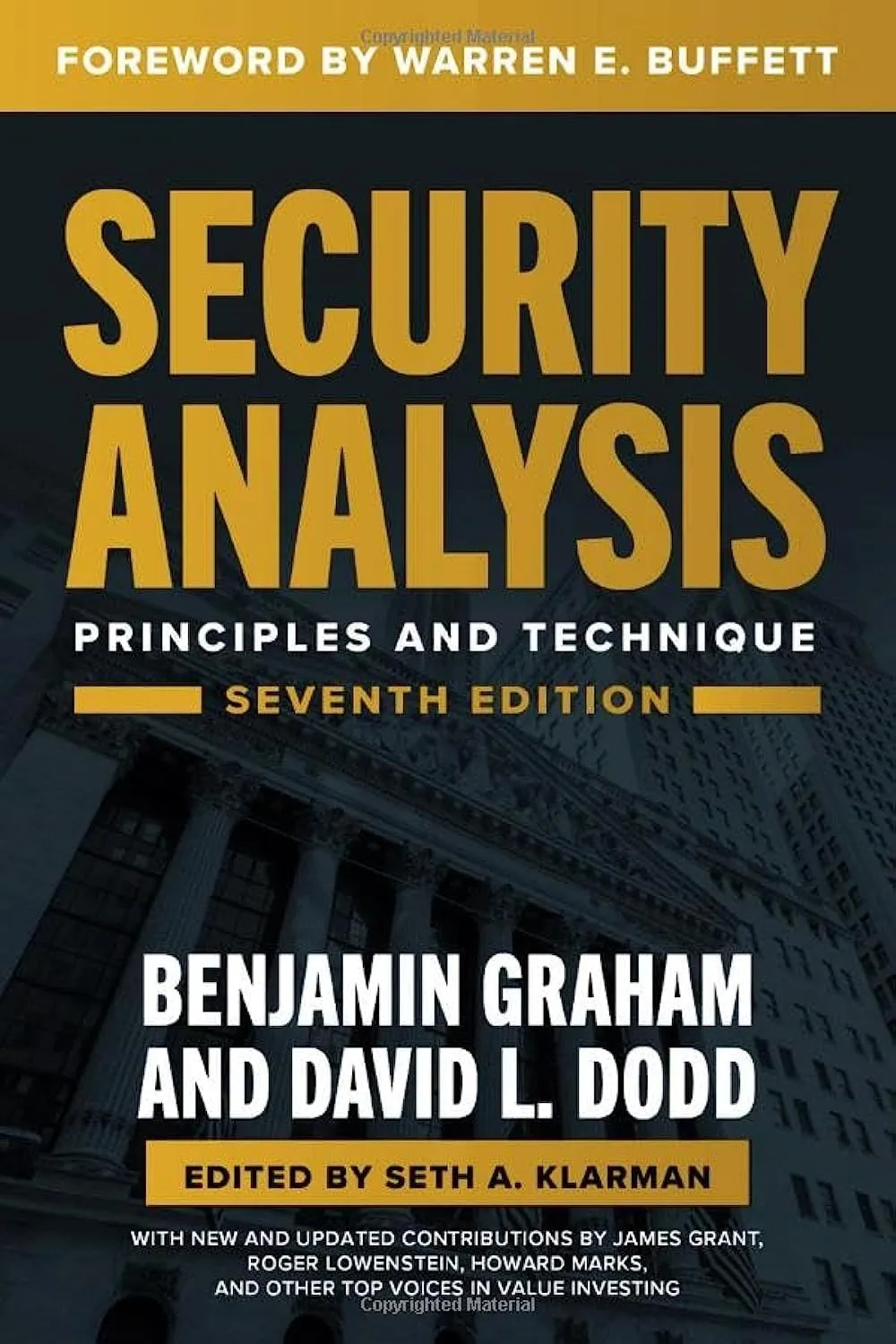
| Security Analysis (Graham/Dodd) | Original valuation methods | Very Advanced | Historical foundation |
| Competition Demystified (Greenwald) | Competitive strategy analysis | Advanced | Understanding franchise durability |
| The Little Book That Builds Wealth (Dorsey) | Economic moats | Beginner | Accessible introduction to competitive advantages |
Read The Intelligent Investor first for philosophy. Read Value Investing for the modern analytical framework. Read Competition Demystified for deeper understanding of franchise durability.
Implementation Guide
Building a Value Investing Practice
Phase 1: Learn the framework (4-6 weeks)
Phase 2: Build a research template (2-3 weeks)
Phase 3: Develop a watchlist (ongoing)
Phase 4: Portfolio construction
EPV Calculation Template
Step 1: Normalize earnings
- Take 5-year average operating income
- Adjust for cyclicality (use mid-cycle estimates)
- Remove one-time charges and gains
- Subtract maintenance capex (not growth capex)
- Apply normalized tax rate

Step 2: Determine cost of capital
- Use industry-average WACC as starting point
- Adjust for company-specific risk factors
- Be conservative: use 10-12% for most companies

Step 3: Calculate EPV
- EPV = Normalized Earnings / Cost of Capital

Step 4: Compare to market cap
- EPV / Market Cap = Ratio
- Ratio > 1.0: Potentially undervalued
- Ratio < 1.0: Potentially overvalued or earnings are above sustainable levels

Step 5: Compare EPV to asset value
- EPV > Asset Value: Franchise exists
- EPV = Asset Value: No franchise, normal returns
- EPV < Asset Value: Assets overvalued or poorly managed
Frequently Asked Questions
Q: How is this different from The Intelligent Investor?
A: Graham's book is about philosophy and principles. Greenwald's book is about implementation. Graham teaches you to think like a value investor; Greenwald gives you the specific analytical tools to value companies systematically.
Q: Is the second edition worth buying if I have the first?
A: Yes. The new chapters on growth stock valuation and risk management add significant value. The new practitioner profiles (Russo, Hilal, Weiss) show how the framework adapts to different investment styles. According to Wiley, the second edition includes "two innovative new chapters discussing the valuation of growth stocks, a perennial problem for investors in the Graham and Dodd tradition."
Q: Does value investing still work in 2026?
A: Yes, with nuance. In the US, value has underperformed growth over the past decade due to the dominance of large-cap technology. But internationally, value has outperformed growth by 11.6% annually since July 2020. As Verdad's research shows, the value premium has returned to positive territory in developed international markets. Reuters reported in October 2025 that investors withdrew $152 billion from US growth funds in the first nine months of 2025, rotating into non-US value stocks.
Q: Can the framework be applied to technology companies?
A: With difficulty but yes. The asset value layer is less useful for intangible-heavy businesses. The EPV layer works if you can normalize earnings. The franchise layer is where technology analysis lives: network effects, switching costs, and scale advantages create durable franchises. Greenwald's return-based approach for growth stocks is the most useful tool for technology valuation.
Q: What is the biggest mistake value investors make?
A: Ignoring franchise erosion. A company trading below asset value may be cheap for a reason: its business model is in secular decline. The asset value provides a floor only if the assets have alternative uses. A factory that makes obsolete products may be worth its scrap value, not its replacement cost.
Final Verdict
Rating: 4.5/5
Value Investing: From Graham to Buffett and Beyond is the most rigorous and practically useful value investing textbook available. Greenwald's three-layer framework provides a systematic alternative to DCF analysis that is more grounded in observable data and less dependent on speculative long-term projections. The second edition's additions on growth valuation and risk management address the most significant gaps in the original.
The 2025 international value revival has validated the framework's core insight: companies trading below their asset value or earnings power value, particularly those with improving fundamentals, can produce exceptional returns. Greenwald's framework gives investors the tools to identify these opportunities systematically.
This is not an easy book. It requires patience, accounting knowledge, and willingness to work through numerical examples. But for serious students of value investing, it is the essential bridge between Graham's original framework and modern practice.
Get Your Copy
Hardcover: Buy on Amazon
Kindle: Buy on Amazon
Prices current as of publication date. Free shipping available with Prime.