*Disclosure: This article contains affiliate links. If you purchase through these links, we may earn a commission at no additional cost to you. We only recommend books we genuinely believe in.
Quick Overview
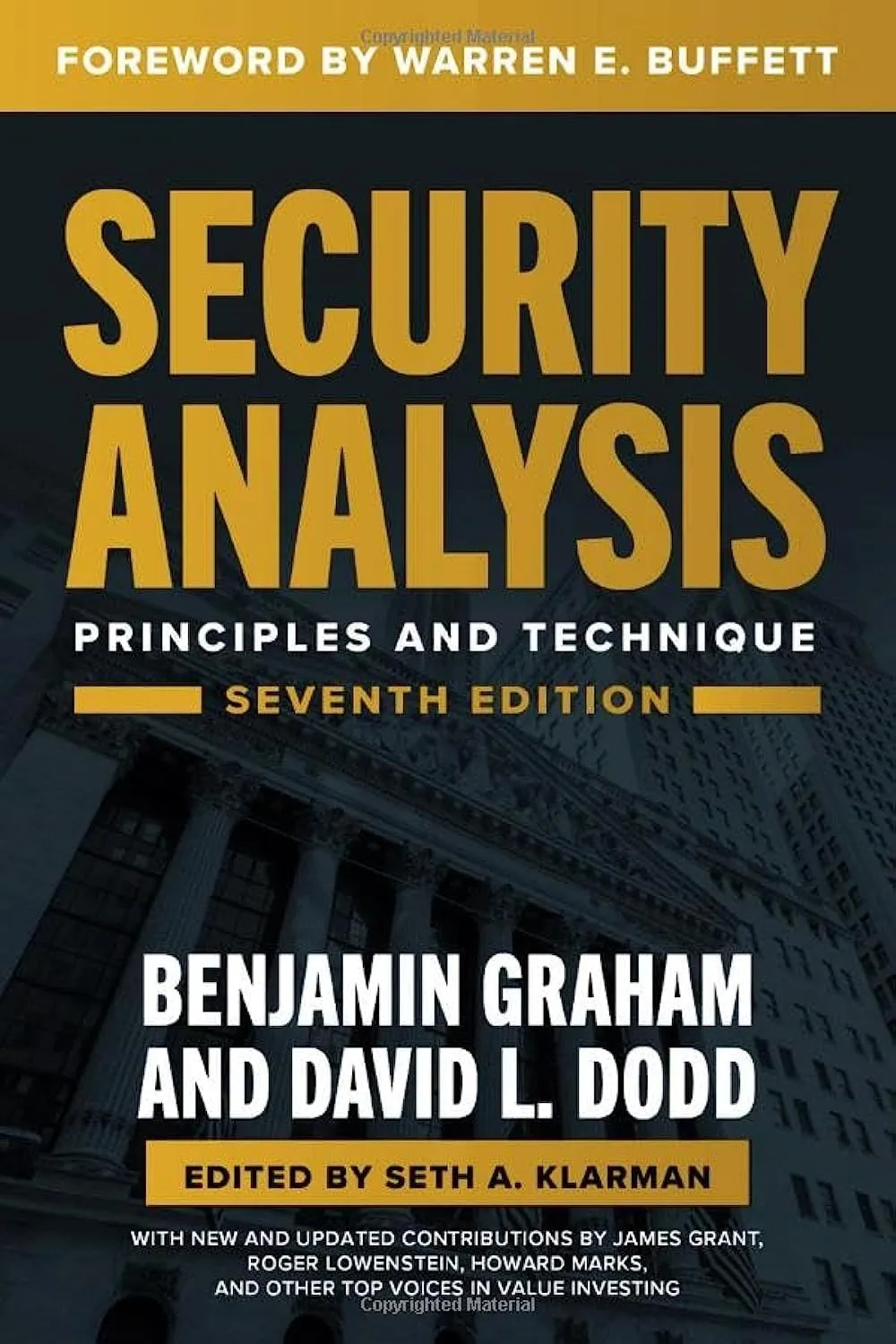
In 1932, the Dow Jones Industrial Average fell 89% from its 1929 peak. Thousands of companies went bankrupt. The prevailing investment wisdom of the 1920s had been largely speculative, and it had produced catastrophe. Benjamin Graham and David Dodd, both of whom had survived the crash, responded by writing a textbook that created the entire discipline of fundamental securities analysis. Security Analysis systematically explained, for the first time, how to evaluate a bond's safety, estimate a stock's intrinsic value, and identify the difference between investment and speculation. Nearly a century later, Warren Buffett still calls it the most important investment book ever written. The 7th edition (2022) features commentary from modern value investors including Seth Klarman, Joel Greenblatt, and Howard Marks, proving the framework remains relevant in an era of algorithmic trading and AI-driven markets.
Book Details
| Attribute | Details |
|---|---|
| Title | Security Analysis |
| Authors | Benjamin Graham & David Dodd |
| Publisher | McGraw-Hill |
| First Published | 1934 |
| Current Edition | 7th (2022) |
| Pages | ~800 |
| Reading Level | Advanced |
| Best For | Professional analysts and serious students |
Get Your Copy
Hardcover (7th Edition): Buy on Amazon
Hardcover (6th Edition): Buy on Amazon
About the Authors
Benjamin Graham (1894-1976) survived the 1929 crash, losing most of his investment fund's capital, and channeled that experience into building a systematic approach to security valuation. He taught at Columbia Business School for 28 years and is widely known as the father of value investing.
David Dodd (1895-1988) was Graham's teaching assistant at Columbia who became his co-author and eventually a full professor himself. The book grew from class notes they developed together in 1927-1934.
The 7th edition (2022) features commentary from modern value investors including Seth Klarman, Joel Greenblatt, Howard Marks, and others, bridging the 1934 framework to contemporary markets.
Why This Book Matters
Security Analysis was written immediately after the 1929-1932 crash, during which the Dow Jones fell 89% and thousands of companies went bankrupt. The prevailing investment "wisdom" of the 1920s had been largely speculative. Graham and Dodd's radical contribution was to argue that securities could be analyzed systematically, that price and value were distinct, and that buying cheap assets with a margin of safety was a sustainable strategy.
Everything in modern fundamental analysis traces to this book:
Warren Buffett took Graham's class twice and has called this the most important investment book ever written. He calls The Intelligent Investor the more readable version for general audiences. For a deeper look at Buffett's approach, read our guide on value investing fundamentals.
The Investment vs. Speculation Distinction
Graham and Dodd open with the most important distinction in investing:
"An investment operation is one which, upon thorough analysis, promises safety of principal and an adequate return. Operations not meeting these requirements are speculative."
This three-part test changed finance:
| Criterion | Investment | Speculation |
|---|---|---|
| Thorough analysis | Required | Optional or absent |
| Safety of principal | Expected | Not guaranteed |
| Adequate return | Expected | Hoped for |
By this definition, buying a stock at 50x earnings without analyzing the business is speculation, regardless of whether it goes up or down. Buying a net-net stock at 60% of liquidation value after careful analysis is investment.
Part I: Survey and Approach
The Three Functions of Analysis
Graham identifies three purposes of security analysis:
Intrinsic Value
Graham's central concept and the most influential idea in the book:
Intrinsic value is the value justified by the facts: assets, earnings, dividends, and definite prospects. It differs from market price. The analyst's job is to estimate intrinsic value and act when price diverges significantly.
Graham is careful to acknowledge that intrinsic value is a range, not a precise number. A stock can be clearly cheap, clearly expensive, or in a zone of uncertainty. The analyst should act only on clear cases.
Part II: Fixed-Income Securities (Bonds)
This section, which occupies roughly a third of the book, is the most detailed analysis of bond safety ever written. Graham and Dodd analyze:
Bond Safety Tests
| Test | Adequate Coverage |
|---|---|
| Earnings coverage of interest (industrial) | 3x minimum, 5x preferred |
| Earnings coverage of interest (utility) | 2x minimum, 3x preferred |
| Earnings coverage of interest (railroad) | 1.75x minimum |
| Debt as % of capitalization (industrial) | Below 50% |
| Working capital ratio | Above 2:1 |
Seven-year earnings test: Graham requires that earnings be sufficient to cover interest charges not just in recent years but over a full business cycle, including recession years. A bond that passes only in good years does not pass.
Bond Ratings vs. Graham's Criteria
Graham was skeptical of bond rating agencies even in 1934, arguing that their ratings often lagged market reality and that independent analysis was superior. This skepticism proved prescient in 2008 when AAA-rated mortgage securities defaulted massively. The 2008 crisis vindicated Graham's insistence on independent analysis over reliance on third-party ratings. For more on how rating agencies failed, read our review of The Big Short.
Part III: Senior Securities with Speculative Features (Preferred Stocks, Convertibles)
Graham and Dodd analyze the hybrid securities that sit between bonds and common stocks. Their key insight: preferred stocks combine the worst features of both asset classes. They lack the contractual obligation of bonds (so the company can skip dividends) while lacking the upside participation of stocks.
The preferred stock trap:
| Feature | Bond | Preferred Stock | Common Stock |
|---|---|---|---|
| Contractual obligation | Yes | No | No |
| Priority in liquidation | First | Second | Last |
| Upside in good times | Limited | Limited | Unlimited |
| Safe in bad times | Generally | Not always | Rarely |
Graham's conclusion: preferred stocks belong only in institutional portfolios with specific income requirements. Individual investors are almost always better off with bonds for safety or common stocks for growth.
Part IV: The Valuation of Common Stocks
This is the section most relevant to modern investors. Graham and Dodd develop a systematic approach to stock valuation at a time when stocks were viewed primarily as speculative instruments.
Earnings Analysis
Graham identifies two types of earnings:
Normal earnings: The average earning power of the business over a complete economic cycle (Graham recommends 7-10 years)
Current earnings: The most recent reported figure
Modern analysts typically focus on current or forward earnings. Graham argued this was dangerous because recent earnings reflect cyclical peaks and troughs. Normalizing earnings across a cycle produces more reliable valuations.
Example:
| Year | Actual EPS |
|---|---|
| 2015 | $3.20 |
| 2016 | $3.80 |
| 2017 | $4.50 |
| 2018 | $5.10 |
| 2019 | $4.80 |
| 2020 | $1.20 (recession) |
| 2021 | $5.50 |
| Average (7-year) | $4.01 |
Using the average $4.01 rather than the recent $5.50 produces a more conservative and cyclically adjusted valuation.
The Graham Number
From Security Analysis, Graham derived a simple valuation formula that bears his name:
Graham Number = Square Root of (22.5 × EPS × Book Value Per Share)The 22.5 comes from Graham's maxim that a stock should not trade above 15x earnings and 1.5x book value simultaneously (15 × 1.5 = 22.5).
Example:
A stock trading below $51.96 passes Graham's basic valuation test.
Net-Net Working Capital (NNWC)
Graham's most conservative valuation: buy stocks trading below their net-net working capital value.
NNWC = Current Assets - Total LiabilitiesIf a company has $10 per share in NNWC and trades at $7, you are buying the operating business for free. You receive the liquid assets at a 30% discount and get the factories, equipment, and business operations thrown in.
Historical returns of net-net investing:
| Study | Period | Annual Excess Return vs. Market |
|---|---|---|
| Graham-Newman | 1926-1956 | +20% per year |
| Oppenheimer (1970-1983) | 1970-1983 | +29% per year |
| Kok & Potgieter | Various international markets | +15-25% per year |
Net-net stocks are rare today in large developed markets. They exist regularly in smaller international markets and occasionally in U.S. micro-cap stocks. A 2024 study by quantitative researcher O'Shaughnessy Asset Management confirmed that net-net strategies continue to outperform in international small-cap markets, particularly in Japan and South Korea, where asset-heavy companies still trade at discounts to liquidation value.
Part V: Analysis of the Income Account
Graham devotes substantial attention to the quality of reported earnings, presaging modern forensic accounting:
Earnings Quality Checklist
Warning signs of low earnings quality:
| Warning Sign | Concern |
|---|---|
| Earnings growing faster than cash flow | Possible accounting manipulation |
| Receivables growing faster than sales | Customers not paying; channel stuffing possible |
| Inventory growing faster than sales | Demand weakness; write-downs likely |
| EBITDA but not EBIT growing | Depreciation masking real costs |
| Frequent "special charges" | Ongoing costs disguised as one-time items |
The 7th Edition (2022) Commentaries
The 2022 edition adds chapter-by-chapter commentary from prominent modern investors:
| Commentator | Perspective |
|---|---|
| Seth Klarman | Margin of safety in modern markets |
| Joel Greenblatt | Formula-based value investing |
| Howard Marks | Risk and market cycles |
| Glenn Greenberg | Concentrated value investing |
| Bruce Berkowitz | Asset-focused investing |
These commentaries are genuinely valuable for translating 1934 principles to current practice. Klarman's remarks on margin of safety are particularly important for understanding how the concept applies in today's information-rich environment.
Strengths & Weaknesses
What We Loved
Areas for Improvement
Who Should Read This Book
Highly Recommended For
Probably Not For
How to Approach Reading Security Analysis
For most investors: Read the Introduction and Part IV (Common Stocks). Skip the railroad bond analysis. Use the 7th edition for the modern commentary.
For serious students: Read cover to cover with a financial statements textbook nearby. Take notes. Apply the frameworks to real companies.
For professionals: Study the bond safety criteria and earnings quality sections especially. These remain among the most rigorous treatments available.
Frequently Asked Questions
Q: Should I read this before or after *The Intelligent Investor*?
A: After. The Intelligent Investor is Graham's translation of Security Analysis into plain English for individual investors. Read it first, then return to Security Analysis when you want the full analytical framework.
Q: Which edition should I buy?
A: The 7th edition (2022) for the modern commentary. If budget is a concern, the 6th edition (2009) is also excellent. Avoid editions older than the 6th.
Q: Is Graham's net-net approach still viable?
A: In U.S. large caps, rarely. In U.S. micro-caps, occasionally. In Japan, South Korea, and certain other markets, it works regularly because asset-heavy companies often trade at discounts. Several value funds explicitly target international net-nets.
Final Verdict
Rating: 4.6/5
Security Analysis is not for everyone, but for the serious student of investing it is irreplaceable. The intellectual framework it established for analyzing securities is the foundation upon which every subsequent development in fundamental analysis was built. Read it as a graduate text, not a casual guide, and it will transform your understanding of what investment analysis actually means.
If you are serious about analyzing individual securities, this book is required reading. The 7th edition commentaries from Klarman, Greenblatt, and Marks bridge the 1934 framework to today's markets. For investors who want a more accessible entry point, start with The Intelligent Investor, then graduate to this one. For those who prefer passive investing, our index fund guide covers the simpler path.
Get Your Copy
Hardcover (7th Edition): Buy on Amazon
Hardcover (6th Edition): Buy on Amazon
Prices current as of publication date. Free shipping available with Prime.