*Disclosure: This article contains affiliate links. If you purchase through these links, we may earn a commission at no additional cost to you. We only recommend books we have personally read and genuinely believe in.
Quick Overview
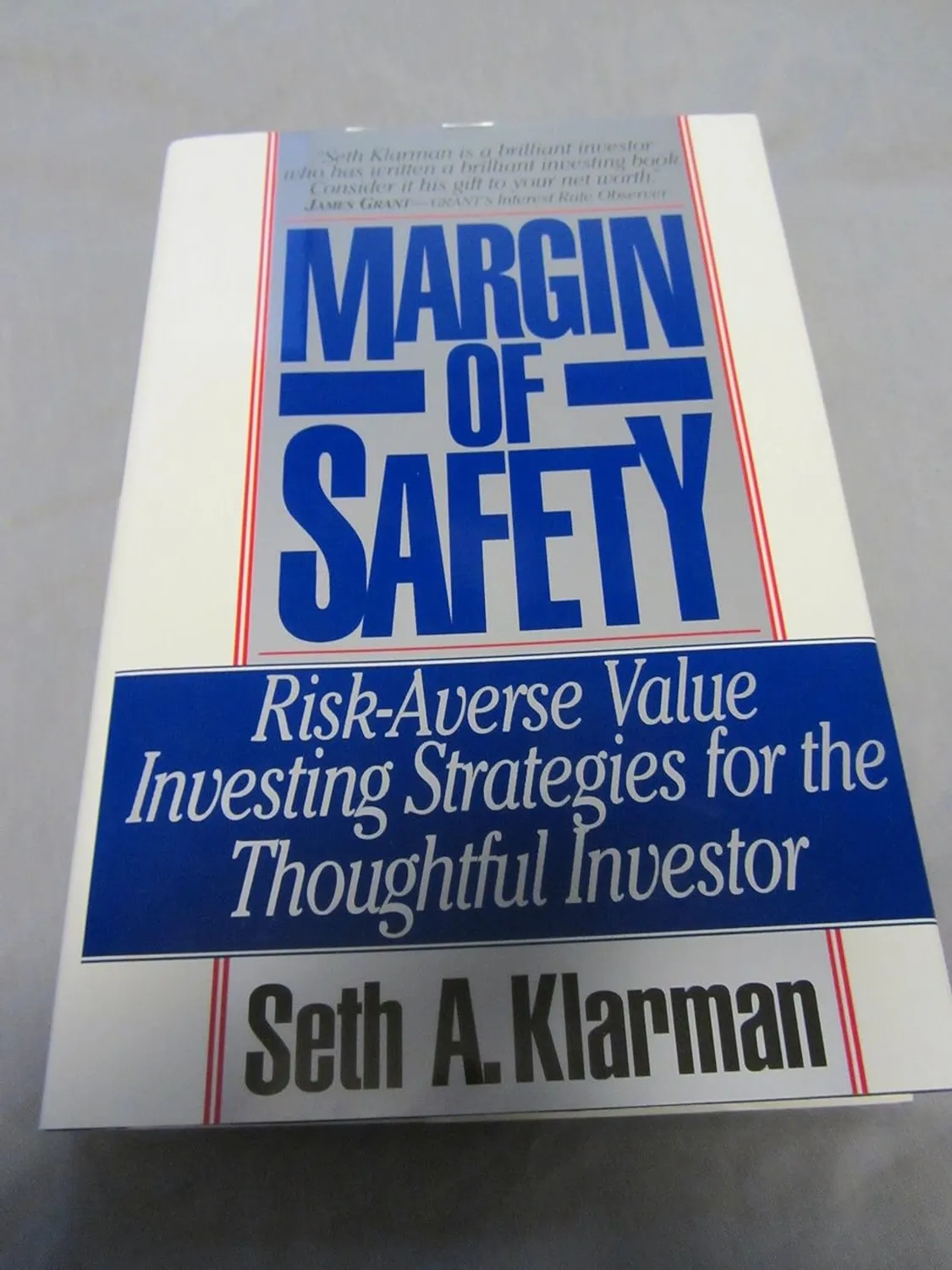
Seth Klarman published Margin of Safety in 1991 through a small print run and never authorized a reprint. Used copies routinely sell for $800 to $2,000 on secondary markets. The book argues that the goal of investing is not to maximize returns but to avoid permanent loss of capital. Klarman distills Graham's principles into a contemporary framework built on risk aversion, patience, and cash as option value. He wrote it because he was frustrated by the quality of available investment literature and wanted to create the book he wished had existed when he started. The ideas are freely summarized online. Obtaining a physical copy requires real dedication or significant money.
Here is the uncomfortable part that most reviews skip: Baupost has averaged only 4% annual gains since 2014, well below both its earlier record and the broader market. Investors pulled approximately $7 billion from the fund between 2021 and 2024. The book's principles are sound, but the recent decade tests them severely. This review covers both the brilliance of the framework and the honest reality of how it has performed in a low-rate, growth-dominated market.
Book Details
| Attribute | Details |
|---|---|
| Title | Margin of Safety: Risk-Averse Value Investing Strategies for the Thoughtful Investor |
| Author | Seth A. Klarman |
| Publisher | HarperBusiness |
| Published | 1991 |
| Pages | 249 |
| Reading Level | Advanced |
| Secondary Market Price | $800-$2,000+ |
Get Your Copy
Hardcover (used): Buy on Amazon (used copies only; price varies widely)
A free PDF circulates widely online. While technically a copyright infringement, the book's availability in this form has ironically increased its influence. Klarman has not pursued legal action against individuals accessing the PDF.
About the Author
Seth Klarman founded Baupost Group in Cambridge, Massachusetts in 1982 with $27 million from four Harvard endowments. At its peak, Baupost managed approximately $30 billion. Klarman's annualized returns since inception are approximately 20%, making him one of the most successful investors of the past 40 years by any measure.
That headline number requires context. The 20% annualized return is concentrated in the first two decades. Since 2014, Baupost has averaged roughly 4% annual gains. The firm delivered a 10% gain in 2024, its first double-digit return in three years, but still modest compared to the S&P 500's performance during the same period. According to Bloomberg data reported in late 2025, investors pulled about $7 billion from Baupost between 2021 and 2024 after years of underwhelming performance.
In June 2024, Baupost undertook the largest restructuring in its 42-year history, cutting almost 20% of its investment staff and refocusing on core strategies: distressed debt, special situations, and event-driven equities. Credit investments now account for roughly 25% of assets, compared to only 5% two years ago. By Q4 2025, Baupost's public equity portfolio had declined from $12.56 billion in 2021 to approximately $5.3 billion across 22 positions.
This matters for evaluating the book. Klarman wrote Margin of Safety when his opportunity set was rich: distressed debt from the 1990s S&L crisis, complex securities from corporate restructurings, small-cap mispricings that institutions could not touch. The current environment, with elevated valuations and fewer distressed opportunities, tests the framework in ways the book does not address.
Why This Book Is Worth Any Price
Margin of Safety covers three interconnected ideas in unusual depth:
The combination of philosophical grounding and practical implementation makes it unique. Most investing books do one or the other. Klarman does both.
Part I: Where Most Investors Go Wrong
The Investment vs. Speculation Distinction
Klarman opens by restoring the Graham distinction with unusual force. The distinction is not semantic. It determines your entire analytical approach.
Investment requires:
Speculation involves:
Klarman's observation: most of what Wall Street calls "investing" is speculation. The analyst predicting earnings momentum is speculating. The fund manager rotating sectors based on economic forecasts is speculating. The individual investor buying a hot technology stock at 100x revenue is speculating.
Institutional Investor Disadvantages
Klarman makes the counterintuitive argument that large institutional investors are systematically disadvantaged relative to small, nimble investors:
| Disadvantage | Explanation |
|---|---|
| Size | Large funds cannot buy enough of a $50M company to matter; small investors can own 5% of it |
| Career risk | Fund managers buy popular stocks to avoid being wrong alone; contrarians get fired |
| Relative performance focus | Measured against benchmarks, not absolute returns |
| Fully invested mandate | Many funds must stay invested regardless of valuation; Klarman holds cash freely |
| Client redemption pressure | Forced selling during market downturns; Baupost has patient capital |
The individual investor with $100,000 can invest in companies that a $10 billion fund cannot touch. The small investor's universe of opportunities is vastly larger than the institutional universe.
Why Wall Street Creates Bad Incentives
The sell-side analyst who issues a "sell" recommendation risks losing investment banking business. The fund manager who holds cash risks assets flowing to competitors. The financial advisor who recommends index funds earns no commission.
Klarman is specific:
"Wall Street professionals fail at investing because, by and large, they are not trying to make money for clients. They are trying to make money for themselves."
This is not cynicism. It is an accurate description of incentive structures. Understanding this protects you from acting on advice that is designed to generate fees rather than returns.
Part II: The Philosophy of Value Investing
What Value Investing Actually Is
Klarman extends Graham's definition:
Value investing is buying assets for less than they are worth, with a margin of safety.
This sounds simple. The difficulty is in every word:
Sources of Intrinsic Value
Klarman identifies three sources:
1. Going-concern value (earnings-based):
The present value of future cash flows the business will generate while operating normally. Requires forecasting earnings and choosing a discount rate. Subject to estimation error, especially for fast-growing companies.
2. Asset value (balance sheet-based):
What the company would be worth if liquidated at fair market value. More reliable for asset-heavy businesses (real estate, natural resources, banks). Most useful when the going-concern value is impaired but assets remain valuable.
3. Liquidation value (conservative asset value):
What the company would be worth if assets were sold under pressure. The most conservative value estimate. Graham's net-net formula uses a version of this.
Klarman's hierarchy: when all three values converge (the business earns well, has valuable assets, and could be liquidated above the stock price), the investment case is most compelling.
The Margin of Safety: Not Just a Number
For Graham, margin of safety was primarily quantitative: buy at 66 cents on the dollar. Klarman argues the margin of safety is a concept, not a formula. It must be appropriate to the certainty of your value estimate:
| Certainty of Value Estimate | Required Margin of Safety |
|---|---|
| Very high (net cash, government debt) | 10-20% |
| High (regulated utility, stable cash flow) | 20-30% |
| Medium (established business, some uncertainty) | 30-40% |
| Low (cyclical business, unclear future) | 40-60% |
| Very low (turnaround, distressed) | 50%+ |
The more uncertain the value estimate, the larger the buffer required before buying.
Part III: Specific Investment Approaches
Risk Aversion as Philosophy
Klarman's most fundamental principle: the goal of investing is not to maximize returns. It is to maximize risk-adjusted returns while avoiding permanent loss of capital.
This distinction changes everything:
Klarman describes his goal as finding situations with limited downside and substantial upside. A security that can fall 10% but rise 50% has a better risk profile than one that can fall 50% but rise 100%, even though the latter has higher absolute upside.
Finding Value: Specific Hunting Grounds
Klarman identifies the situations most likely to produce mispricings:
1. Complex securities:
Corporate spin-offs, reorganization securities, and rights offerings are often mispriced because the typical investor cannot evaluate them quickly. Professional institutions often sell them reflexively (to avoid explaining them to clients). This creates opportunity.
2. Selling by non-economic actors:
When institutions are forced to sell (index deletions, credit rating downgrades, margin calls), the selling is driven by mandate, not analysis. Prices can fall far below intrinsic value.
3. Out-of-favor industries:
The best values are usually found in industries that investors currently despise. The energy sector in 2020, the financial sector in 2009, the technology sector in 2002. Each produced exceptional values for buyers willing to look past the current narrative.
4. Small and micro-cap stocks:
Limited analyst coverage and institutional inability to own meaningful stakes creates persistent mispricings. This is the hunting ground where individual investors have genuine advantages.
5. Distressed debt:
When companies face bankruptcy, their bonds trade at cents on the dollar. Most investors cannot or will not analyze these situations. Klarman built much of Baupost's early track record in distressed debt.
Portfolio Management: Sizing and Concentration
Klarman's approach to portfolio construction:
| Conviction Level | Position Size |
|---|---|
| Highest conviction | 5-10% |
| High conviction | 3-5% |
| Medium conviction | 1-3% |
| Speculative/early position | Under 1% |
He typically holds 30-50 positions. Enough to be diversified against individual errors; few enough that each position was thoroughly researched.
Cash as a Position
Klarman's most unusual practice: he holds large amounts of cash (sometimes 30-50% of the portfolio) when he cannot find adequate bargains. He views cash not as a non-performing asset but as option value, ready to deploy when others are panicking and prices fall.
Historical cash levels at Baupost (approximate):
This counter-cyclical behavior is the most important driver of Baupost's long-term performance. It also explains the recent underperformance. In a market where the S&P 500 returned nearly 18% in 2025 alone, holding 10-30% cash is a significant drag. The question is whether that patience will be rewarded in the next downturn, or whether it represents a permanent opportunity cost.
The Value Investing Landscape in 2025-2026
The value vs growth debate has shifted significantly since Klarman wrote this book. Fama-French data from July 1926 through June 2025 shows that value stocks have delivered higher average annualized returns than growth stocks over the full 99-year period: 12.8% for value versus 10.1% for growth. In small caps, the disparity is even larger, with value outperforming growth by 541 basis points per annum.
But the recent picture is more complicated. Growth stocks outperformed value across all cap ranges in 2025:
| Index | 2025 Return |
|---|---|
| S&P 500 Growth | 19.9% |
| S&P 500 Value | 12.3% |
| Russell 1000 Growth | 16.3% |
| Russell 1000 Value | 15.1% |
| Russell 2000 Growth | 13.0% |
| Russell 2000 Value | 11.9% |
Source: Investing.com analysis of iShares ETF returns
The HML (high minus low book-to-market) factor did recover from its 2010-2019 drought, delivering approximately 4.2% annualized returns from January 2021 through December 2025, according to Quant Decoded's 50-year factor analysis. A dollar invested in U.S. value stocks in January 1975 grew to approximately $185 by December 2025, compared to roughly $65 for growth stocks.
What does this mean for Klarman's framework? The long-term data supports value investing. The short-term reality is that growth has dominated for most of the past 15 years, and a risk-averse approach that holds cash and demands deep discounts has been costly. The CAPE (Shiller PE) ratio stands at 40 as of late 2025, above the 2021 peak and approaching the 1999 dotcom level of 44. This either means value opportunities are coming (Klarman would argue this) or that the market has fundamentally changed (growth investors would argue this).
Klarman's Q4 2025 13F filing shows he purchased more than 2.1 million shares of Amazon, making it his new #2 holding. He simultaneously cut his Alphabet stake by 41%. This is a classic Klarman move: buying a quality company at what he perceives as a discount to intrinsic value (Amazon at 21 times forward earnings, a 51% discount to its 5-year average forward P/E) while taking profits on a position that has doubled. The book's principles are visible in every trade.
The Klarman Framework Applied: A Case Study Approach
Step 1: Identify the Opportunity Category
What type of situation is this? Spin-off, distressed debt, out-of-favor industry, net-net, asset play? Different categories require different analytical frameworks.
Step 2: Estimate Intrinsic Value Conservatively
Use the most conservative reasonable assumptions. For going-concern value, use normalized (not peak) earnings. Apply a discount rate that reflects genuine risk, not academic optimization.
Step 3: Determine the Margin of Safety Required
How certain is your value estimate? More uncertainty requires a larger margin. Be honest about your analytical limitations.
Step 4: Assess the Catalysts
What will close the gap between price and value? Management change, spinoff completion, asset sale, earnings recovery? The absence of a catalyst does not prevent buying but affects sizing and patience required.
Step 5: Size Based on Risk, Not Conviction Alone
A position can have very high conviction but be sized smaller due to binary outcomes (regulatory approval, litigation result). Risk management comes from diversification of outcomes, not just diversification of industries.
Strengths & Weaknesses
What We Loved
Areas for Improvement
Who Should Read This Book
Highly Recommended For
Probably Not For
Comparison to Similar Books
| Book | Focus | Cash Treatment | Availability |
|---|---|---|---|
| Margin of Safety | Risk-averse value investing | Central concept, 30-50% cash | Out of print, $800+ |
| The Intelligent Investor (Graham) | Foundational value investing | 25-75% allocation guidance | Widely available |
| The Most Important Thing (Marks) | Risk and cycles | Discussed but not central | Widely available |
| Security Analysis (Graham/Dodd) | Technical valuation | Minimal | Widely available |
| Value Investing (Greenwald) | Modern value framework | Limited | Widely available |
Read Margin of Safety for the risk philosophy and cash-as-option-value concept. Read The Intelligent Investor for the foundational framework. Read The Most Important Thing for cycle awareness. Read Security Analysis for valuation mechanics.
Implementation Guide
Applying Klarman's Principles as an Individual Investor
Step 1: Adopt the risk-averse mindset
Step 2: Build a cash discipline
Step 3: Hunt where institutions cannot
Step 4: Size positions by risk, not conviction
Step 5: Learn to love complex situations
Frequently Asked Questions
Q: Is paying $1,000+ for a used copy worth it?
A: For a professional investor, potentially yes. For most individual investors, the free PDF (legally questionable but widely available) or thorough summaries online provide adequate access to the core ideas. The concepts are more important than the physical book.
Q: Why has Klarman never reprinted it?
A: He has cited the risk of copying strategies that worked in his small-fund era but may not scale, and general discomfort with widespread public attention to his methods. Some speculate he is concerned about commoditizing approaches that provide Baupost competitive advantage.
Q: If Baupost has only returned 4% annually since 2014, do the book's principles still work?
A: The principles are sound but the environment has been hostile to value investing. Growth stocks dominated from 2010 to 2025, driven by low interest rates and technology concentration. The long-term data (99 years of Fama-French) still favors value. The question is whether you have the patience to wait for the cycle to turn. Klarman clearly does. Most individual investors do not.
Q: How does the margin of safety concept apply to index fund investors?
A: For index investors, the margin of safety concept translates to valuation awareness. When the CAPE ratio is at 40 (as it was in late 2025), the margin of safety is thin. Consider reducing equity exposure or shifting toward value indices when valuations are historically extreme.
Final Verdict
Rating: 4.9/5
Margin of Safety is the most rigorous value investing text written after Security Analysis. Its treatment of institutional disadvantages, risk aversion as a philosophy, and cash as option value are uniquely valuable. The recent decade of Baupost underperformance does not invalidate the framework. It demonstrates how hard it is to follow. Holding cash while the market rises 18% in a year requires a conviction that most investors lack. The book's ideas are sound. The execution is brutal. Read it for the philosophy, then decide whether you have the temperament to live by it.
Get Your Copy
Hardcover (used): Buy on Amazon (used copies only)
Warning: Prices vary widely. Verify seller reputation before purchasing. Free summaries and the PDF version are widely available online.