*Disclosure: This article contains affiliate links. If you purchase through these links, we may earn a commission at no additional cost to you. We only recommend books we genuinely believe in.
Quick Overview
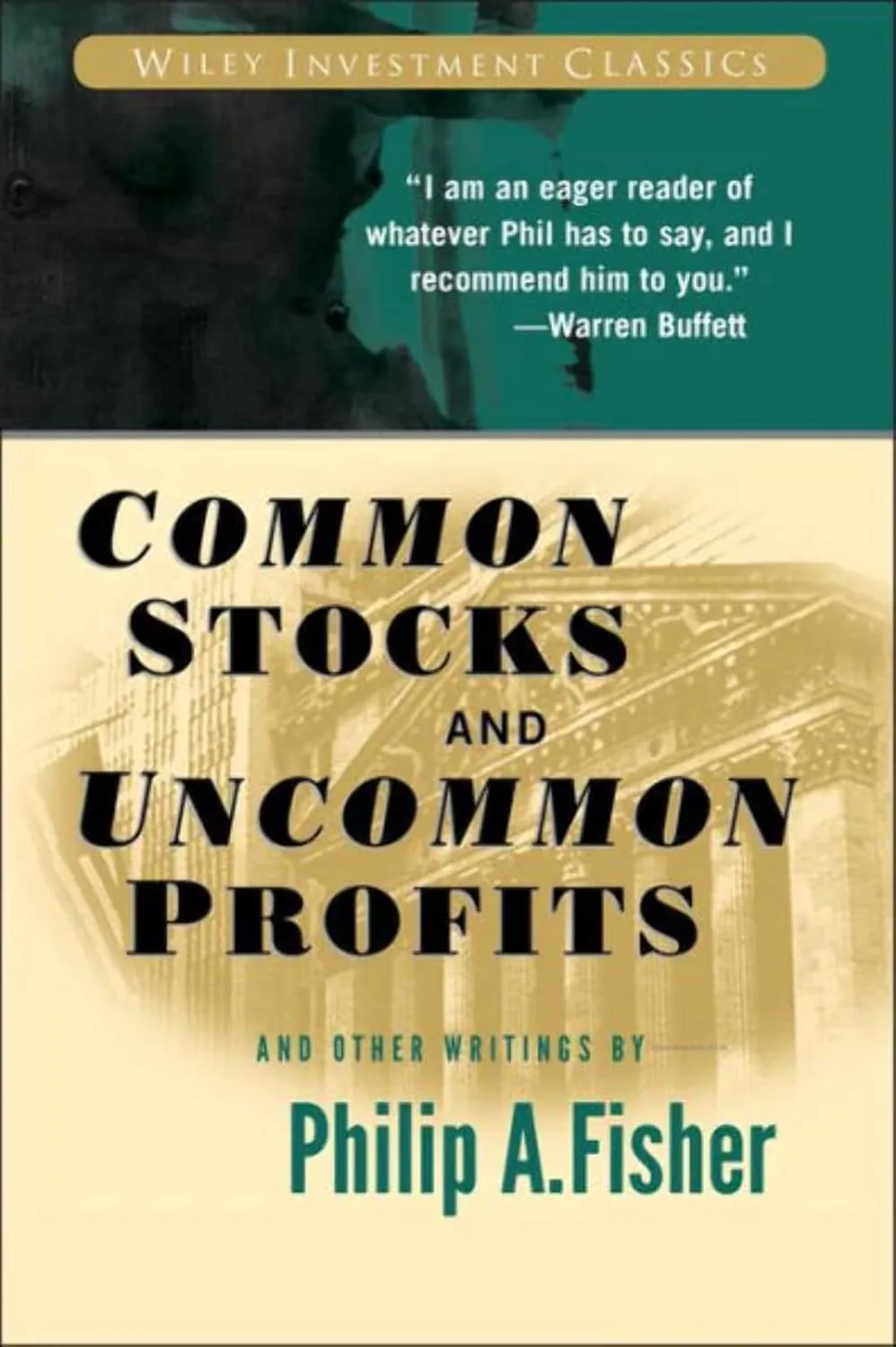
Warren Buffett has said he is "85% Graham and 15% Fisher." This book is where the 15% came from. Where Graham focused on quantitative analysis of balance sheets to find cheap stocks, Fisher focused on qualitative analysis of business quality to find great companies worth holding forever. His influence on Buffett's evolution from net-net bargain hunter to franchise business owner was decisive. In an era of AI-generated investment summaries and algorithmic trading, Fisher's "scuttlebutt" method, gathering intelligence by talking to customers, competitors, and employees, has become more valuable, not less. As Finimize noted in a 2025 article, scuttlebutt offers "the kind of insights algorithms cannot reach," making it "one of the few remaining sources of differentiated insight in an efficient market."
Book Details
| Attribute | Details |
|---|---|
| Title | Common Stocks and Uncommon Profits |
| Author | Philip A. Fisher |
| Publisher | Wiley Investment Classics |
| First Published | 1958 |
| Pages | 320 |
| Reading Level | Intermediate |
| Amazon Rating | 4.6/5 stars |
Get Your Copy
Paperback: Buy on Amazon
Kindle: Buy on Amazon
About the Author
Philip Fisher (1907-2004) ran Fisher & Co., a San Francisco-based investment firm, for over 70 years. He identified Motorola in 1955 and held it until his death, nearly 50 years. He identified Texas Instruments in the 1950s at a few dollars per share. His investment record over seven decades is one of the most distinguished in the history of the profession. He was famously selective: he might investigate 20 companies before finding one worth buying. He had no use for speculation, momentum, or short-term trading. His approach to evaluating common stock through qualitative research remains the gold standard for growth investors.
The Scuttlebutt Method
Fisher's most original contribution to investment research is the "scuttlebutt" method: gathering information about a company from its ecosystem of competitors, customers, suppliers, former employees, and industry experts.
Why Scuttlebutt Works
Annual reports and financial statements tell you what happened. They do not tell you:
Scuttlebutt fills these gaps with direct observation and conversation.
The Scuttlebutt Sources
| Source | What They Know | How to Access |
|---|---|---|
| Competitors | Relative competitive position, product quality | Competitor annual reports, industry conferences |
| Customers | Product value, customer service, switching likelihood | Customer interviews, product reviews |
| Former employees | Culture, management quality, internal strategy | LinkedIn, referrals |
| Suppliers | Growth trajectory, payment practices, customer importance | Supplier relations contacts |
| Industry experts | Technical capability, market position | Academic researchers, consultants |
| Trade publications | Industry dynamics, competitive threats | Subscription trade journals |
Fisher spent weeks researching a single company before buying. Modern investors can access much of this information through:
A 2024 Forbes article by Jacob Wolinsky outlined a modern approach to scuttlebutt, noting that while the tools have changed, the principle remains the same: "the best insights about a business come not from spreadsheets, but from real people who interact with the company every day." For investors who want to apply this systematically, our guide on how to research stocks before investing covers the practical steps.
The Scuttlebutt Verification Loop
Fisher used each source to verify and extend what he learned from others:
Annual report → Initial hypothesis about management quality
    ↓
Competitor interviews → Does the industry see what management claims?
    ↓
Customer interviews → Are the claimed competitive advantages real?
    ↓
Former employee conversations → Is the culture consistent with management's public statements?
    ↓
Supplier conversations → Is the business growing as management claims?
    ↓
Decision: Confirmed thesis → Buy / Disconfirmed → Pass
The 15 Points
Fisher's core framework is 15 qualitative criteria for evaluating whether a company is truly exceptional:
Point 1: Does the Company Have Products or Services With Sufficient Market Potential?
Fisher seeks companies whose addressable market will allow significant growth for many years. A company that has saturated its current market cannot grow regardless of how well it executes.
Identifying large addressable markets:
Point 2: Does Management Have the Determination to Continue Developing Products?
Fisher distinguishes between companies that grow until they exhaust their current product line and those that continuously reinvest in developing the next generation. The latter are worth significantly more.
Examples of continuous product development:
Point 3: How Effective Is the Company's Research and Development?
Not all R&D is equal. Fisher focuses on R&D efficiency: how much revenue and profit does the company generate per dollar of R&D spending?
R&D effectiveness metrics:
| Metric | Formula | Target |
|---|---|---|
| R&D as % of revenue | R&D spend / Revenue | Consistent with industry; growing |
| Revenue per R&D dollar | Revenue / R&D spend | Rising over time |
| New product revenue % | Revenue from products < 5 years old | Above 30% for innovation leaders |
Point 4: Does the Company Have an Above-Average Sales Organization?
A great product that is poorly sold produces inferior results. Fisher checks whether the sales organization can effectively communicate the product's value to the right customers.
Point 5: Does the Company Have a Worthwhile Profit Margin?
High gross margins indicate pricing power, the ability to charge more than the cost of production. Fisher's rule: in any industry, look for the companies with consistently higher margins than competitors. This is usually a sign of genuine competitive advantage. Learn more about this metric in our gross profit margin glossary entry.
Margin analysis:
| Margin Type | Strong | Average | Weak |
|---|---|---|---|
| Gross margin | Above 40% | 20-40% | Below 20% |
| EBIT margin | Above 20% | 10-20% | Below 10% |
| Net margin | Above 15% | 5-15% | Below 5% |
These vary significantly by industry. The relevant comparison is always within an industry: a software company with a 70% gross margin and a cement company with a 25% gross margin are not comparable. Compare within sectors.
Point 6: What Is the Company Doing to Maintain or Improve Profit Margins?
Fisher looks for companies actively working to improve margins through:
Point 7: Does the Company Have Outstanding Labor and Personnel Relations?
Fisher found that companies with genuine respect for employees consistently outperformed over long periods. Good labor relations reduce turnover (expensive to replace skilled workers), increase productivity, and improve morale.
Signals of strong labor relations:
Point 8: Does the Company Have Outstanding Executive Relations?
Beyond the CEO, Fisher examines the depth of management talent. Great CEOs surrounded by weak lieutenants are vulnerable. The best companies develop talent internally and promote from within.
Point 9: Does the Company Have Depth to Its Management?
A company where every important decision flows through one person is fragile. Fisher looks for organizations that can function and grow even as individual managers change.
Point 10: How Good Are the Company's Cost Analysis and Accounting Controls?
Fisher's check against the scuttlebutt: do the financial statements reflect what the operating data would predict? Discrepancies between what management says about operations and what the financials show are warning signs.
Point 11: Are There Other Aspects of the Business Somewhat Peculiar to the Industry That Will Give the Investor Important Clues?
Fisher's catch-all for industry-specific factors: patent protections, regulatory environments, customer concentration, capital requirements, and other industry-specific characteristics that determine long-term returns.
Point 12: Does the Company Have a Short-Range or Long-Range Outlook on Profits?
Fisher strongly prefers management teams that think in years and decades rather than quarters. Companies that sacrifice long-term investment to hit quarterly earnings estimates consistently underperform those that invest for the future even when it temporarily hurts reported earnings.
Point 13: In the Foreseeable Future Will the Growth of the Company Require Sufficient Equity Financing?
Growth that requires constant dilutive share issuance transfers value from existing shareholders to new investors. Fisher prefers companies that can finance growth internally through retained earnings, or through debt if the returns justify it.
Point 14: Does Management Talk Freely to Investors About Its Affairs When Things Are Going Well but "Clam Up" When Troubles and Disappointments Occur?
Management teams that communicate only good news and go silent on bad news are not trustworthy stewards of shareholder capital. Fisher values management teams that discuss problems candidly and explain how they plan to address them.
Point 15: Does the Company Have Management of Unquestionable Integrity?
The most important and least quantifiable criterion. Fisher believes no stock with questionable management deserves to be bought regardless of how attractive the numbers look.
The "When to Sell" Framework
Fisher is unusual among value investors in having a clear "when to sell" framework. His answer: almost never, but specifically when:
What Fisher does NOT consider as reasons to sell:
Fisher's most important selling insight:
"If the job has been correctly done when a common stock is purchased, the time to sell it is, almost never."
Fisher's Investment Philosophy Applied to Motorola
Fisher bought Motorola in 1955. Here is how it scored on his criteria at purchase:
| Criterion | Assessment |
|---|---|
| Market potential | Enormous: consumer electronics just beginning |
| Product development determination | Exceptional: constant innovation culture |
| R&D effectiveness | Industry-leading patents in transistor technology |
| Sales organization | Strong retail and commercial relationships |
| Profit margins | Above industry average consistently |
| Labor relations | Respected employer in the Chicago area |
| Management depth | Strong bench under Bob Galvin |
| Long-range outlook | Explicitly communicated multi-decade vision |
| Equity financing | Self-financing through retained earnings |
| Management integrity | Galvin family reputation beyond question |
Fisher held Motorola until his death in 2004, 49 years, through television, consumer electronics, semiconductor, cell phone, and government systems cycles.
The result: A tiny initial investment grew to an enormous sum through decades of compounding. Fisher's point: finding truly great companies and holding them through normal market volatility produces better results than constantly seeking new opportunities.
Fisher vs. Graham: The Complementary Approaches
| Approach | Graham | Fisher |
|---|---|---|
| Primary focus | Quantitative | Qualitative |
| Key metric | Net asset value, P/E | Business quality, management |
| Time horizon | Shorter (sell at fair value) | Longer (hold forever) |
| Diversification | Wider portfolio | Concentrated (few stocks) |
| Information source | Financial statements | Scuttlebutt research |
| Buy signal | Cheap vs. assets | Quality at reasonable price |
| Best suited for | Bear markets, asset-heavy industries | Growth companies, technology |
Warren Buffett synthesized these approaches: Graham's margin of safety for the entry price, Fisher's quality analysis for what to buy. The combination is more powerful than either alone.
Strengths & Weaknesses
What We Loved
Areas for Improvement
Who Should Read This Book
Highly Recommended For
Probably Not For
Frequently Asked Questions
Q: Is Fisher's approach compatible with index investing?
A: The principles can inform your thinking about what you own. Practically, the time commitment for the full scuttlebutt method makes it suited to concentrated active portfolios rather than index supplements.
Q: How relevant is the scuttlebutt method in the internet age?
A: More accessible than ever. Customer reviews, Glassdoor, Reddit communities, LinkedIn, and free earnings call transcripts provide more scuttlebutt data than Fisher ever had. The method is more powerful today than in 1958.
Q: What is the single most important Fisher principle?
A: Point 15, management integrity. No amount of analytical sophistication compensates for management that steals from shareholders or misleads investors. Start there and work backwards. If you want to understand why this matters, read about economic moats and how management quality sustains them.
Final Verdict
Rating: 4.7/5
Common Stocks and Uncommon Profits is the essential complement to The Intelligent Investor. Where Graham gives you the price discipline, Fisher gives you the quality framework. Together they form the foundation of intelligent investing. The 15 points and scuttlebutt method remain the best available tools for evaluating whether a business is genuinely excellent.
If you are serious about picking individual stocks, this book is required reading. The scuttlebutt method takes time and effort that most investors will not invest, which is exactly why it works. For those who would rather not spend weeks researching individual companies, dividend investing or a simple index fund strategy may be a better fit.
Get Your Copy
Paperback: Buy on Amazon
Kindle: Buy on Amazon
Prices current as of publication date. Free shipping available with Prime.