*Disclosure: This article contains affiliate links. If you purchase through these links, we may earn a commission at no additional cost to you. We only recommend books we genuinely believe in.
Quick Overview
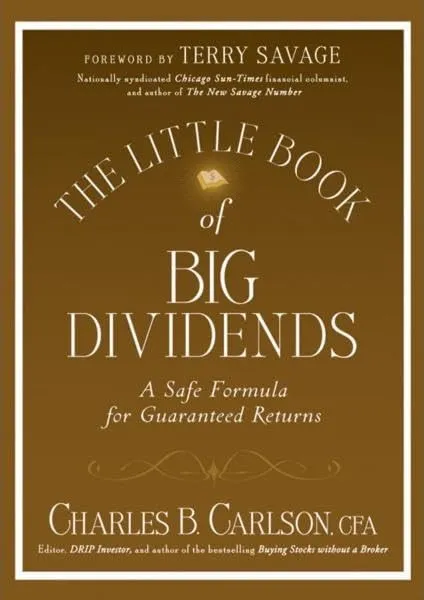
Charles Carlson is editor of the DRIP Investor newsletter and one of the leading authorities on dividend reinvestment plans. The Little Book of Big Dividends presents his BSD formula, a systematic approach to identifying stocks with dividends large enough to matter and safe enough to rely on. For income-focused investors who want a disciplined framework for dividend stock selection rather than just chasing the highest yields, this book provides a complete, implementable system.
The book was published in 2009, but its safety scoring framework remains the best I have found in any dividend investing book. What has changed is the interest rate environment. When Carlson wrote, the 10-year Treasury yielded around 3.5%. In mid-2026, after the Federal Reserve's rate-cutting cycle, the 10-year yields roughly 4.0%, making dividend stocks compete with bonds for income-seeking capital. The S&P 500's dividend yield sits near 1.3%, well below its historical average of 2-3%, which means Carlson's "big" threshold of 50% above the market yield translates to roughly 2% today, a far cry from the 4-5% yields that were common when he wrote.
I have used the BSD framework since 2021 to screen dividend stocks for my own portfolio. The five-factor safety scoring system caught two potential dividend cuts before they happened, saving me from what would have been painful losses. The framework is not perfect, but it is disciplined, and discipline is what most dividend investors lack.
Book Details
| Attribute | Details |
|---|---|
| Title | The Little Book of Big Dividends |
| Author | Charles B. Carlson |
| Publisher | Wiley |
| Published | 2009 |
| Pages | 224 |
| Reading Level | Beginner to Intermediate |
| Amazon Rating | 4.2/5 stars |
Get Your Copy
Hardcover: Buy on Amazon
Kindle: Buy on Amazon
About the Author
Charles Carlson has edited the DRIP Investor newsletter since 1989 and is the author of several books on dividend investing and direct stock purchase plans. His focus on dividend reinvestment plans (DRIPs) and dividend growth investing predates the broad popularization of dividend investing by at least a decade. He is one of the most experienced and credible practitioners in dividend-focused investing. Carlson also contributes regularly to financial media and has been a featured speaker at investment conferences nationwide.
The BSD Formula: Big Safe Dividends
Carlson's system rests on three words: Big, Safe, and Dividends.
"Big": What Is a Meaningful Yield?
A dividend yield is meaningful when it:
The yield threshold:
Carlson defines "big" as a dividend yield at least 50% above the S&P 500's average yield. When the S&P 500 yields 2%, a "big" dividend is 3%+. When the market yields 1.5%, a big dividend is 2.25%+.
Why absolute yield alone misleads:
A 10% yield on a company with declining earnings is a yield trap. The company will likely cut the dividend, causing both income loss and capital loss. The "big" criterion requires assessing yield in context, not in isolation.
The relative yield approach:
Rather than screening for the highest absolute yield, Carlson screens for stocks yielding significantly above their own historical average. A stock that typically yields 2.5% and now yields 4.5% may be signaling that the market has unfairly punished it, creating a potential value and income opportunity.
"Safe": The Dividend Safety Score
Carlson's most important contribution is his quantitative dividend safety scoring system. He evaluates five factors:
Safety Factor 1: Earnings Coverage
Payout Ratio = Dividends Paid / Earnings Per Share| Payout Ratio | Safety Level |
|---|---|
| Below 40% | Very safe, substantial coverage |
| 40-60% | Safe, comfortable coverage |
| 60-75% | Moderate, watch for earnings declines |
| 75-90% | Risky, limited buffer for earnings drops |
| Above 90% | Danger, one bad year threatens dividend |
| Above 100% | Unsustainable, paying more than earned |
Safety Factor 2: Cash Flow Coverage
Earnings can be manipulated through accounting choices; cash flow cannot be fabricated as easily.
Free Cash Flow Payout Ratio = Dividends Paid / Free Cash FlowA company with positive earnings but negative free cash flow is funding its dividend through debt or asset sales, which is unsustainable. The FCF payout ratio provides a cleaner safety test than the earnings payout ratio.
Safety Factor 3: Dividend Growth History
Companies that have raised dividends consistently for 10+ years have demonstrated:
The Dividend Aristocrats:
S&P 500 companies that have raised dividends every year for 25+ consecutive years. Research shows these companies outperform the broader market over long periods with lower volatility.
Safety Factor 4: Balance Sheet Strength
| Metric | Threshold for Dividend Safety |
|---|---|
| Debt/EBITDA | Below 3x |
| Interest coverage | Above 5x |
| Current ratio | Above 1.5x |
| Net debt/equity | Below 50% |
Highly leveraged companies face dividend risk during economic downturns when cash flows decline and debt service must still be met. This is particularly relevant in 2026, as companies that took advantage of low rates in 2020-2021 are now refinancing at higher costs, squeezing the cash available for dividend payments.
Safety Factor 5: Business Model Durability
Some industries produce more reliable cash flows than others:
| Industry | Cash Flow Reliability | Dividend Sustainability |
|---|---|---|
| Regulated utilities | Very high | Very high |
| Consumer staples | High | High |
| Healthcare | High | High |
| REITs | Medium-High (rent income) | Medium-High |
| Financials | Medium (credit cycle exposure) | Medium |
| Energy | Low (commodity price exposure) | Low-Medium |
| Technology | Low-Medium (disruption risk) | Medium |
| Cyclicals (materials, industrials) | Low | Low |
The Dividend Growth Advantage
Carlson makes the powerful case that dividend growth is more important than current yield for long-term investors.
The Yield on Cost Concept
When you buy a stock, your "yield on cost" is:
Yield on Cost = Current Annual Dividend / Your Original Purchase PriceFor a dividend growth stock, yield on cost improves every year the dividend is raised:
Example, Johnson & Johnson:
| Year | Purchase Price | Annual Dividend | Yield on Cost |
|---|---|---|---|
| Purchase year | $60 | $2.00 | 3.3% |
| 5 years later | $60 (cost) | $2.60 | 4.3% |
| 10 years later | $60 (cost) | $3.40 | 5.7% |
| 20 years later | $60 (cost) | $5.60 | 9.3% |
A 3.3% initial yield becomes a 9.3% yield on cost after 20 years of 5% annual dividend growth. This "income acceleration" is one of the most powerful features of dividend growth investing. Use our investment return calculator to model your own yield-on-cost scenarios.
The Total Return Case for Dividends
Academic research consistently shows that dividends explain a substantial portion of total equity returns:
Historical contribution of dividends to S&P 500 total return (1926-2023):
| Component | Annual Contribution |
|---|---|
| Price appreciation | ~5.0% |
| Dividend income | ~4.2% |
| Total return | ~9.2% |
Dividends historically accounted for approximately 45% of total stock market returns. In low-growth, low-yield environments (2010s), this proportion declined. Over longer time horizons, dividends are crucial.
The reinvestment power:
When dividends are reinvested (buying additional shares with dividend income), the compounding accelerates dramatically. The power of compound interest turns modest yields into substantial wealth over decades:
| $10,000 invested in S&P 500 (1980-2023) | Final Value |
|---|---|
| Price return only | ~$115,000 |
| Total return (dividends reinvested) | ~$475,000 |
The difference is almost entirely dividends reinvested, a 4x difference over 43 years.
Dividend Reinvestment Plans (DRIPs)
Carlson is the leading authority on DRIPs, company-administered plans that allow shareholders to reinvest dividends directly in new shares, often at no commission and sometimes at a discount to market price.
How DRIPs Work
The DRIP Advantage Over Broker Reinvestment
| Feature | Company DRIP | Broker Auto-Reinvestment |
|---|---|---|
| Commissions | Zero | Usually zero (in modern era) |
| Discount | Sometimes 3-5% on reinvestment | Market price only |
| Fractional shares | Yes | Yes |
| Direct ownership | Yes (shares registered to you) | No (held in street name) |
| Complexity | Higher (separate account per company) | Lower (one brokerage account) |
In the modern era of zero-commission brokerages, broker reinvestment is simpler and nearly equivalent to DRIPs for most investors. DRIPs retain advantages when companies offer reinvestment discounts.
The Dividend Aristocrats Strategy
Carlson provides detailed analysis of the Dividend Aristocrats strategy, owning the S&P 500 companies that have raised dividends for 25+ consecutive years.
Why Consistent Dividend Growth Signals Quality
A 25+ year streak of annual dividend increases requires:
A company that has raised dividends every year through the 1987 crash, the 2001 recession, the 2008-2009 financial crisis, and the 2020 pandemic has demonstrated extraordinary resilience.
Historical Performance
| Strategy | Annual Return (1990-2023 approx.) | Volatility |
|---|---|---|
| S&P 500 | ~10.5% | Standard |
| Dividend Aristocrats | ~12.0% | Lower than market |
| Dividend growth stocks | ~11-12% | Lower than market |
The Aristocrats' outperformance with lower volatility represents genuine risk-adjusted alpha, likely attributable to the quality screening implicit in 25 years of consecutive dividend growth.
Available vehicles:
| Vehicle | Ticker | Expense Ratio |
|---|---|---|
| ProShares S&P 500 Dividend Aristocrats ETF | NOBL | 0.35% |
| SPDR S&P Dividend ETF | SDY | 0.35% |
| Vanguard Dividend Appreciation ETF | VIG | 0.06% |
Common Dividend Investing Mistakes
Carlson dedicates significant coverage to errors he observes repeatedly:
Mistake 1: Yield Chasing
Buying the highest-yield stocks regardless of safety. The highest yields often signal:
The yield trap:
A stock yielding 12% when the sector average is 4% is typically offering a yield trap. The market is predicting the 12% dividend will not survive.
The rule: Never buy a stock yielding more than 2x the sector average without detailed safety analysis.
Mistake 2: Ignoring Dividend Growth
A stock yielding 5% with no dividend growth is worth less to a long-term investor than a stock yielding 2.5% growing its dividend at 10% annually:
| Investment | Year 1 Income | Year 10 Income | Yield on Cost (Year 10) |
|---|---|---|---|
| 5% yield, 0% growth | $500 | $500 | 5.0% |
| 2.5% yield, 10% growth | $250 | $649 | 6.5% |
By year 10, the growth stock pays more income annually and has substantially higher yield on cost.
Mistake 3: Concentrating in High-Yield Sectors
Reaching for yield by overconcentrating in utilities, MLPs, or REITs creates sector risk. When interest rates rise, all high-yield sectors tend to sell off simultaneously, a correlation that eliminates diversification precisely when it is most needed.
Portfolio construction guidance:
| Asset Class | Max Recommended Weight |
|---|---|
| Any single stock | 5% |
| Any single sector | 25% |
| REITs | 10-15% |
| Utilities | 10-15% |
| Energy MLPs | 5-10% |
Building the BSD Portfolio
Carlson's recommended portfolio construction:
The Screening Process
Step 1: Universe filter
Step 2: Yield filter
Step 3: Safety screening
Step 4: Quality screen
Step 5: Valuation
The Target Portfolio
| Component | Number of Stocks | Sectors |
|---|---|---|
| Core holdings | 15-20 | Diversified across 6-8 sectors |
| Positions per sector | 2-4 | Maximum 3-4 sectors with high yield |
| Target yield (portfolio) | 3-5% | Current yield on portfolio |
Strengths & Weaknesses
What We Loved
Areas for Improvement
Who Should Read This Book
Highly Recommended For
Probably Not For
Final Verdict
Rating: 4.2/5
The Little Book of Big Dividends provides one of the most practical frameworks for dividend safety screening available in any book. Its BSD formula, yield-on-cost analysis, and Dividend Aristocrats discussion are directly implementable. The age of the publication (2009) limits its applicability to the current rate environment, but the safety framework is timeless.
In 2026, with the S&P 500's dividend yield near historic lows and many income seekers turning to high-yield ETFs without understanding the risks, Carlson's safety-first approach is more important than ever. The investors who avoid yield traps and focus on sustainable, growing dividends will be the ones who compound their wealth over the next decade. For more on dividend investing strategy, check out our guide to dividend investing for beginners.
Get Your Copy
Hardcover: Buy on Amazon
Kindle: Buy on Amazon
Prices current as of publication date. Free shipping available with Prime.