*Disclosure: This article contains affiliate links. If you purchase through these links, we may earn a commission at no additional cost to you. We only recommend books we genuinely believe in.
Quick Overview
Wall Street analysts are wrong most of the time, and their errors are predictable. That is the foundation of David Dreman's contrarian strategy. He proved it with four decades of data: analysts systematically overestimate growth for popular stocks and underestimate recovery potential for despised ones. His strategy of buying the cheapest, most out-of-favor stocks on measurable metrics like P/E ratio, P/B ratio, and price-to-cash flow has been validated in his own portfolios and in independent academic research. The value premium has compressed somewhat since Dreman's book was published, as more capital has flowed into factor-based strategies. A 2025 analysis by Quant Decoded found the unconditional value premium has narrowed from its historical average of 4-5% to roughly 2-3% annually. But the behavioral mechanism behind it, investor overreaction, remains deeply embedded in human psychology and shows no sign of disappearing.
Book Details
| Attribute | Details |
|---|---|
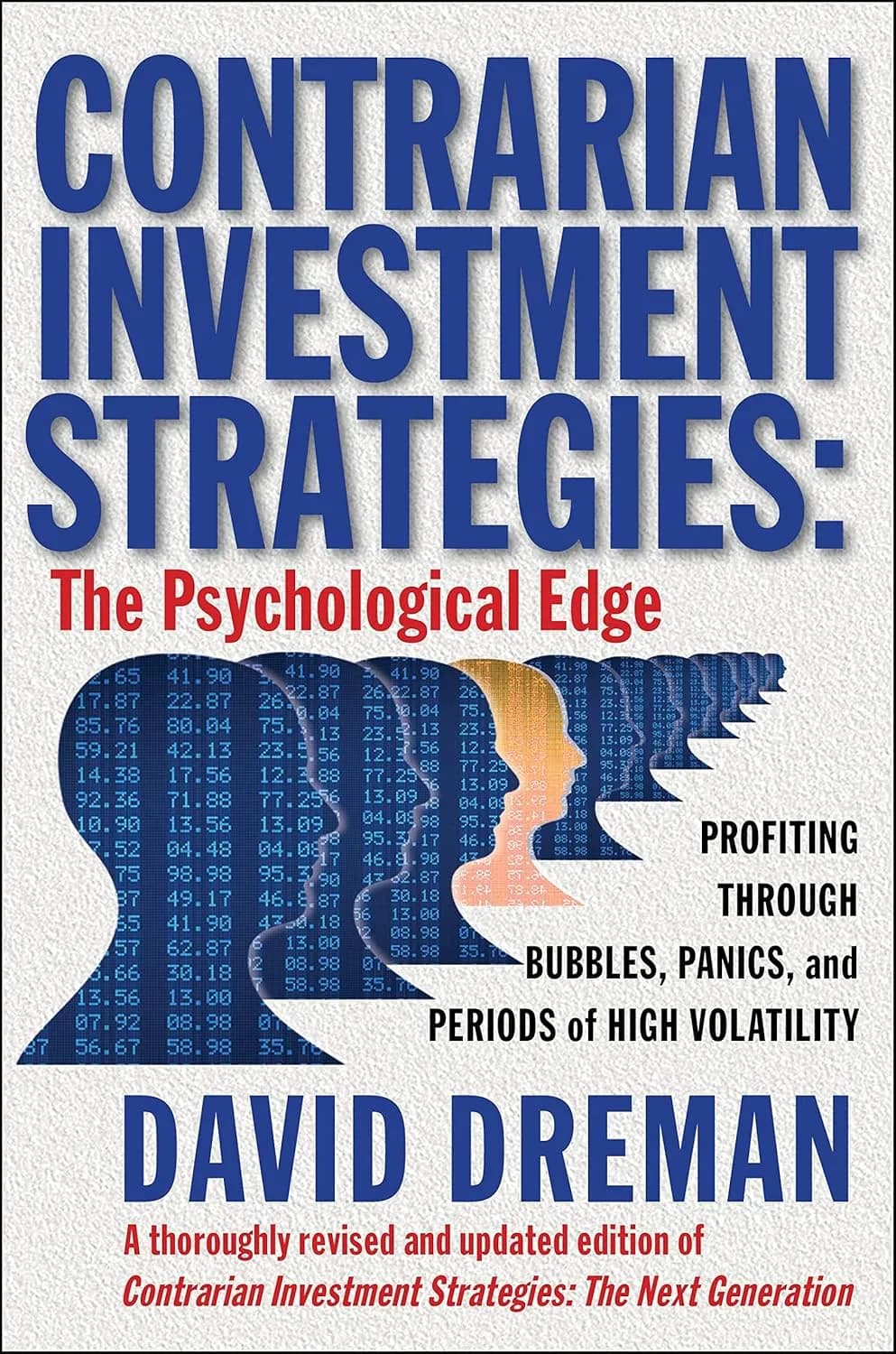
| Title | Contrarian Investment Strategies: The Psychological Edge |
| Author | David Dreman |
| Publisher | Free Press |
| First Published | 1979; updated editions 1982, 1998, 2012 |
| Pages | 464 |
| Reading Level | Intermediate |
| Amazon Rating | 4.5/5 stars |
Get Your Copy
Hardcover: Buy on Amazon
Kindle: Buy on Amazon
About the Author
David Dreman founded Dreman Value Management in 1977 and managed the Kemper-Dreman High Return Fund, which was rated the top-performing fund over the 1988-1998 period by Lipper Analytical Services. He has been a Forbes columnist for over 35 years and has published four editions of this book incorporating progressively more data. His research on analyst forecast errors and contrarian stock returns is among the most frequently cited in behavioral finance.
The Core Thesis: Analysts Are Systematically Wrong
Dreman's foundational argument: security analysts consistently make large, predictable errors in their earnings forecasts. These errors create systematic mispricings that contrarian investors can exploit.
The Analyst Forecast Error Evidence
Dreman studied every quarterly earnings forecast made by Wall Street analysts against actual results over multiple decades.
The finding:
| Forecast Horizon | Percentage of Forecasts Wrong by More Than 5% | Average Error Magnitude |
|---|---|---|
| 1 quarter | ~65% | ~40% |
| 2 quarters | ~75% | ~55% |
| 4 quarters | ~80%+ | ~70%+ |
Analysts are wrong, often dramatically wrong, far more often than the confidence of their forecasts suggests. More importantly, the errors are not random. They cluster in predictable ways:
Analysts systematically overestimate:
Analysts systematically underestimate:
Why Analysts Are Wrong
Dreman identifies three structural reasons:
1. Excessive extrapolation: Analysts project recent trends far into the future. A company growing at 25% per year is modeled to continue growing at 25%. This extrapolation is almost always wrong. Regression to the mean is far more common than sustained above-average growth.
2. Overweighting recent information: Analysts dramatically overweight the most recent quarter's results. A bad quarter triggers massive estimate cuts; a good quarter triggers estimate increases. The actual signal in one quarter of results is far smaller than analysts' responses suggest.
3. Incentive distortions: Analysts who cover companies maintain relationships with those companies' management. Critical forecasts damage those relationships. The incentive to maintain access biases analysts toward optimism.
The Contrarian Strategy
Based on the analyst forecast error finding, Dreman's strategy is simple: buy the stocks that analysts hate most (low P/E, low P/B, low price-to-cash flow) and sell the stocks they love most (high multiples, high growth expectations).
Why Low P/E Stocks Outperform
The earnings surprise asymmetry:
When a "glamour" stock (high P/E, high expectations) reports earnings that are slightly below expectations, the stock falls dramatically, because the expectations were very high and any disappointment is catastrophic.
When a "value" stock (low P/E, low expectations) reports earnings that are slightly above expectations, the stock rises dramatically, because expectations were low and any positive surprise is rewarded.
The probability-weighted outcome:
| Stock Type | Earnings Miss Probability | Earnings Beat Probability | Net Effect |
|---|---|---|---|
| Glamour (high P/E) | High (expectations already high) | Low | Negative expected surprise |
| Value (low P/E) | Low (expectations already low) | High | Positive expected surprise |
The systematic difference in earnings surprise probability, compounded over many stocks and many years, drives the contrarian return premium.
The Long-Run Performance Data
Dreman's data covers the Compustat universe of U.S. stocks from 1970 through 2010 (with similar results found in international markets):
P/E quintile performance (U.S. large cap, 1970-2010):
| P/E Quintile | Annual Return | Annualized vs. Market |
|---|---|---|
| Lowest P/E (cheapest 20%) | +14.5% | +3.5% above market |
| 2nd quintile | +12.8% | +1.8% above market |
| 3rd quintile (middle) | +11.0% | Market |
| 4th quintile | +9.8% | -1.2% below market |
| Highest P/E (most expensive 20%) | +8.0% | -3.0% below market |
A 3.5% annual edge for low P/E stocks compounds to enormous differences over time:
| Period | $100,000 at Market Return (11%) | $100,000 at Contrarian Return (14.5%) |
|---|---|---|
| 10 years | $283,942 | $390,702 |
| 20 years | $806,231 | $1,527,476 |
| 30 years | $2,289,230 | $5,970,722 |
P/B quintile performance:
Similar results: lowest P/B quintile outperforms highest P/B quintile by approximately 3% annually.
Price-to-cash flow quintile performance:
Similar results: lowest price-to-cash flow outperforms by approximately 3% annually.
The combined contrarian screen:
Stocks that are simultaneously in the bottom quintile of P/E, P/B, and price-to-cash flow (the cheapest stocks on all three measures) outperform by 4-5% annually, the most powerful contrarian signal.
Modern context on the value premium:
The decade from 2010 to 2020 was the most sustained period of value underperformance on record. The Fama-French HML factor returned -2.1% annualized during this period, as growth stocks dominated. But from 2021 through 2025, the HML factor delivered approximately 4.2% annualized returns, driven by rising interest rates and valuation mean-reversion. The value premium was dormant, not dead. Investors who abandoned value at the end of the 2010s missed the recovery. For more on how market cycles affect your portfolio, read our guide on investing during a recession.
The Behavioral Finance Foundation
Dreman connects his empirical findings to behavioral finance theory, anticipating Kahneman's work by decades.
The Overreaction Hypothesis
Werner De Bondt and Richard Thaler published a landmark 1985 paper showing that stocks that performed worst over the previous 5 years dramatically outperformed over the subsequent 5 years, and vice versa. This "long-run reversal" effect is consistent with investor overreaction to bad news. A 2024 study by Valeriy Zakamulin in the Review of Behavioral Finance confirmed this pattern persists, corroborating Dreman's insights with more recent data.
The overreaction cycle:
Company has problems (earnings miss, industry headwind, management issues)
    → Analysts cut estimates dramatically
    → Media coverage turns negative
    → Institutional investors sell (can't hold a "falling knife")
    → Price falls below fundamental value
    → Stock is now a contrarian opportunity
    → Company stabilizes or recovers
    → Analysts start revising estimates up
    → Positive surprises vs. low expectations
    → Price recovers to or above fair value
    → Contrarian investor profits
This cycle repeats reliably across industries, time periods, and geographies, because the behavioral driver (overreaction to negative news) is a stable feature of human psychology.
The Representativeness Heuristic Applied to Stocks
Kahneman and Tversky's representativeness heuristic: people judge the probability of an event by how closely it resembles the prototype of that category. Applied to stocks:
A stock with strong growth history, great management, and positive news coverage represents a great investment. Investors treat the history as a reliable guide to the future, extrapolating the trend.
A stock with poor earnings, negative press, and declining estimates represents a terrible investment. Investors extrapolate the decline.
Both extrapolations are typically wrong beyond one or two quarters, because mean reversion is more powerful than trend continuation for most companies over medium-term horizons (3-5 years).
The investment opportunity:
The representativeness heuristic systematically misprices stocks in both directions. Glamour stocks are overpriced because their representative characteristics (great growth history, strong brand) lead investors to extrapolate the past. Value stocks are underpriced because their representative characteristics (poor recent results, negative sentiment) lead investors to extrapolate the problems.
Implementing the Contrarian Strategy
The Screening Process
Step 1: Universe definition
Step 2: Apply the contrarian screens
| Screen | Threshold |
|---|---|
| P/E ratio | Bottom quintile of the market (typically below 10-12x) |
| P/B ratio | Bottom quintile (typically below 1.5x) |
| Price-to-cash flow | Bottom quintile (typically below 8x) |
| Dividend yield | Top quintile preferred (but not required) |
Step 3: Quality filters (avoid value traps)
Not all cheap stocks deserve to be bought. Dreman identifies warning signs:
| Red Flag | Why Dangerous |
|---|---|
| Debt/equity above 100% | Excessive leverage amplifies losses |
| Interest coverage below 2x | Cannot comfortably service debt |
| Negative operating cash flow | Earnings are accrual-based, not real |
| Declining sales for 3+ years | Secular decline, not cyclical setback |
| Industry with no barriers to entry | No moat means no recovery of margins |
Step 4: Diversify
Hold 20-30 contrarian stocks across multiple sectors. No individual position should exceed 5% of portfolio. The power of the contrarian approach is statistical: the average performance of low P/E stocks is superior, but individual stocks will vary widely.
The Patience Requirement
Contrarian strategies require patience that most investors cannot provide:
Typical contrarian holding period: 2-4 years before thesis plays out
Why the strategy is uncomfortable:
Historical data on contrarian patience:
Dreman's data shows that contrarian outperformance is concentrated in years 2-4 after purchase, not in the first year. Investors who bail out after one year of poor performance miss most of the alpha. This is a classic example of what behavioral economists call the sunk cost fallacy in reverse: the discomfort of holding losers causes most investors to sell exactly when the strategy requires patience.
Sector Rotation and Contrarian Timing
Entire sectors can become contrarian opportunities:
Historical sector contrarian opportunities:
| Sector | Period of Extreme Cheapness | Subsequent Performance |
|---|---|---|
| U.S. financial stocks | 2008-2009 | +200%+ over 5 years |
| U.S. energy stocks | 2015-2016 | +80%+ over 3 years |
| U.S. pharma | 2000-2002 | +70%+ over 5 years |
| European banks | 2011-2012 | +100%+ over 4 years |
When an entire sector trades at multi-year low valuations due to specific problems (regulatory, cyclical, credit), the contrarian opportunity is substantial.
Contrarian vs. Other Value Approaches
| Approach | Core Metric | Holding Period | Concentration |
|---|---|---|---|
| Dreman Contrarian | P/E, P/B, P/CF quintile | 2-4 years | Diversified (20-30 stocks) |
| Buffett/Fisher | Business quality + fair price | Indefinitely | Concentrated (8-15 stocks) |
| Graham Net-Net | Book value below working capital | 1-3 years | Very diversified |
| Greenblatt Magic Formula | Earnings yield + ROIC | 1 year | Diversified |
Dreman's approach is the most systematic and data-validated. Buffett's approach requires deeper qualitative analysis of business quality. Both work, through different mechanisms.
Strengths & Weaknesses
What We Loved
Areas for Improvement
Who Should Read This Book
Highly Recommended For
Probably Not For
Frequently Asked Questions
Q: Does the contrarian approach still work after decades of research?
A: The academic literature suggests the value premium has diminished somewhat post-publication as more capital pursues it. The unconditional premium has compressed from 4-5% to roughly 2-3% annually. However, the conditional premium (buying value when valuation spreads are wide) remains substantial. Low P/E stocks have continued to outperform on a risk-adjusted basis in most periods, though the margin has narrowed. The 2021-2025 value recovery, driven by rising rates and valuation mean-reversion, demonstrated the premium was dormant rather than eliminated.
Q: How is this different from the Magic Formula?
A: Greenblatt's Magic Formula adds profitability (ROIC) as a quality screen to the earnings yield (value) screen. Dreman uses multiple value metrics (P/E, P/B, P/CF) and relies on statistical diversification rather than quality screening. Both work through similar behavioral mechanisms.
Final Verdict
Rating: 4.5/5
Contrarian Investment Strategies is the most data-backed value investing book available. Its analyst forecast error research, four-decade return database, and behavioral finance integration provide a uniquely complete case for systematic contrarian investing. The value premium has compressed since publication, but the behavioral mechanism behind it remains intact. Essential reading alongside The Intelligent Investor.
If you want to understand why cheap stocks keep beating expensive ones, and why most investors cannot bring themselves to buy them, this book explains it with more data than any alternative. For investors who lack the patience for contrarian holding periods, a target-date fund or simple index strategy may be more practical.
Get Your Copy
Hardcover: Buy on Amazon
Kindle: Buy on Amazon
Prices current as of publication date. Free shipping available with Prime.