*Disclosure: This article contains affiliate links. If you purchase through these links, we may earn a commission at no additional cost to you. We only recommend books we genuinely believe in.
Quick Overview
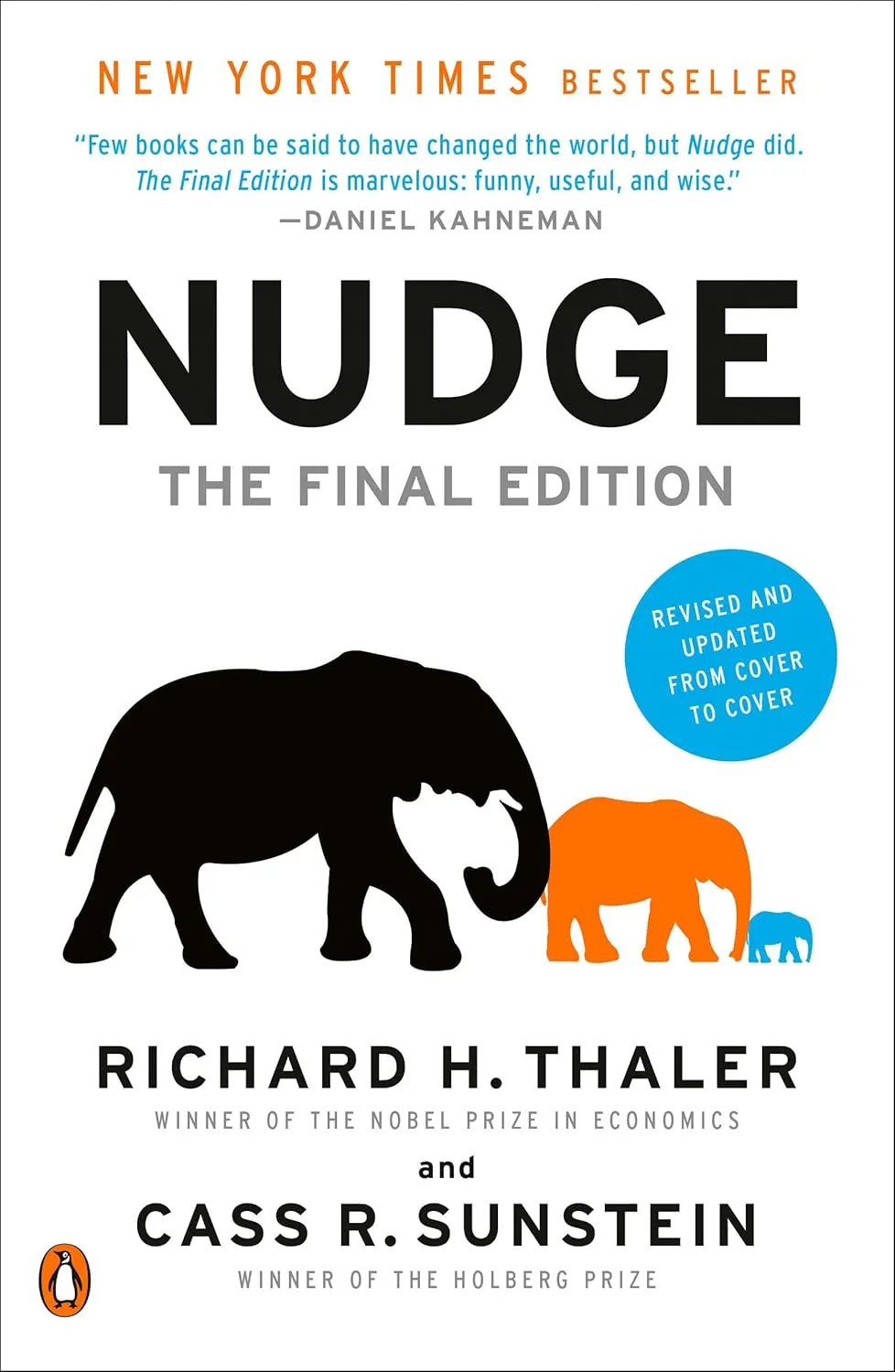
A 401(k) plan that requires you to opt in has a participation rate of about 40%. The same plan that enrolls you automatically and requires you to opt out has a participation rate above 85%. That single design change, rooted in the ideas in this book, has redirected billions of dollars into retirement accounts. Richard Thaler (2017 Nobel Prize in Economics) and Cass Sunstein (Harvard Law professor, former White House regulatory czar) argue that the way choices are presented has enormous influence on the choices people make. Policymakers, employers, and financial institutions can use this to guide people toward better outcomes without restricting their freedom. The final edition (2021) incorporates 13 years of real-world evidence from nudge programs globally, and the retirement savings applications are directly relevant to every investor.
Book Details
| Attribute | Details |
|---|---|
| Title | Nudge: The Final Edition |
| Authors | Richard H. Thaler & Cass R. Sunstein |
| Publisher | Penguin Books |
| First Published | 2008 |
| Final Edition | 2021 |
| Pages | 368 |
| Reading Level | Beginner to Intermediate |
| Amazon Rating | 4.5/5 stars |
Get Your Copy
Paperback (Final Edition): Buy on Amazon
Kindle: Buy on Amazon
About the Authors
Richard Thaler is Professor of Behavioral Science and Economics at University of Chicago Booth School of Business and won the Nobel Prize in Economics in 2017 for his work on behavioral economics. His research on mental accounting, the disposition effect, and limited rationality underpins much of modern behavioral finance theory. Cass Sunstein is the Robert Walmsley University Professor at Harvard Law School and served as Administrator of the White House Office of Information and Regulatory Affairs (2009-2012), where he implemented nudge-based policy reforms that saved an estimated $2.6 billion in regulatory costs over three years.
The Core Framework: Choice Architecture
Libertarian paternalism: A philosophy that preserves freedom of choice (libertarian) while steering people toward better outcomes through thoughtful design of the choice environment (paternalism).
The key insight: every choice environment has a design. A default setting is a choice. The order of options is a choice. The framing of information is a choice. These design decisions affect outcomes whether or not the designer intended them to. The question is not whether to influence choices (you always do) but whether to do it thoughtfully or carelessly.
The choice architect's tools:
| Tool | Description | Example |
|---|---|---|
| Default settings | What happens if you do nothing | Opt-in vs. opt-out for 401(k) enrollment |
| Simplification | Reducing complexity of choices | Simple fund menus instead of 400 options |
| Feedback | Showing consequences of choices | Energy usage comparison to neighbors |
| Framing | How information is presented | "90% survival rate" vs. "10% mortality rate" |
| Social norms | Showing what peers do | "Most people in your situation save X%" |
| Pre-commitment | Locking in future good behavior | Save More Tomorrow program |
The Retirement Savings Revolution
The most financially significant chapter covers the transformation of U.S. retirement savings through behavioral design.
The Default Enrollment Problem
Before behavioral design:
Most 401(k) plans required employees to actively enroll (opt-in). Analysis of participation rates:
| Enrollment Type | Average Participation Rate |
|---|---|
| Opt-in (active enrollment required) | 37-49% |
| Opt-out (automatic enrollment, can opt out) | 85-95% |
The same employees, the same benefits, the same plan. The only difference is whether they must act to join or must act to leave. Participation more than doubled through a single design change.
The Default Contribution Rate Problem
Automatic enrollment solved the participation problem but created a new one. Most plans defaulted employees at 3% contribution rates. Research showed employees rarely increased from the default:
| Default Rate | Average Final Contribution Rate |
|---|---|
| 3% | 4.1% |
| 6% | 6.8% |
| 10% | 10.4% |
The default anchors behavior. Setting defaults higher produces significantly better outcomes.
Save More Tomorrow (SMarT)
Thaler and Shlomo Benartzi designed the most elegant retirement savings nudge:
The SMarT structure:
Results from the original Thaler-Benartzi study:
| Group | Starting Contribution | After 3 Raises | Increase |
|---|---|---|---|
| SMarT program | 3.5% | 13.6% | +10.1 percentage points |
| Control group (asked to increase now) | 3.5% | 6.5% | +3.0 percentage points |
SMarT produced savings rates more than 3x higher than a direct request for the same outcome. The Pension Protection Act of 2006 codified automatic enrollment and SMarT-style auto-escalation as best practices, transforming retirement savings nationwide.
What 2025-2026 Research Shows
The nudge literature has matured significantly since the original SMarT studies, and the findings are more nuanced than the early results suggested.
A 2024 paper by Choukhmane published in the American Economic Review examined auto-enrollment effects at 36 months rather than the initial 12-month window. The short-run gains in participation and contributions were real, but they attenuated over the medium run. At 36 months, the average savings increases were modest. However, auto-enrollment significantly lowered inequality in savings, meaning it helped the lowest-saving employees most even if the average effect faded.
A 2026 NBER working paper by Bloomfield, Dao, Lee, and Slavov studied state Auto-IRA programs and found something important: unlike employer-sponsored auto-enrollment, where effects can reverse after job separation, auto-IRA savings persist across job switches because the accounts are portable. This suggests the design of the default matters as much as the default itself. For low-earning and high-mobility populations, auto-IRAs produced larger effects than previous studies of employer plans found.
A 2025 Georgetown study confirmed these findings, showing that auto-IRA enrollment represents a particularly effective policy for low-earning workers who change jobs frequently. The portability of the account between employers appears to be the key mechanism underlying the persistence of savings.
A 2025 study published in the International Journal of Bank Marketing tested light nudging, personalized pension projections, and workplace financial education among 290 middle-aged workers in Hong Kong. Light nudging alone produced improvements across most dimensions of retirement financial preparation and increased private retirement savings, though the effect was confined to participants with high investment confidence or high risk tolerance.
Read more about maximizing your retirement savings in our guides to 401(k) catch-up contributions and whether you should contribute to a 401(k) at your first job.
Financial Nudges: How Institutions Shape Your Behavior
Credit Card Minimum Payments
Thaler and Sunstein identify a destructive nudge embedded in credit card statements: showing the minimum payment prominently anchors behavior toward that number.
The minimum payment anchor:
| Scenario | Average Monthly Payment |
|---|---|
| No minimum shown | $200 |
| Minimum of $25 shown | $50-75 |
Showing the minimum payment reduces average payments by 60-70%, increasing the amount of interest paid and the time to payoff. Use our credit card interest calculator to see how much minimum payments actually cost you.
The counter-nudge: Set up autopay for the full statement balance. This eliminates the minimum payment anchor and ensures you never pay interest. Read our guide on avoiding car loan rip-offs for more on how lenders use similar anchoring tactics.
Mortgage Disclosure
The authors analyze how mortgage disclosure requirements affect decision quality. When borrowers receive simple, standardized disclosure of the total cost of their mortgage (rather than complex APR calculations), they make significantly better decisions.
The disclosure comparison:
| Disclosure Type | Borrower Decision Quality |
|---|---|
| Complex APR disclosure | Moderate. Confusing to most borrowers |
| Simple total cost ("you will pay $X total over 30 years") | High. Immediately comparable |
| No disclosure | Poor. Borrowers focus on monthly payment only |
The lesson for mortgage shoppers: always calculate the total cost over the life of the loan, not just the monthly payment or even the APR. Our mortgage payoff early calculator can help you see the full picture.
Fund Selection and Menu Design
In defined contribution plans, the number of fund options significantly affects employee allocation quality:
| Number of Fund Options | Typical Employee Behavior |
|---|---|
| 2-5 options | Split roughly evenly (1/n heuristic) |
| 50+ options | Choice paralysis; often default to money market |
| 10-15 options with clear categorization | Better allocation toward appropriate risk level |
Vanguard and Fidelity's research confirms: simpler fund menus produce better retirement outcomes than complex menus, even though more options theoretically allow more optimization. This is one reason the three-fund portfolio has become so popular.
The RECAP Principle
Thaler and Sunstein propose a regulatory principle they call RECAP (Record, Evaluate, and Compare Alternative Prices):
Require service providers to give customers data about their own usage and costs in a machine-readable format, enabling easy comparison to alternatives.
Financial applications:
| Service | RECAP Benefit |
|---|---|
| Bank accounts | See all fees paid over the past year; compare to alternatives |
| Credit cards | See total interest paid; compare to balance transfer offers |
| Investment accounts | See total fees paid (expense ratios, advisor fees); compare to low-cost alternatives |
| Insurance | Compare total premiums paid to claims paid; evaluate value |
| Mortgages | See total cost over life of loan; compare refinancing options |
Most financial institutions do not voluntarily provide this information in easily comparable form. Seeking it out manually is worth the effort. The Consumer Financial Protection Bureau has moved toward RECAP-style disclosures since the book's publication, though progress has been uneven across product categories.
Key Nudge Principles for Personal Finance
Set Better Defaults for Yourself
If institutions will not set good defaults for you, set them yourself:
| Area | Self-Imposed Default |
|---|---|
| Retirement | Automatic max 401(k) contribution; auto-escalate annually |
| Savings | Automatic transfer on payday (before spending) |
| Investments | Automatic dividend reinvestment; automatic rebalancing alert |
| Debt | Automatic full statement balance payment |
| Emergency fund | Automatic monthly transfer until target is hit |
Use our savings goal calculator to set your target, then automate the path to it.
Use Social Norms Strategically
People respond powerfully to information about what similar people do. Use this for motivation:
Design Your Environment for Long-Term Thinking
| Environment Change | Effect |
|---|---|
| Delete financial news apps | Reduces reactive trading on noise |
| Remove brokerage app from phone home screen | Reduces checking frequency; reduces emotional reactions |
| Hide investment balances in app (show only when needed) | Reduces loss aversion responses to volatility |
| Set annual review date instead of checking weekly | Reduces harmful tinkering |
| Unsubscribe from daily market email updates | Reduces anchoring to recent performance |
For more on designing your financial environment, read our guide on the psychology behind impulse buying.
Nudge Theory Applied: Global Evidence
Since publication, nudge units have been established in:
Documented outcomes:
| Country | Nudge | Result |
|---|---|---|
| UK | Default pension enrollment | Participation rate from 61% to 83% |
| UK | Showing social norm on tax letters | 15% increase in on-time tax payments |
| US | SMarT program | Savings rates tripled |
| Australia | Default super (pension) enrollment | Nearly universal coverage |
| Germany | Opt-out organ donation | Donation rates 5x higher than opt-in |
The OECD reported in 2024 that over 200 nudge interventions have been formally evaluated across member countries, with the majority showing statistically significant positive effects, though effect sizes vary considerably by context.
Strengths & Weaknesses
What We Loved
Areas for Improvement
Who Should Read This Book
Highly Recommended For
Probably Not For
Frequently Asked Questions
Q: Should I read the original 2008 edition or the Final Edition (2021)?
A: The Final Edition. It incorporates 13 years of evidence, updates the policy discussion, and removes some sections that became less relevant. Worth the small premium.
Q: What is the single most important nudge to implement?
A: Default 401(k) enrollment at the maximum contribution rate with auto-escalation to the IRS limit. If your employer does not offer this, set it up manually with automatic annual increases. Read our guide to 401(k) catch-up contributions for more.
Q: Is nudging manipulative?
A: Thaler and Sunstein address this directly. They argue that all choice environments involve design choices. The question is whether the design is transparent and beneficial. Requiring people to opt out of beneficial defaults (like retirement savings) is less manipulative than requiring them to opt in to benefits that require effort to access.
Q: Do nudges still work in 2026?
A: Yes, but the research has become more nuanced. A 2024 American Economic Review study showed that auto-enrollment gains can attenuate over 36 months in employer plans. However, a 2026 NBER study found that portable auto-IRA accounts maintain their effects across job changes, solving the persistence problem. The nudge works best when the default is sticky and portable.
Final Verdict
Rating: 4.5/5
Nudge is the most practically applicable behavioral economics book for improving financial outcomes. Its retirement savings research alone justifies reading. The framework for understanding how defaults, framing, and social norms shape financial behavior provides a toolkit for designing your own financial environment more effectively. The 2024-2026 research has made the picture more nuanced: auto-enrollment effects can fade in employer plans but persist in portable auto-IRA structures, and light nudging works best when paired with financial education. The core insight, that you can design your choice environment to work with your psychology rather than against it, remains as powerful as ever.
Want to put these ideas into practice? Use our retirement number calculator to set your target, then automate the path to it. Read our guide to dollar-cost averaging to see how automatic investing implements the nudge philosophy in practice.
Get Your Copy
Paperback (Final Edition): Buy on Amazon
Kindle: Buy on Amazon
Prices current as of publication date. Free shipping available with Prime.