*Disclosure: This article contains affiliate links. If you purchase through these links, we may earn a commission at no additional cost to you. We only recommend books we have personally read and genuinely believe in.
Quick Overview
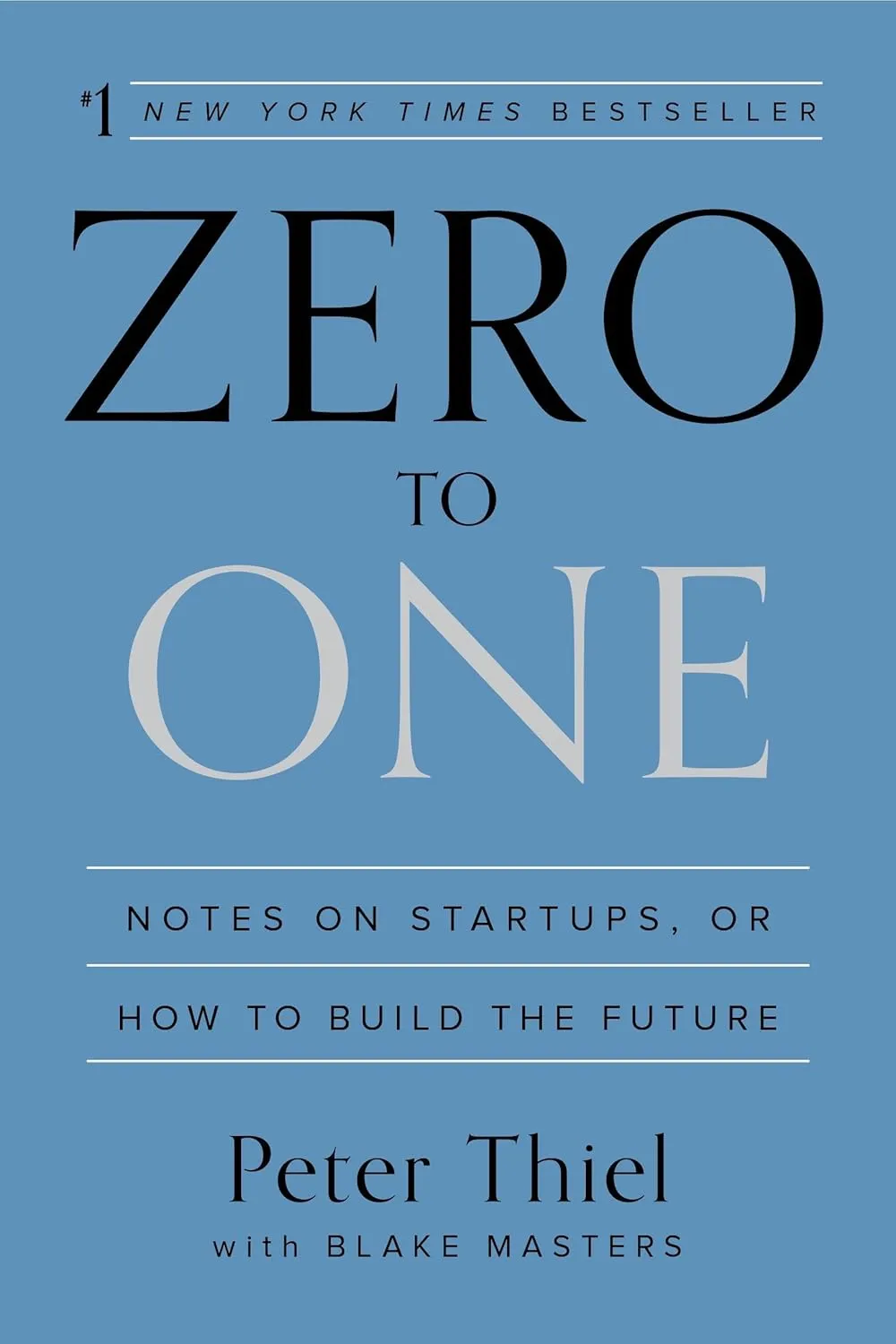
Peter Thiel co-founded PayPal, was the first outside investor in Facebook, and co-founded Palantir. Zero to One is adapted from a Stanford course he taught on startups. Its central argument is deliberately contrarian: competition is for losers. The most valuable companies are those that create monopolies in new markets, going from zero (nothing exists) to one (something new exists). Copying what already works (going from one to n) is far less valuable and far more competitive. I first read this book in 2015 when I was evaluating a SaaS startup investment, and Thiel's four-point monopoly framework helped me identify that the company lacked any defensible moat. I passed on the deal. The company folded 18 months later. In 2026, with AI startups proliferating at unprecedented rates, Thiel's framework has become more relevant than ever. As one Substack analysis put it, the book is "the most important strategy text of the AI era, and almost everyone building in AI today is violating its every principle."
Book Details
| Attribute | Details |
|---|---|
| Title | Zero to One |
| Authors | Peter Thiel & Blake Masters |
| Publisher | Crown Business |
| Published | 2014 |
| Pages | 224 |
| Reading Level | Intermediate |
| Amazon Rating | 4.5/5 stars |
Get Your Copy
Hardcover: Buy on Amazon
Kindle: Buy on Amazon
Audiobook: Buy on Amazon
About the Authors
Peter Thiel co-founded PayPal (sold to eBay for $1.5B in 2002), was the first outside investor in Facebook ($500K for 10.2% stake), co-founded Palantir Technologies, and founded Founders Fund. His net worth exceeds $5 billion. Blake Masters was a Stanford law student who took Thiel's course and organized his notes into the book.
Thiel's influence extends beyond investing. His "Competition Is for Losers" Wall Street Journal op-ed, adapted from the book, became one of the most quoted and most misunderstood ideas in modern startup culture. As Glasp's analysis explains, read casually it sounds like a defense of ruthlessness. Read carefully, it is an argument about economics: the fight most startups pick, a grinding battle against near-identical rivals, is a trap that guarantees thin margins and short lives.
The Core Argument: Monopoly vs. Competition
Competition Is for Losers
Thiel's most provocative argument: economics textbooks teach that perfect competition is ideal for society. From a business perspective, perfect competition is catastrophic. It drives all profits to zero.
The economics of competition vs. monopoly:
| Market Structure | Company Characteristics |
|---|---|
| Perfect competition | Many identical sellers; price = marginal cost; zero economic profit |
| Monopoly | Single seller; sets price; captures economic surplus |
Airlines compete intensely and collectively earn thin margins or lose money despite being essential infrastructure. Google is a monopoly in search and earns 20%+ operating margins. Which is the better business? Thiel's answer is obvious.
The rhetorical games companies play:
Monopolies pretend to face competition (to avoid antitrust scrutiny): Google describes itself as competing with all advertising businesses, all software companies, all consumer electronics companies. This makes it sound like Google faces intense competition.
Competitive companies pretend to be monopolies: a restaurant opening in New York City might say "there is no other authentic Thai fusion restaurant in the West Village." By defining the market narrowly enough, any business can appear unique. By defining it broadly enough, any monopoly appears competitive.
The investment implication:
When evaluating any business, identify its actual market position:
Businesses with genuine monopoly characteristics (pricing power, switching costs, network effects, scale advantages) consistently earn above-normal returns. Businesses in commodity-like competition rarely do.
The Characteristics of Monopoly
Thiel identifies four characteristics that make monopolies durable:
1. Proprietary Technology
A proprietary technology is at least 10x better than the closest substitute. 10x is Thiel's threshold because anything less is incrementally better, which can be competed around.
Examples of genuine 10x improvements:
| Company | Technology | How Much Better |
|---|---|---|
| Search algorithm | 10x more relevant results | |
| Amazon (early) | Bookstore | 10x more selection, often cheaper |
| iPhone | Smartphone UI | Dramatically simpler than alternatives |
| PayPal | Online payments | Made impossible transactions possible |
| Nvidia | GPU architecture | CUDA ecosystem, 10x training performance |
2. Network Effects
A product becomes more valuable as more people use it. This creates natural monopoly dynamics: the largest network is most valuable, attracting more users, growing further.
| Company | Network Effect |
|---|---|
| More friends on the platform, more valuable | |
| Visa/Mastercard | More merchants accepting, more cardholders, more merchants |
| Microsoft Office | More users, more file compatibility, more users |
| More contacts, more value for all users |
The paradox of network effects: the best network effect businesses start in small markets where they can dominate quickly. Facebook started at Harvard (one small, concentrated market) before expanding. If you try to build a global network from day one, you will fail to dominate any specific community.
3. Economies of Scale
Businesses with high fixed costs and low marginal costs become more profitable as they scale. Software is the extreme case: creating the software costs millions; copying it costs nothing.
| Business | Marginal Cost of Serving One More Customer |
|---|---|
| Software | Near zero |
| Digital media | Near zero |
| Physical manufacturing | Significant |
| Restaurants | Very significant (each unit requires full staff, location) |
Businesses with near-zero marginal costs can scale to global scope with minimal incremental cost, enabling monopoly capture at scale.
4. Branding
A strong brand creates genuine value through trust, associations, and customer loyalty that competitors cannot easily replicate.
Thiel's caveat on branding: building a brand without underlying substance is not a foundation. Apple's brand is powerful because it is built on real proprietary technology (hardware-software integration) and genuine design superiority, not just marketing.
The Startup Trajectory
Start Small and Monopolize
The correct startup strategy, according to Thiel:
The Thiel vs. Lean Startup contrast:
| Approach | Focus | Validation |
|---|---|---|
| Thiel (Zero to One) | Build what is definitively better; monopolize a small market | Conviction and proprietary insight |
| Ries (Lean Startup) | Build minimum viable product; iterate based on feedback | Customer validation |
Both are valid for different situations. Thiel's approach is better when you have a strong proprietary insight. Lean Startup is better when you are uncertain about customer needs.
The "Last Mover" Advantage
Thiel reframes "first mover advantage," the standard teaching that being first in a market is a durable advantage.
The first mover advantage is only valuable if you can maintain your position. Many first movers are displaced by better later entrants (MySpace to Facebook, Alta Vista to Google, Napster to iTunes/Spotify).
The last mover advantage: the company that establishes the final dominant position in a market earns all the durable value. Being last (in the sense of being the winner that no subsequent competitor displaces) is what matters.
The implication for startups: the question is not "can we be first?" but "can we build something that remains the dominant player indefinitely?"
The Power Law and Portfolio Investing
Venture Capital and the Power Law
Thiel addresses venture capital through the lens of power law distributions, the principle that outcomes are not normally distributed but follow a power law where a small number of outcomes dominate.
Venture capital return distribution:
| Portfolio Outcome | Frequency | Return |
|---|---|---|
| Total loss | 50-70% | -100% |
| Return of capital | 15-20% | ~0% |
| 2-5x return | 5-10% | Modest |
| 10-100x return | 3-5% | Large |
| 100x+ return | 1-2% | Enormous (drives all returns) |
A typical venture portfolio where 1-2% of investments return 100x will outperform a portfolio of consistent 10x returns. This is counterintuitive but mathematically true: the power law means the best investment in any portfolio is worth more than all the others combined.
Investment implication for public markets:
The same power law applies to public equity markets. Studies consistently find:
Thiel's power law perspective validates passive investing from an unexpected direction: the dominance of a few exceptional companies means most stock-picking is a loser's game. You can explore this further with our investment return calculator.
The Venture Investor's Decision Framework
If you manage a portfolio of investments, the power law has specific implications:
Wrong approach (diversification-driven): invest in 50 companies hoping that some work out. This provides statistical diversification but means you cannot meaningfully add value to any company and reduces your exposure to any single winner.
Thiel's approach (conviction-driven): invest in a small number of companies you believe have the potential to be the last dominant player in a large market. Hold long enough for the power law to operate.
The rule of thumb: every investment in a portfolio must have the potential to return the entire fund's value. If a $100M fund has 20 portfolio companies, each must have the potential to be worth $100M in your stake. If it cannot get there, do not invest regardless of how safe it seems.
The Definite vs. Indefinite Optimism Framework
Thiel introduces a useful 2x2 framework for thinking about society and investment:
| Optimistic | Pessimistic | |
|---|---|---|
| Definite | Plan for specific positive future; execute systematically | Plan for specific negative future; prepare systematically |
| Indefinite | Hope good things happen; no specific plan | Hope bad things don't happen; no specific plan |
The U.S. in different eras:
| Era | Stance |
|---|---|
| 1950s-60s | Definite optimistic (specific plans: moon, infrastructure, industrial policy) |
| 1970s | Definite pessimistic (specific plans: prepare for energy crisis, decline) |
| 1982-2007 | Indefinite optimistic (diversify, hope markets work out; no specific vision) |
| Post-2008 | Indefinite pessimistic (hedge everything; no positive specific vision) |
The investment application:
Indefinite optimism leads to passive, diversified portfolios (don't know what will succeed, so own everything). Definite optimism leads to concentrated positions based on specific views about where value will be created.
Thiel argues indefinite optimism produces below-optimal outcomes because it relies on processes (market mechanisms, statistical diversification) to generate results that only definite plans can actually produce.
In 2026, this framework feels especially relevant. The AI investment boom has produced what Stanford HAI's AI Index 2026 documented as $285.9 billion in U.S. private AI investment in 2025, with 1,953 newly funded AI startups. Much of this capital is deployed with indefinite optimism: investors do not know which AI companies will win, so they fund many and hope the power law sorts it out. Thiel would argue this is exactly the wrong approach.
The Secrets Framework
Thiel's most philosophical section: every successful company is built on a secret, something true that most people do not believe or do not know.
The test for any startup idea:
"What important truth do very few people agree with you on?"
Examples of valuable secrets:
| Company | The Secret |
|---|---|
| Airbnb | Strangers would rent rooms in each other's homes |
| Uber | People would get into cars with strangers |
| PayPal | Online payments could be made person-to-person cheaply |
| Tesla | Electric cars could be desirable, not just practical |
The secret types:
| Type | Description |
|---|---|
| Secrets about nature | Discoveries about how the physical world works |
| Secrets about people | Insights into what people want or how they behave |
Most valuable startups are built on secrets about people, what they want that they are not yet getting, or how they will behave when given a new option.
Zero to One in the AI Era: 2026 Validation and Stress Test
Thiel's framework has been tested dramatically by the AI boom of 2023-2026. The results are mixed: some principles have been validated powerfully, while others face new challenges.
Where Thiel's Framework Holds Up
Nvidia is the textbook Thiel monopoly in 2026. Its 87.4% share of merchant data center AI chip revenue in Q1 2026 ($75.2 billion in a single quarter) demonstrates all four monopoly characteristics:
| Thiel Characteristic | Nvidia's Position |
|---|---|
| Proprietary technology | CUDA ecosystem, 4M+ developers, 20+ years of software moat |
| Network effects | Every ML framework optimized for CUDA first; switching costs measured in years |
| Economies of scale | 60% of TSMC CoWoS capacity; R&D budget competitors cannot match |
| Branding | Nvidia = AI computing, the default currency of the AI boom |
As Silicon Analysts note, Nvidia's share is projected to decline from 87% to 75% by 2026 as custom silicon grows. But the total market is expanding so fast that Nvidia's absolute revenue continues to grow. This is the Thiel monopoly in its purest form.
Where the Framework Faces Challenges
The AI era has also revealed limits to Thiel's framework:
The Secrets Framework in 2026
Thiel's secrets framework may be the most durable element of the book in the AI era. As the Medium analysis argues, "AI can automate customer service" is not a secret. Everyone knows it. That is why there are hundreds of AI customer service companies, and why almost none of them will build anything defensible. The valuable secrets in 2026 are contrarian: specific vertical niches where AI creates genuine 10x improvements that generic AI tools cannot replicate.
Strengths & Weaknesses
What We Loved
Areas for Improvement
Who Should Read This Book
Highly Recommended For
Probably Not For
Comparison to Similar Books
| Book | Framework | Execution Detail | AI Relevance |
|---|---|---|---|
| Zero to One | Very High | Low | Very High (validated by Nvidia) |
| The Lean Startup | Medium | Very High | Medium |
| The Innovator's Dilemma | High | Medium | High |
| The Hard Thing About Hard Things | Low | Very High | Low |
Read Zero to One for the strategic framework. Read The Lean Startup for the execution playbook. Read The Innovator's Dilemma for why incumbents fail. They complement each other.
Implementation Guide
Applying Thiel's Framework in 2026
Step 1: Run the monopoly test on any business idea
Step 2: Apply the secrets test
Step 3: Start small and monopolize
Step 4: Think about the last mover advantage
Step 5: Apply the power law to your portfolio
Step 6: Choose definite over indefinite optimism
Frequently Asked Questions
Q: Does the monopoly argument only apply to technology companies?
A: No. Any business with proprietary advantages, network effects, or scale economics can be a monopoly. A local restaurant chain that dominates its geographic market has some monopoly characteristics. The principles apply broadly, though technology businesses tend to have more scalable monopoly characteristics.
Q: Is this book relevant for investors in public companies?
A: Yes, significantly. The monopoly characteristics Thiel describes (proprietary technology, network effects, scale, brand) correspond closely to Warren Buffett's economic moat concept. Identifying businesses with durable moats is the primary task of long-term equity investors.
Q: How does the framework apply to AI startups in 2026?
A: Thiel's framework is more relevant than ever, but also harder to execute. The barrier to building an AI product has collapsed, which means proprietary technology moats are shorter-lived. The startups that succeed are not building generic AI tools. They are building vertical-specific solutions with domain expertise, proprietary data, and network effects that compound over time. Nvidia is the ultimate validation of the framework. The hundreds of AI wrapper startups with no moat are the ultimate cautionary tale.
Q: Is Thiel's celebration of monopoly ethically problematic?
A: This is a fair criticism. Thiel uses "monopoly" in a specific sense: a company so good at what it does that no other firm can offer a close substitute. He is not advocating for anti-competitive behavior in the regulatory sense. But the OECD's 2026 report on AI markets shows that regulators are increasingly concerned about concentration in AI infrastructure, even if they have not yet found evidence of competitive harm. The line between "so good nobody can compete" and "so dominant nobody can compete" is blurrier than Thiel admits.
Final Verdict
Rating: 4.4/5
Zero to One is one of the most thought-provoking business books of the past decade. Its monopoly framework, power law analysis, and network effects treatment are each independently valuable. The 2026 AI boom has validated the framework (Nvidia is the textbook Thiel monopoly) while also exposing its limits (open-source models commoditize technology moats faster than Thiel anticipated). The book is stronger on identifying what to build than on how to build it, and Thiel's libertarian worldview will not resonate with every reader. But for entrepreneurs and investors who want to think more clearly about competitive dynamics and value creation, this remains essential reading. In the AI era, it may be the most important strategy book ever written.
Get Your Copy
Hardcover: Buy on Amazon
Kindle: Buy on Amazon
Audiobook: Buy on Amazon
Prices current as of publication date. Free shipping available with Prime.