*Disclosure: This article contains affiliate links. If you purchase through these links, we may earn a commission at no additional cost to you. We only recommend books we genuinely believe in.
Quick Overview
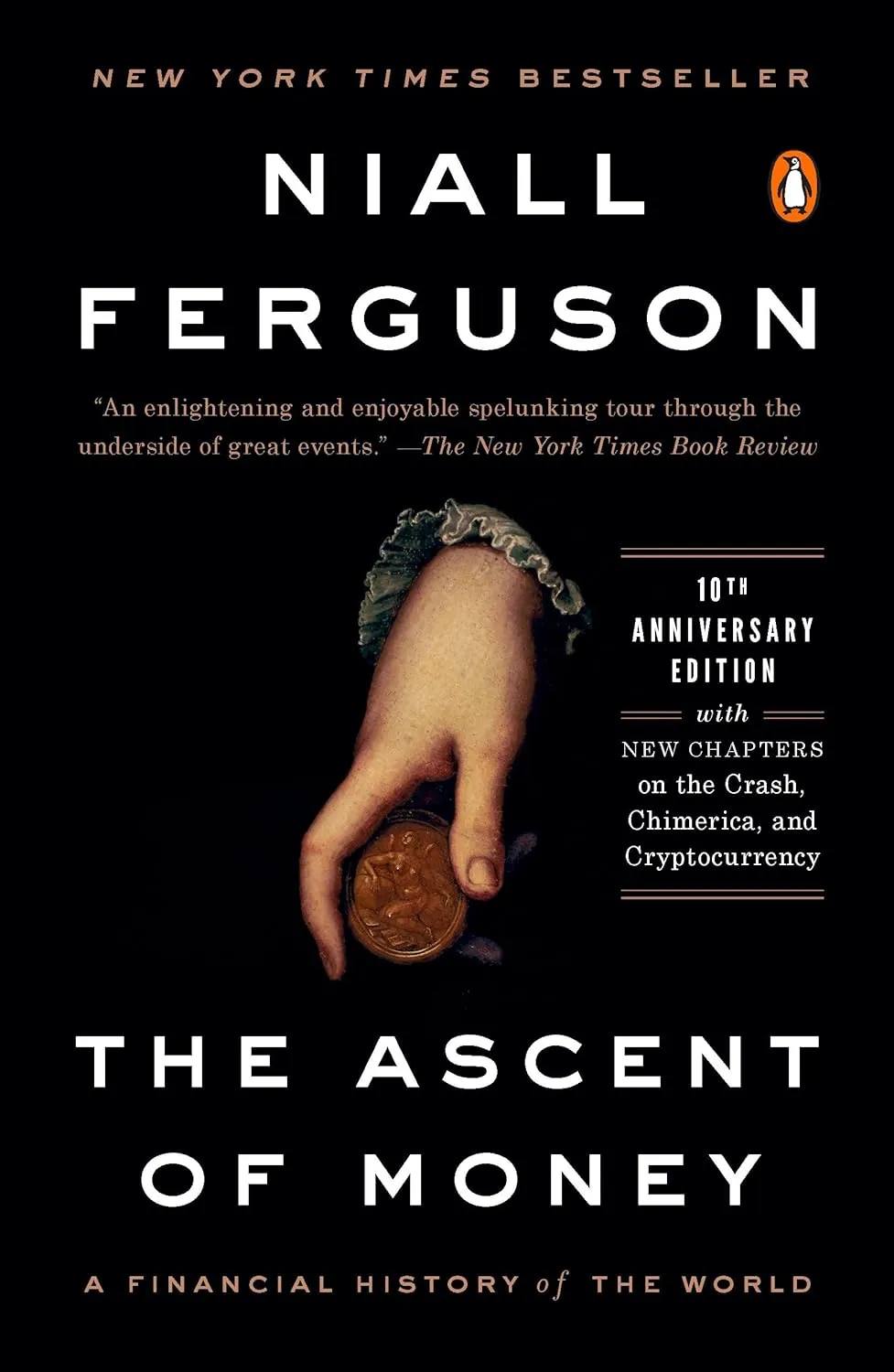
Niall Ferguson is the Milbank Family Senior Fellow at the Hoover Institution, Stanford, and one of the most prolific and controversial historians alive. The Ascent of Money traces the history of finance from ancient Mesopotamian grain receipts to 21st-century derivatives and hedge funds. Ferguson's thesis: financial innovation has been the engine of human progress, and the societies that developed the most sophisticated financial systems consistently outcompeted those that did not. The book was published in 2008, just as the global financial system was collapsing, giving its historical analysis immediate relevance. For investors, it provides the historical context that makes modern financial markets comprehensible. A 2025 Bank for International Settlements report on the evolution of credit markets echoed Ferguson's central point: every major financial innovation, from Renaissance banking to blockchain, follows the same arc of innovation, adoption, excess, and regulation.
Book Details
| Attribute | Details |
|---|---|
| Title | The Ascent of Money |
| Author | Niall Ferguson |
| Publisher | Penguin Books |
| Published | 2008 |
| Pages | 400 |
| Reading Level | Intermediate |
| Amazon Rating | 4.4/5 stars |
Get Your Copy
Paperback: Buy on Amazon
Kindle: Buy on Amazon
Audiobook: Buy on Amazon
About the Author
Niall Ferguson is the author of over a dozen books including The Pity of War, Empire, The House of Rothschild, and Civilization. He holds appointments at Stanford and Harvard and has been a visiting professor at Oxford. His television documentary series for Channel 4 and PBS accompanied this book. He is known for contrarian analysis grounded in extensive archival research.
The Financial Innovations That Built Civilization
Chapter 1: Credit, The Root of All Money
Ferguson traces credit to Mesopotamia circa 3000 BCE, where temples issued receipts for grain deposits that circulated as money. This was the first banking system: deposits, loans, and interest.
The Medici Bank and modern banking:
The Medici family of Florence created banking innovations in the 14th-15th centuries that are still with us:
Why credit matters for investment:
Credit enables investment that could not be funded from savings alone. The railroad boom of the 19th century, the electrification of America, and the tech boom of the 2000s were all funded substantially through credit. Understanding credit cycles, expansion, excess, contraction, is fundamental to understanding economic cycles. For a practical application, see our guide on how to build credit.
The compound interest demonstration Ferguson uses:
If the $24 paid to buy Manhattan Island in 1626 had been invested at 7% interest, it would be worth approximately $3.7 trillion by 2006, more than all the real estate in the United States. This is not an argument for buying Manhattan differently; it is a demonstration of what consistent long-run compounding produces. You can model this yourself with our compound interest calculator.
Chapter 2: Bonds, Masters of the Universe
Government bonds are among history's most important financial innovations. The ability to borrow against future tax revenues allowed governments to fund wars, infrastructure, and public goods that current tax revenues could not support.
The Medici financial network and papal finance:
The Medici bank's relationship with the papacy was one of history's first sovereign debt relationships. The Pope's creditworthiness was backed by the Church's assets and income across Europe, a proto-government bond market.
The Rothschild network and 19th-century bond markets:
The Rothschild family built the dominant bond distribution network across Europe by the early 19th century. Nathan Mayer Rothschild in London financed the British war effort against Napoleon and then profited from the news of Napoleon's defeat by trading British government bonds before the news became public.
The bond-equity relationship:
Ferguson explains the fundamental relationship between bonds and equities that every investor needs:
| Economic Condition | Bond Performance | Equity Performance |
|---|---|---|
| Falling inflation/rates | Very positive | Positive |
| Rising inflation/rates | Very negative | Mixed |
| Recession | Positive (safe haven) | Negative |
| Strong growth | Slightly negative | Very positive |
| Deflation | Positive (real value rises) | Very negative |
Understanding this relationship explains why a balanced portfolio reduces volatility without proportionally reducing long-run returns.
Chapter 3: Stock Markets, Blowing Bubbles
Ferguson traces the stock market from the first publicly traded company, the Dutch East India Company (VOC), founded in 1602, to the modern era.
The VOC as the first public company:
The Dutch East India Company issued shares to the general public in 1602. Shareholders received a claim on the company's profits from the spice trade with Asia. This solved the financing problem of long-duration ventures (ships might not return for 2-3 years) by allowing investors to diversify across multiple voyages and sell their stakes to others.
The Amsterdam exchange:
Amsterdam's securities exchange, established in the early 17th century, developed most of the features of modern stock markets:
Josephus Penso de la Vega's 1688 book Confusión de confusiones, the first book written about financial markets, describes practices that would be recognizable on any trading floor today.
The Mississippi Scheme and South Sea Bubble (1719-1720):
Both bubbles occurred simultaneously. John Law in France and the South Sea Company in Britain each used financial engineering to convert government debt into equity, inflating an enormous bubble. Both collapsed within months of each other, destroying fortunes across Europe.
Ferguson's key observation: The pattern of speculative manias has not changed in 400 years. The instruments change (tulips, South Sea shares, railroad bonds, internet stocks, mortgage CDOs), but the psychology, greed amplified by easy credit during periods of optimism followed by panic, is identical across every era. For more on this pattern, read our review of Devil Take the Hindmost.
Chapter 4: Insurance, Free to Choose
Ferguson traces the history of insurance from the early marine insurance markets of the Mediterranean to modern hedge funds (which he argues are essentially sophisticated insurance vehicles).
Lloyd's of London:
In the 1680s, Edward Lloyd's coffee house in London became the gathering place for merchants and ship captains. Underwriters who accepted insurance risk wrote their names and the premium they would accept under the policy's terms, hence "underwriting." Lloyd's became the dominant marine insurance market and is still operational today.
Life insurance and the Widows' Fund:
Scottish ministers in the 1740s invented the first actuarially sound life insurance scheme to provide pensions for ministers' widows. This Scottish Widows' Fund (still operating) was founded on the principle that mortality could be predicted statistically even if an individual's death date could not.
The actuarial revolution:
The insight that risk in aggregate is predictable even when individual events are not is foundational to all insurance and much of modern finance. This same insight underlies:
The failure of insurance models:
Ferguson notes that insurance models fail when the assumption of independence among risks breaks down. Auto insurance works because car accidents are largely independent: one driver having an accident does not make others more likely. The 2008 financial crisis demonstrated that mortgage defaults were highly correlated (not independent): when housing declined nationally, all mortgages were affected simultaneously. The insurance model (credit default swaps) that priced them as independent failed catastrophically. For a deeper dive into this failure, read our review of The Big Short.
Chapter 5: Real Estate, Safe as Houses?
Ferguson examines the history of real estate as an investment and the periodic manias it generates.
The homeownership ideology:
The U.S. policy of promoting homeownership (from the Federal Housing Administration in 1934 through the Community Reinvestment Act to Fannie Mae and Freddie Mac) fundamentally shaped the 2008 crisis. Political support for homeownership led to policies that made mortgages available to increasingly marginal borrowers.
The rent vs. buy calculation:
Ferguson provides the calculation that most first-time homebuyers never do:
| Cost | Ownership | Renting |
|---|---|---|
| Monthly payment | Mortgage + taxes + insurance + maintenance | Rent |
| Opportunity cost | Equity tied up in down payment | Invested elsewhere |
| Transaction costs | 5-8% on purchase and sale | Minimal |
| Flexibility | Low | High |
| Leverage | Built-in (mortgage) | None |
| Hedge against rent inflation | Yes | No |
The rent vs. buy decision is not obviously in favor of buying, particularly in expensive cities where price-to-rent ratios are high. The formula: price-to-rent ratio above 20 (annual rent × 20 = purchase price) suggests renting is likely preferable in financial terms.
Real estate as an inflation hedge:
Real estate provides a genuine inflation hedge because:
However, real estate is an imperfect inflation hedge because:
Chapter 6: International Finance, Chimerica
Ferguson's most original contribution is his concept of "Chimerica," the symbiotic relationship between China and America that characterized the 2000s:
The global imbalances table (circa 2006):
| Country | Current Account Balance | Foreign Exchange Reserves |
|---|---|---|
| United States | -$800B (deficit) | Minimal |
| China | +$250B (surplus) | $1 trillion+ |
| Japan | +$170B (surplus) | $900B+ |
| Germany | +$150B (surplus) | Moderate |
| Oil exporters | +$450B (surplus) | Growing rapidly |
The surplus countries recycled their surpluses into U.S. dollar assets, particularly Treasury bonds. This kept U.S. long-term interest rates lower than domestic conditions alone would have produced, enabling the credit boom.
Ferguson's Investment Framework
From the historical patterns Ferguson documents, several investment principles emerge:
The Financial History Checklist
Before making any major investment decision, Ferguson's history suggests asking:
| Question | What to Look For |
|---|---|
| What does credit expansion look like? | If credit is expanding rapidly, bubble conditions may be developing |
| What is the bond-equity relationship signaling? | Rising long rates = headwind for equities; falling rates = tailwind |
| Where are we in the insurance cycle? | Cheap insurance = risk underpriced; expensive = risk fully priced |
| What are real estate price-to-rent ratios? | Above 20x = overvalued; below 10x = undervalued |
| What global imbalances exist? | Persistent imbalances tend to resolve, often disruptively |
The Long-Run Returns Chart
Ferguson provides long-run asset return data that reinforces the case for equity ownership:
| Asset Class | Real Return (inflation-adjusted, long-run U.S. average) |
|---|---|
| Equities | ~6.5-7% per year |
| Corporate bonds | ~2-3% per year |
| Government bonds | ~1-2% per year |
| Cash/T-Bills | ~0.5-1% per year |
| Gold | ~0.5-1% per year |
| Real estate (housing) | ~1% per year (Shiller data) |
Over long periods (20+ years), equities have dramatically outperformed every other asset class. This is the empirical foundation for the case for equity investing.
Strengths & Weaknesses
What We Loved
Areas for Improvement
Who Should Read This Book
Highly Recommended For
Probably Not For
Final Verdict
Rating: 4.5/5
The Ascent of Money is the most ambitious financial history book written for general readers. Its sweep from Mesopotamia to 2008 provides unique context for understanding modern financial markets. The Chimerica concept, the insurance chapter, and the long-run asset return data are each individually valuable.
If you want to understand why financial markets work the way they do, this book is the best starting point. The patterns Ferguson documents from centuries of financial history are still playing out today. For investors who want to apply these historical lessons practically, our guide on asset allocation shows how to put the principles into practice.
Get Your Copy
Paperback: Buy on Amazon
Kindle: Buy on Amazon
Audiobook: Buy on Amazon
Prices current as of publication date. Free shipping available with Prime.