*Disclosure: This article contains affiliate links. If you purchase through these links, we may earn a commission at no additional cost to you. We only recommend books we have personally read and genuinely believe in.
Quick Overview
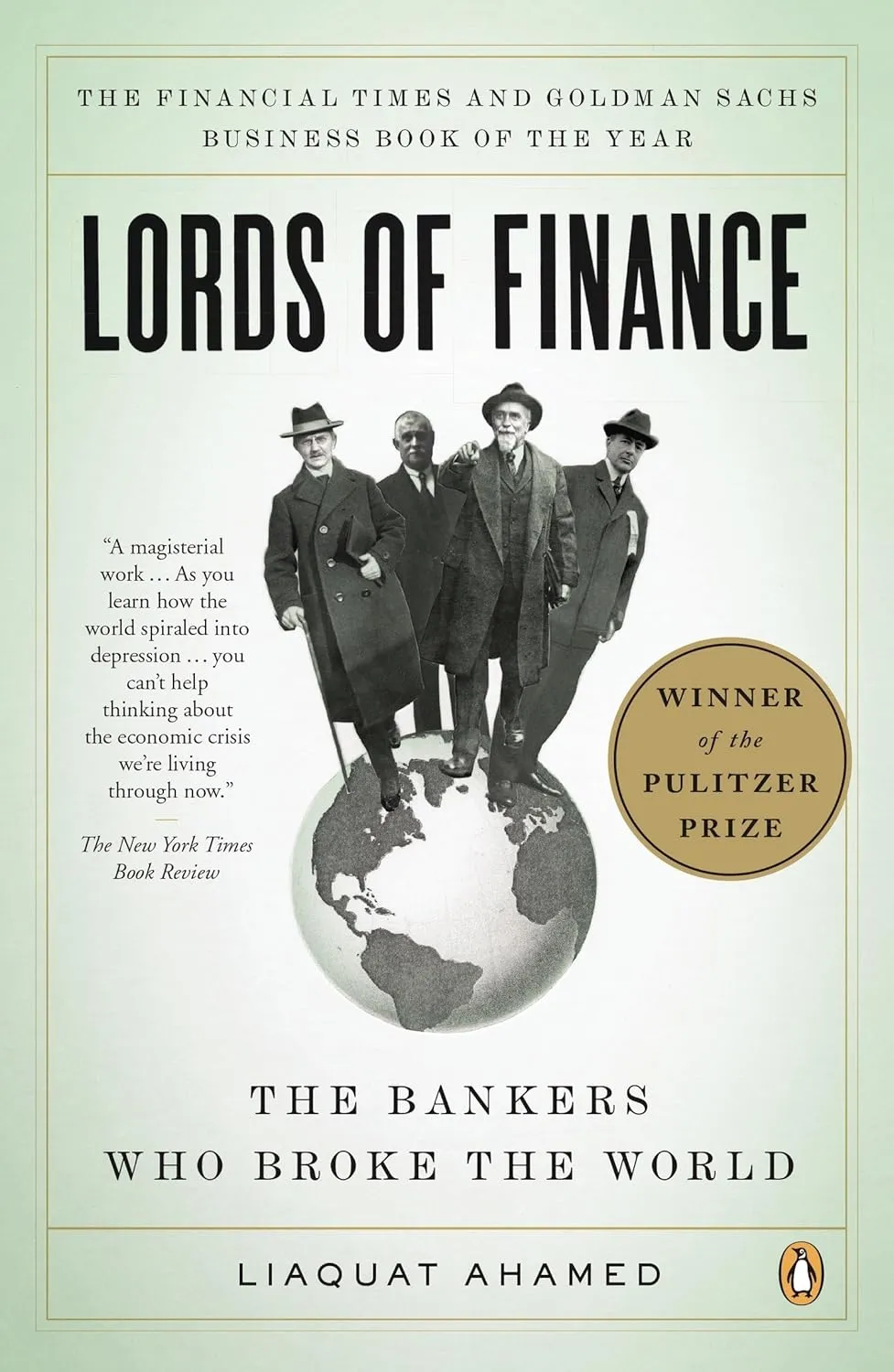
Four men had the power to prevent the Great Depression and failed. Liaquat Ahamed tells the story of the four central bankers who shaped monetary policy in the 1920s and 1930s: Montagu Norman (Bank of England), Benjamin Strong (Federal Reserve), Émile Moreau (Banque de France), and Hjalmar Schacht (Reichsbank). Their decisions on interest rates, gold reserves, and currency pegs turned a severe recession into the worst economic catastrophe in modern history. Lords of Finance won the 2010 Pulitzer Prize for History and remains the clearest explanation of how monetary policy errors amplify financial crises.
The book's relevance has only grown. Ahamed published a new book in 2025, 1873: The First Great Depression, which traces the railroad boom and bust of the 1870s. In a 2025 interview with the Financial Times, he drew explicit parallels between the railroad speculation of 1873, the dot-com bubble of 2000, and the AI spending boom of 2024-2026. His framework for understanding how monetary systems transmit financial shocks into economic catastrophes applies directly to debates about Federal Reserve policy in 2026.
Book Details
| Attribute | Details |
|---|---|
| Title | Lords of Finance |
| Author | Liaquat Ahamed |
| Publisher | Penguin Books |
| Published | 2009 |
| Pages | 576 |
| Reading Level | Intermediate |
| Pulitzer Prize | History, 2010 |
| Amazon Rating | 4.7/5 stars |
Get Your Copy
Paperback: Buy on Amazon
Kindle: Buy on Amazon
Audiobook: Buy on Amazon
About the Author
Liaquat Ahamed spent his career as a professional investment manager at the World Bank and as a principal at Fischer Francis Trees & Watts, a fixed-income investment management firm. His background in finance and economics makes his historical analysis unusually technically sophisticated. Lords of Finance was his first book, followed by 1873: The First Great Depression (2025), which extends his analysis to the railroad boom and panic of the 1870s. He holds a PhD in economics from Harvard.
The Four Central Bankers
Benjamin Strong (Federal Reserve Bank of New York)
Strong was the dominant figure in American central banking from 1914 until his death in 1928. Brilliant, charismatic, and internationally respected, he was the only American central banker taken seriously by his European counterparts. His death in October 1928, just one year before the crash, is one of history's great what-ifs.
Strong's policy record:
The 1927 Decision:
At a secret meeting in Long Island in 1927, Strong and the three European central bankers agreed to coordinate monetary policy. Strong would cut U.S. interest rates to help Britain stay on the gold standard. The rate cut worked, but it may also have fueled the speculative boom that preceded the 1929 crash. The parallel to the Fed's rate cuts in response to economic stress while asset prices are elevated is not lost on modern readers. In 2025-2026, the Fed faced a similar tension: inflation was cooling but asset prices, particularly AI-related stocks, were at record highs.
Montagu Norman (Bank of England)
Norman served as Governor of the Bank of England for 24 years (1920-1944), the longest tenure in the institution's history. Brilliant but neurotic, he was obsessed with restoring Britain to the gold standard at the prewar parity rate of $4.86 to the pound.
The 1925 Mistake:
Winston Churchill, as Chancellor of the Exchequer, returned Britain to the gold standard at the prewar rate in 1925 on Norman's advice. John Maynard Keynes publicly argued this was a mistake. The pound was overvalued at $4.86, which would cripple British exports and force deflation.
Keynes was right. British exports became uncompetitive. Unemployment remained stuck at 10%+ throughout the late 1920s, even during the global boom. When the Depression hit, Britain's already-weakened economy had no buffer.
The lesson: Returning to the gold standard at the prewar parity rate required British workers to accept wage cuts proportional to the overvaluation. When they refused (as the General Strike of 1926 demonstrated), the adjustment happened through unemployment instead. Currency policy has real human consequences.
Hjalmar Schacht (Reichsbank)
Schacht was the financial genius who ended Germany's hyperinflation in 1923 with a single brilliant technical stroke, and then presided over the buildup to the next crisis.
The Hyperinflation (1921-1923):
Germany printed money to pay World War I reparations to France and Britain. The result was the most dramatic hyperinflation in modern history:
| Date | Marks per Dollar |
|---|---|
| January 1921 | 64 |
| July 1922 | 493 |
| January 1923 | 17,972 |
| July 1923 | 353,412 |
| November 1923 | 4,200,000,000,000 |
A loaf of bread cost 200 billion marks. Workers were paid twice daily and immediately spent their wages before prices rose further. Savings of a lifetime were destroyed in weeks.
Schacht's Solution:
Schacht introduced the Rentenmark in November 1923, backed by a mortgage on all German agricultural and industrial land (not gold, which Germany did not have). He fixed the exchange rate at 1 trillion old marks = 1 new Rentenmark. The hyperinflation stopped almost overnight through the credibility of the new currency and strict controls on money creation.
The Lasting Damage:
The hyperinflation destroyed the savings of Germany's middle class and created a deep institutional memory of inflation that persists in German economic policy to this day. The Bundesbank's famous inflation aversion, and Germany's pushback against ECB money creation during the Eurozone crisis, are direct descendants of 1923. This institutional memory is why Germany has been the most hawkish member of the European Central Bank on inflation in 2025-2026, even as other Eurozone members push for rate cuts.
Émile Moreau (Banque de France)
The least well-known of the four, Moreau represented French interests that were fundamentally different from Britain's and America's. France emerged from World War I with the most gold reserves in Europe (having converted paper reparations claims into gold) and a conservative monetary tradition.
France's role in the Depression:
France's accumulation of gold in the late 1920s contributed to the global deflationary pressure that deepened the Depression. By pulling gold out of international circulation into the Banque de France's vaults, France tightened global monetary conditions at precisely the moment they needed to be loosened.
The Gold Standard: The Mechanism of Catastrophe
Ahamed's most important contribution is explaining clearly why the gold standard transformed a financial crisis into the Great Depression.
How the Gold Standard Works
Under the gold standard, each currency is pegged to gold at a fixed rate. Central banks must maintain gold reserves sufficient to back their currency in circulation. This limits money creation to the amount of gold held.
The adjustment mechanism (theory):
| Country with Trade Deficit | Country with Trade Surplus |
|---|---|
| Exports less than imports | Exports more than imports |
| Gold flows out | Gold flows in |
| Money supply contracts | Money supply expands |
| Prices fall (deflation) | Prices rise (inflation) |
| Exports become cheaper | Imports become cheaper |
| Balance restores | Balance restores |
In theory, the gold standard is self-correcting. In practice, it was far more painful than the theory suggested. I found this section of the book particularly relevant when thinking about modern debates over monetary policy. The gold standard was the 1920s equivalent of a rules-based monetary system: automatic, rigid, and unable to respond to crises. The parallel to modern debates about algorithmic stablecoins and fixed-supply cryptocurrencies is striking.
Why the Gold Standard Made the Depression Worse
When the 1929 crash triggered bank failures and credit contraction, central banks faced a terrible choice:
Option 1: Let money supply contract (follow gold standard rules)
Option 2: Abandon gold standard, expand money supply
The Federal Reserve, Bank of England, and other central banks chose Option 1, maintaining gold convertibility at the cost of allowing the Depression to deepen. Milton Friedman and Anna Schwartz's A Monetary History of the United States demonstrated that the Fed's failure to offset the contraction in private credit with money creation was the primary cause of the Great Depression's severity. This analysis was later confirmed and extended by Ben Bernanke's own academic research in the 1980s, which showed that deflation and the debt-deflation spiral (described by Irving Fisher) were the key transmission mechanisms.
The evidence:
| Country | Abandoned Gold Standard | Subsequent Recovery |
|---|---|---|
| United Kingdom | 1931 | Recovery began immediately |
| United States | 1933 (FDR) | Recovery began after abandonment |
| France | 1936 (last to leave) | Depression most severe |
Countries that left the gold standard earliest recovered soonest. The gold standard was the mechanism that transmitted financial crisis into economic catastrophe.
The 1929-1933 Banking Crisis
Ahamed provides a clear account of the banking crisis that was the proximate cause of the Depression's severity.
The Mechanism of Bank Runs
In 1929-1933, the United States had no deposit insurance. When rumors spread that a bank was in trouble, depositors rushed to withdraw before the bank ran out of cash. The very act of withdrawal could make the bank insolvent, a self-fulfilling prophecy.
The cascade:
The Fed, under its new and weaker leadership after Strong's death, failed to provide liquidity to solvent banks facing runs. This failure allowed liquidity crises to become solvency crises. The same dynamic appeared in the March 2023 banking crisis, when Silicon Valley Bank, Signature Bank, and First Republic failed in rapid succession. The Fed's emergency lending facilities prevented a broader panic, but the episode demonstrated that bank runs remain a structural risk even with modern safeguards. For practical guidance on protecting your deposits, see our guide to FDIC insurance limits.
The Lesson for 2008 and 2023
Ben Bernanke, Federal Reserve Chairman from 2006-2014, was the world's leading academic expert on the Great Depression. When 2008 arrived, he explicitly drew on Kindleberger's and Friedman's analysis:
The 2008 financial crisis was as severe in financial terms as 1929. The economic outcome was dramatically less severe because the 2008 policy response was informed by the 1929 failure. Lords of Finance explains why this comparison matters.
The March 2023 banking crisis (SVB, Signature, First Republic) tested the same principles. The Fed's emergency Bank Term Funding Program provided liquidity against Treasury collateral at par value, preventing the fire-sale dynamic that deepened the 1930s crisis. The episode validated the lessons Bernanke drew from the Depression. For a deeper look at how the Fed manages crises, read our guide to how the Federal Reserve works.
The Policy Lessons
Lesson 1: Monetary Policy Errors Can Amplify Financial Crises Into Depressions
The Great Depression was not an inevitable consequence of the 1929 crash. It was made catastrophic by specific policy errors, chiefly the failure to provide liquidity during bank runs and the contractionary effects of gold standard adherence.
For investors: The central bank's response to financial crises matters enormously. The 1929 policy failure extended the Depression for a decade. The 2008 policy response (aggressive and immediate) limited the economic damage to a severe two-year recession. The 2023 response (emergency lending facilities) contained the regional bank crisis within weeks. Understanding how the Fed responds to crises helps investors position their portfolios. For a practical tool, see our investment return calculator.
Lesson 2: The Gold Standard Was Deflationary and Unstable
The gold standard's appeal (it prevented governments from printing money irresponsibly) came at a cost: it removed the monetary flexibility to respond to economic shocks. When a shock required monetary expansion, the gold standard prevented it.
Modern relevance: Cryptocurrency advocates sometimes propose Bitcoin as a modern gold standard, with fixed supply and no central authority to inflate it. Lords of Finance is the most powerful rebuttal: fixed monetary supply is a feature in stable times and a catastrophe during crises. Ahamed made this point explicitly in a 2025 interview, noting that the 1870s railroad boom, like the 2020s AI boom, was fueled by easy money that a rigid monetary system would have been unable to absorb. For more on crypto risks, see our guide to what is cryptocurrency.
Lesson 3: International Monetary Coordination Is Difficult But Essential
The four central bankers of the 1920s understood that their currencies were interdependent through the gold standard. But their national interests frequently conflicted. France accumulated gold at Britain's expense. Britain maintained an overvalued pound that crippled its economy. The United States cut rates in 1927 partly to help Britain, possibly fueling its own bubble.
Modern relevance: The 2008 crisis required unprecedented international coordination: coordinated rate cuts, currency swap lines between central banks, and G20 fiscal stimulus agreements. The failure modes documented in Lords of Finance were explicitly in policymakers' minds. The 2023 banking crisis similarly required international cooperation, with the Fed and other central banks coordinating dollar swap lines to prevent global dollar shortages.
Strengths and Weaknesses
What We Loved
Areas for Improvement
Who Should Read This Book
Highly Recommended For
Probably Not For
Frequently Asked Questions
Q: Do I need economics background to read this?
A: No. Ahamed explains monetary concepts clearly as he goes. The narrative is accessible to general readers.
Q: Why did Bernanke say "We won't do it again" at Friedman's 90th birthday?
A: Bernanke was acknowledging that the Fed's contractionary policy during 1929-1933 was the primary cause of the Depression's severity. His "we won't do it again" referred to the Fed's commitment to provide liquidity in future crises, a commitment he honored in 2008. The 2023 banking crisis tested the same principle under different conditions, and the Fed's emergency response again validated the lesson.
Q: Should I read Lords of Finance or Ahamed's newer book 1873 first?
A: Start with Lords of Finance if you are interested in the Great Depression and modern central banking. Start with 1873 if you are more interested in how speculative booms (railroads then, AI now) interact with monetary systems. Both are excellent. Lords of Finance is the more polished narrative. 1873 is more directly relevant to current events.
Final Verdict
Rating: 4.8/5
Lords of Finance is the finest financial history book written in the last two decades. Its narrative quality is exceptional, its monetary analysis is technically sound, and its relevance to understanding modern central banking is direct. With Ahamed's 2025 follow-up 1873 extending the analysis to the railroad boom and drawing parallels to the AI spending boom, the framework he built in Lords of Finance has proven adaptable to each new financial era. Essential reading for any investor who wants to understand why the Federal Reserve behaves as it does.
Get Your Copy
Paperback: Buy on Amazon
Kindle: Buy on Amazon
Audiobook: Buy on Amazon
Prices current as of publication date. Free shipping available with Prime.
For more on financial history and investing, read our guide to how the Federal Reserve works and why bonds matter in your portfolio.