*Disclosure: This article contains affiliate links. If you purchase through these links, we may earn a commission at no additional cost to you. We only recommend books we genuinely believe in.
Quick Overview
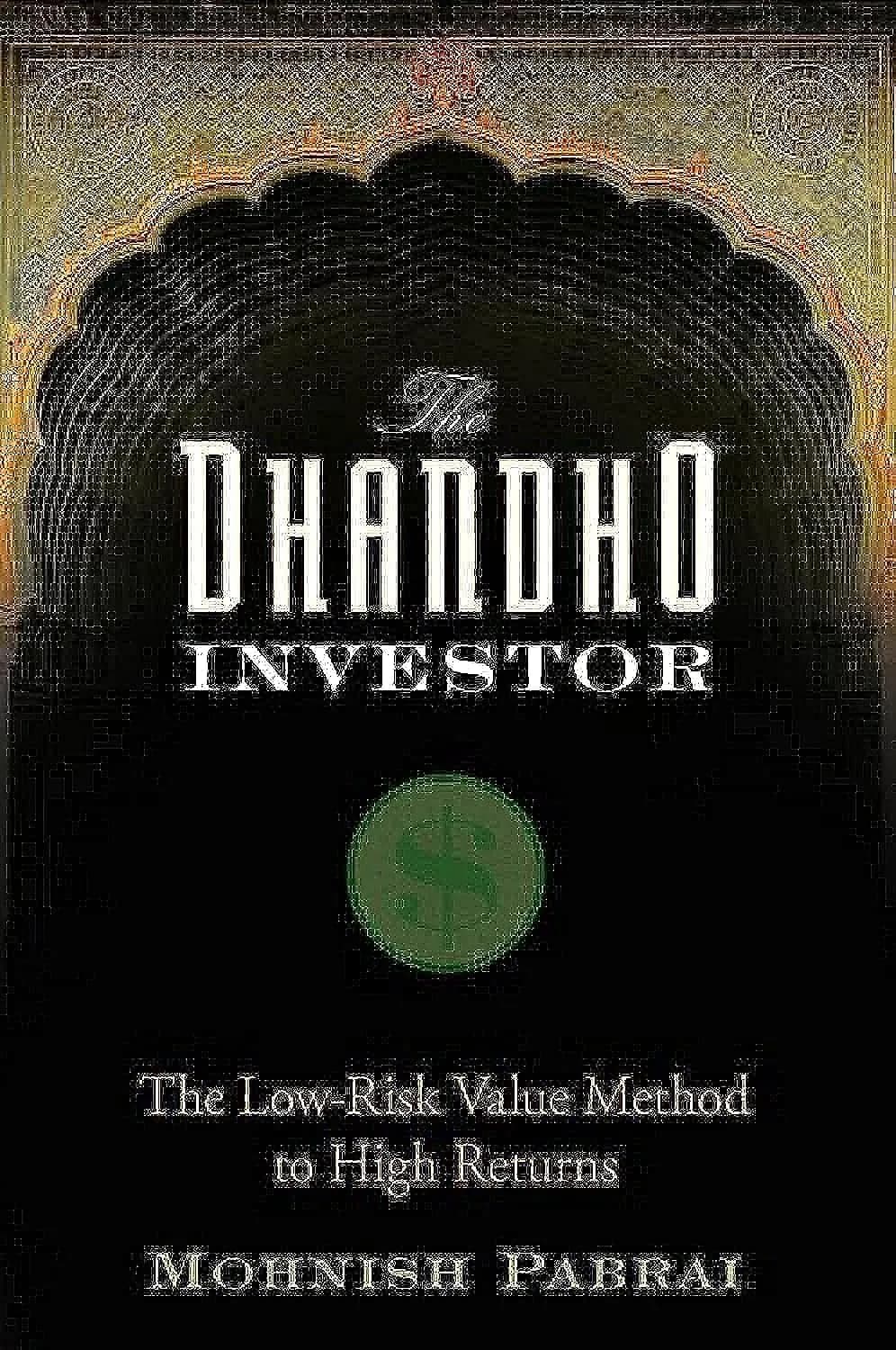
I read The Dhandho Investor in 2018, and it changed how I think about position sizing. Mohnish Pabrai is an Indian-American investor who runs Pabrai Investment Funds. His approach is openly derivative of Buffett and Munger, but he synthesizes it through the lens of Gujarati business culture. "Dhandho" means business in Gujarati, specifically the low-risk, high-return entrepreneurial style of Indian immigrants who built motel businesses across America. The result is one of the most original and practical value investing books written in the last 20 years. At 208 pages, it is a fast read with ideas that stick.
Book Details
| Attribute | Details |
|---|---|
| Title | The Dhandho Investor |
| Author | Mohnish Pabrai |
| Publisher | Wiley |
| Published | 2007 |
| Pages | 208 |
| Reading Level | Intermediate |
| Amazon Rating | 4.6/5 stars |
Get Your Copy
Hardcover: Buy on Amazon
Kindle: Buy on Amazon
About the Author
Mohnish Pabrai was born in India, moved to the United States, built an IT consulting business (TransTech), sold it in 2000, and used the proceeds to start Pabrai Investment Funds. He has no formal finance credentials. His investing education came entirely from reading, primarily Buffett, Munger, and Graham. He famously paid $650,000 at a charity auction in 2008 for lunch with Warren Buffett, alongside Guy Spier (who wrote The Education of a Value Investor). His intellectual honesty about cloning Buffett's approach rather than inventing his own is unusual and refreshing.
As of mid-2026, Pabrai manages approximately $1.2 billion across private partnerships and ETF assets. His estimated net worth is around $150 million. He remains active and vocal about his positions, sharing his thinking freely in quarterly letters and interviews.
The Dhandho Framework
The Origin Story: Patels and Motels
The book opens with the story of how Gujarati immigrants from India came to own a disproportionate share of American motels. Starting in the 1970s and accelerating through the 1980s and 1990s, immigrants from the Patel community bought distressed motels using a specific financial structure:
The Patel motel economics (simplified):
| Item | Value |
|---|---|
| Motel purchase price | $500,000 |
| Down payment (own capital) | $50,000 |
| Seller financing | $450,000 |
| Annual revenue | $200,000 |
| Annual expenses (family-operated) | $150,000 |
| Annual cash flow | $50,000 |
| Return on invested capital | 100% per year |
| Downside if everything fails | Loss of $50,000 |
The Patel structure achieved enormous returns on equity because the downside was limited (worst case, the bank forecloses and they lose the down payment) while the upside was uncapped (successful motels funded a chain). This is the core of Dhandho: limited downside, uncapped upside.
The Dhandho Principles
Pabrai derives nine investing principles from the Patel model:
Heads I Win, Tails I Do Not Lose Much
Pabrai's central investment principle, expressed through Kelly Criterion logic:
The Kelly Criterion
The Kelly Criterion (developed by John Kelly at Bell Labs in 1956) tells you the optimal fraction of capital to bet on a favorable wager:
Kelly % = (Probability of Win x Win Amount - Probability of Loss x Loss Amount) / Win AmountExample:
Pabrai uses Kelly logic to size positions: the more asymmetric the payoff (large upside, small downside), the larger the position.
Finding Asymmetric Payoffs
The ideal Pabrai investment has:
| Characteristic | Target |
|---|---|
| Downside | Limited to 20-25% of investment |
| Upside | 2-3x or more over 3-5 years |
| Probability of success | 80%+ |
| Estimated Kelly size | 20-30% of portfolio |
The heads/tails framing:
A situation where:
Is an extraordinary bet. You risk $1 to potentially gain $2, with 80% probability of heads. Pabrai looks for these asymmetries in distressed businesses where the worst case is already partially priced in.
The Nine Dhandho Principles Applied
Principle: Invest in Distressed Businesses in Distressed Industries
Pabrai is explicit: the best investments are found when both the specific company and its industry are under maximum stress.
Historical examples of industry distress creating opportunity:
| Industry | Distress Period | Recovery |
|---|---|---|
| Airlines | 2001-2002 (post-9/11) | Southwest and JetBlue earned exceptional returns |
| Financials | 2008-2009 | Banks at 20-40% of book value recovered to full value |
| Energy | 2015-2016 | Oil majors and quality E&Ps tripled from trough |
| Hotels | 2020 (COVID) | Marriott, Hilton recovered 100%+ from lows |
The key filter: is the distress temporary (cyclical, event-driven) or permanent (structural obsolescence)? Buying airlines in 2002 was a temporary distress play. Buying Blockbuster Video in 2008 was a structural obsolescence mistake. For more on identifying cyclical vs. structural distress, read our blog post on spotting value traps.
Principle: Few Bets, Big Bets, Infrequent Bets
Pabrai explicitly rejects diversification for investors doing genuine fundamental research:
His portfolio concentration approach:
| Position | Size |
|---|---|
| Highest conviction | 10-20% of portfolio |
| High conviction | 5-10% |
| Monitoring position | 1-2% |
| Maximum positions | 10-15 |
| Minimum positions | 5-6 |
Pabrai's argument: if you have thoroughly researched 10 companies and have high conviction in all 10, spreading capital equally across 50 companies adds diversification but reduces returns. The 40th-best idea always earns less than the 10th-best idea.
The Buffett partnership letters validation:
Buffett managed his partnership with extreme concentration in the 1950s and 1960s, often putting 25-40% of the fund in a single idea. His early performance (50%+ annualized) reflected this concentration. His later performance at Berkshire (20%+ for decades) reflected both concentration and the compounding advantages of size.
Principle: Invest in Low-Risk, High-Uncertainty Businesses
Pabrai's most important conceptual contribution is separating risk from uncertainty:
| Concept | Definition | Investor Response |
|---|---|---|
| Risk | Probability and magnitude of permanent capital loss | Must be low |
| Uncertainty | Range of possible outcomes | Can be wide |
A stock can have enormous uncertainty (the outcome is unclear) while having low risk (the downside is limited). Investors confuse uncertainty with risk, selling stocks with wide outcome ranges even when the downside is protected. This confusion is a persistent source of mispricing.
Practical example:
A pharmaceutical company awaiting FDA approval for a cancer drug:
Most investors see the uncertainty and pass. Pabrai sees the asymmetry and buys.
The Cloning Approach
One of the book's most distinctive sections: Pabrai argues that individual investors should study and clone the positions of great investors rather than inventing original ideas.
The cloning logic:
Pabrai's 13-F cloning strategy:
Limitation: 13-F filings only show long equity positions, not options, shorts, or non-U.S. positions. The filing is 45 days after quarter-end. A position disclosed may already be partially exited.
Case Studies from Pabrai Funds
Stewart Enterprises
Stewart was a funeral home operator trading at 3-4x earnings when Pabrai invested. The business had pricing power (death is inelastic demand), high switching costs (emotional attachment to service providers), and a predictable cash flow stream. The stock doubled within two years as the market recognized its franchise characteristics.
The funeral industry moat:
| Characteristic | Value |
|---|---|
| Demand inelasticity | People will always need funeral services |
| Local monopoly | First-call position in each community |
| Pre-need contracts | Locks in future revenue |
| Emotional switching cost | Families rarely switch providers mid-arrangement |
Frontline Ltd.
Frontline was an oil tanker company Pabrai invested in during a cyclical downturn. The thesis: tanker rates are cyclical, and at trough rates with a well-capitalized balance sheet, the stock was trading at a fraction of its normalized earnings power. The position tripled within 18 months as tanker rates recovered.
The cyclical investment framework:
Pabrai's Track Record: The Uncomfortable Truth
The book presents Pabrai's early track record as evidence that the Dhandho framework works. His first eight years (1999-2007) saw annualized returns of 29%+, extraordinary by any standard. But the post-publication record is more complicated and worth examining honestly.
The drawdowns:
| Period | Drawdown | Context |
|---|---|---|
| 2007-2009 | -65% | Financial crisis; concentrated portfolio amplified losses |
| 2018-2020 | -50% | Multiple positions went against him simultaneously |
| Q1 2025 | -17.95% | Pabrai Wagons Fund vs. S&P 500's -4.27% |
The recovery:
Pabrai's private funds recovered from both the 2008 and 2018 drawdowns, and his long-term track record remains strong. The Pabrai Wagons Fund (launched September 2023) reported a YTD return of +12.12% as of Q2 2026, slightly ahead of the S&P 500's +10.21%. But the fund was "meaningfully behind the S&P 500 since inception" as of Q1 2025, and the gap only narrowed in recent quarters.
What the track record tells us:
The Dhandho framework is sound in principle. Buying distressed assets with limited downside and uncapped upside is a legitimate strategy. But Pabrai's real-world results demonstrate the cost of concentration: the same approach that produces 29% annualized returns in good periods also produces 65% drawdowns in bad ones. The book underweights this reality. "Heads I win, tails I do not lose much" sounds great in theory, but in 2008, tails meant losing two-thirds of your capital.
2026 portfolio positioning: As of Q2 2026, Pabrai's top holdings include offshore oil services, Indian financial services, software, metallurgical coal, and Turkish infrastructure. These are classic Dhandho plays: unloved, misunderstood, and trading at discounts to normalized earnings. The portfolio has near-zero overlap with the S&P 500, which means it will look very different from the index in any given period. That is the point of the strategy, but it requires patience most investors do not have.
Strengths & Weaknesses
What I Found Valuable
Where the Book Falls Short
Who Should Read This Book
Highly Recommended For
Probably Not For
Frequently Asked Questions
Q: Has Pabrai's track record held up since the book was published?
A: Mixed. Pabrai had severe losses in 2008-2009 (down 65%+) and again in 2018-2020 (down 50%). The Pabrai Wagons Fund was behind the S&P 500 from its September 2023 launch through Q1 2025, then caught up by Q2 2026 with a +12.12% YTD return. His long-term record in private funds remains strong, but his concentration approach exposes him to sharp periodic drawdowns that test most investors' resolve. The framework is sound even when specific applications fail.
Q: Where can I find 13-F filings for cloning?
A: SEC EDGAR (sec.gov) has all 13-F filings free. Websites like Dataroma.com aggregate filings from top value investors and make them easier to browse.
Q: Is concentrating in 10-15 stocks actually lower risk?
A: Lower risk only if you do the research properly. Pabrai's argument is that deep knowledge of 10 businesses reduces error rates vs. shallow knowledge of 50. For most investors, a concentrated undiversified portfolio simply amplifies mistakes. If you are not spending 20+ hours per week on research, stick with index funds.
Final Verdict
Rating: 4.6/5
The Dhandho Investor is one of the most original value investing books written in the last two decades. Its core insights, distress creates opportunity, risk and uncertainty are different things, asymmetric payoffs justify concentration, are genuinely valuable. The Patel motel framework is the most memorable illustration of the heads-I-win-tails-I-do-not-lose-much philosophy in any investing book. The book's weakness is that it presents the upside of concentration without fully reckoning with the drawdowns. Pabrai's own track record since publication, with two 50%+ drawdowns, tells the fuller story. Read it for the framework, but size your bets more conservatively than Pabrai does.
Get Your Copy
Hardcover: Buy on Amazon
Kindle: Buy on Amazon
Prices current as of publication date. Free shipping available with Prime.