This review is for informational purposes only and does not constitute financial advice.
Retirement for Real People with Real Budgets
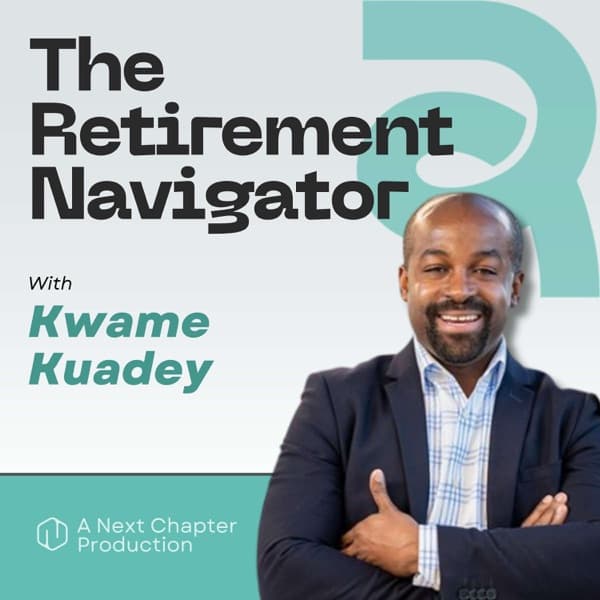
Kwame Kuadey opens the first episode with a sentence that tells you what the show is not: "While other retirement experts chase wealthy clients, I help real people with real budgets retire with dignity." That framing is the show's identity. Most retirement content assumes a seven-figure portfolio and a financial advisor. The Retirement Navigator assumes you are starting with $500 or $500,000, and that the rules, the systems, and the non-financial side of retirement apply to both.
Kuadey is the co-founder of Benefits Insider, where he has helped over 250,000 people maximize their Social Security and Medicare benefits. He is an adjunct professor of finance at Johns Hopkins University Carey Business School. The show launched in August 2025 and has published 15 episodes as of August 2026, running weekly. The format is interview-based, running 30 to 50 minutes, with guests from retirement research, policy, and practice.
If you want a show that treats retirement as a life transition rather than a portfolio problem, grounded in research from the Center for Retirement Research at Boston College, this is the most honest in the category. If you want technical depth on Roth conversions and RMD rules, pair it with The Retirement and IRA Show.
The Research-Backed Interviews
The May 14, 2026 episode, "Americans Will Struggle in Retirement: Are You Prepared," is the show's signature content. Kuadey interviews Andy Eschtruth, Director of the Center for Retirement Research at Boston College, who has spent three decades studying how people plan for and live through retirement. The conversation covers the Social Security funding shortfall in plain language, what it means for current and future beneficiaries, and what Congress is likely to do about it.
The research is sobering. The National Retirement Risk Index shows that 40 to 50% of American workers are not on track to maintain their standard of living in retirement. Only 1 in 2 private sector workers participates in a retirement plan. Two in five retired households cannot cover unexpected expenses. Eschtruth explains that raising the retirement age is actually a benefit cut, and what that means if you claim early. The history of Social Security reform suggests Congress will act late but will act, which means current beneficiaries are likely safe but future claimants face uncertainty.
That level of research integration is what separates this show from the rest of the retirement category. Most shows cite a statistic and move on. Kuadey asks the researcher to explain the methodology, the assumptions, and what the number actually means for a specific listener. For listeners who want to understand the Social Security funding question in depth, this episode is the clearest explanation available in free podcast form.
The Medicare Content
The March 26, 2026 episode, "The Medicare Trap Most Retirees Fall Into at 65 (And Cannot Escape at 75)," is the episode most listeners approaching 65 should hear. Kuadey explains that choosing Medicare at age 65 may seem like a simple decision, but it can shape your healthcare access and costs for the rest of your life. The trap is that certain decisions made at enrollment cannot be easily reversed, and the penalties for late enrollment compound over time.
The August 27, 2026 episode on the caregiving divide made the point that most people plan carefully for retirement income but very few plan for the cost of long-term care. The gap catches even well-prepared families by surprise. Kuadey interviews a long-term care policy expert about why the system is confusing, expensive, and difficult to navigate, even for people who have saved responsibly. The episode covers what long-term care insurance covers, what Medicare does and does not cover, and what options exist for middle-income families who do not qualify for Medicaid but cannot afford private care.
For listeners navigating the Medicare decision, the show's content is essential because the stakes are permanent. Our guide to how much you need to retire covers the income side, but the healthcare side is where the show adds the most.
The Non-Financial Side
Where The Retirement Navigator separates itself from the rest of the retirement category is in the non-financial content. The June 4, 2026 episode, "Work Longer, Live Better: Career Reinvention and Retirement," featured Kerry Hannon, a personal finance expert and author, on what she calls the longevity economy. The thesis is that you may have more working years ahead of you than you think, and that can be a good thing. Career reinvention after 55 is not a consolation prize. It is a strategy for extending income, maintaining social connection, and finding purpose in the next chapter.
The July 9, 2026 episode on social isolation made the point that your social life may matter more to your retirement satisfaction than your bank account. The research on retirement happiness consistently shows that social connection, purpose, and physical health are stronger predictors of satisfaction than portfolio size. Kuadey covers the practical side: building community before you retire, maintaining work friendships after you leave, and the specific risks of isolation for people who live alone.
The July 23, 2026 episode on living alone and staying safe covered the Snug app, a check-in service for people who live alone, as a practical tool for the safety side of solo retirement. That kind of concrete, non-financial advice is what most retirement shows skip entirely. For listeners thinking about the lifestyle side, our guide to catch-up retirement savings in your 40s covers the financial preparation, and the show covers everything else.
Where the Show Has Limits
The show is young. Fifteen episodes is enough to establish a voice and a format, but the library is not deep enough to cover every retirement topic. Listeners who want exhaustive coverage of Roth conversion mechanics, RMD timing, or annuity selection will need to pair this with a more technical show.
The interview format means the quality varies with the guest. The Eschtruth interview is exceptional. Some of the earlier episodes, where Kuadey is still finding the show's rhythm, are less polished. The show improves consistently across its run, and the recent episodes are the strongest.
Kuadey runs Next Chapter Media, which produces the show and a YouTube channel with 216,000 subscribers. The show sells a community membership and educational resources. He discloses this, and the free content stands on its own, but listeners should evaluate the paid offerings separately.
Who Should Listen
The show fits adults 55 and older who are approaching or in retirement and want research-backed guidance on both the financial and non-financial sides of the transition. It suits people who want honest information about the state of retirement in America, including the statistics that are uncomfortable, and who want practical guidance on Medicare, Social Security, caregiving, and social connection. A listener who finished the Eschtruth episode would understand the Social Security shortfall, what Congress is likely to do, and what it means for their own claiming strategy. That is a complete answer to the question most retirement content oversimplifies.
It fits less well for listeners who want deep technical content on tax strategy and IRA mechanics, anyone who wants short episodes, or listeners who are still in the accumulation phase. For the technical side, pair with The Retirement and IRA Show. For the transition framework, pair with Retirement GPS.
Getting Started
Begin with the "Americans Will Struggle in Retirement" episode, because it gives you the research baseline that frames the rest of the show. Then move to the Medicare trap episode if you are approaching 65. Track your own retirement readiness and Social Security claiming strategy as you apply the advice, because the show's guidance only pays off if you can see whether your plan holds up against the research.
The Retirement Navigator will not give you the deepest technical analysis or the longest episode library. It will give you the most honest and research-grounded treatment of retirement as a life transition, and for listeners who want clarity over guesswork, that honesty is the point.
This post is for informational purposes only and does not constitute financial advice.