*Disclosure: This article contains affiliate links. If you purchase through these links, we may earn a commission at no additional cost to you. We only recommend books we genuinely believe in.
Quick Overview
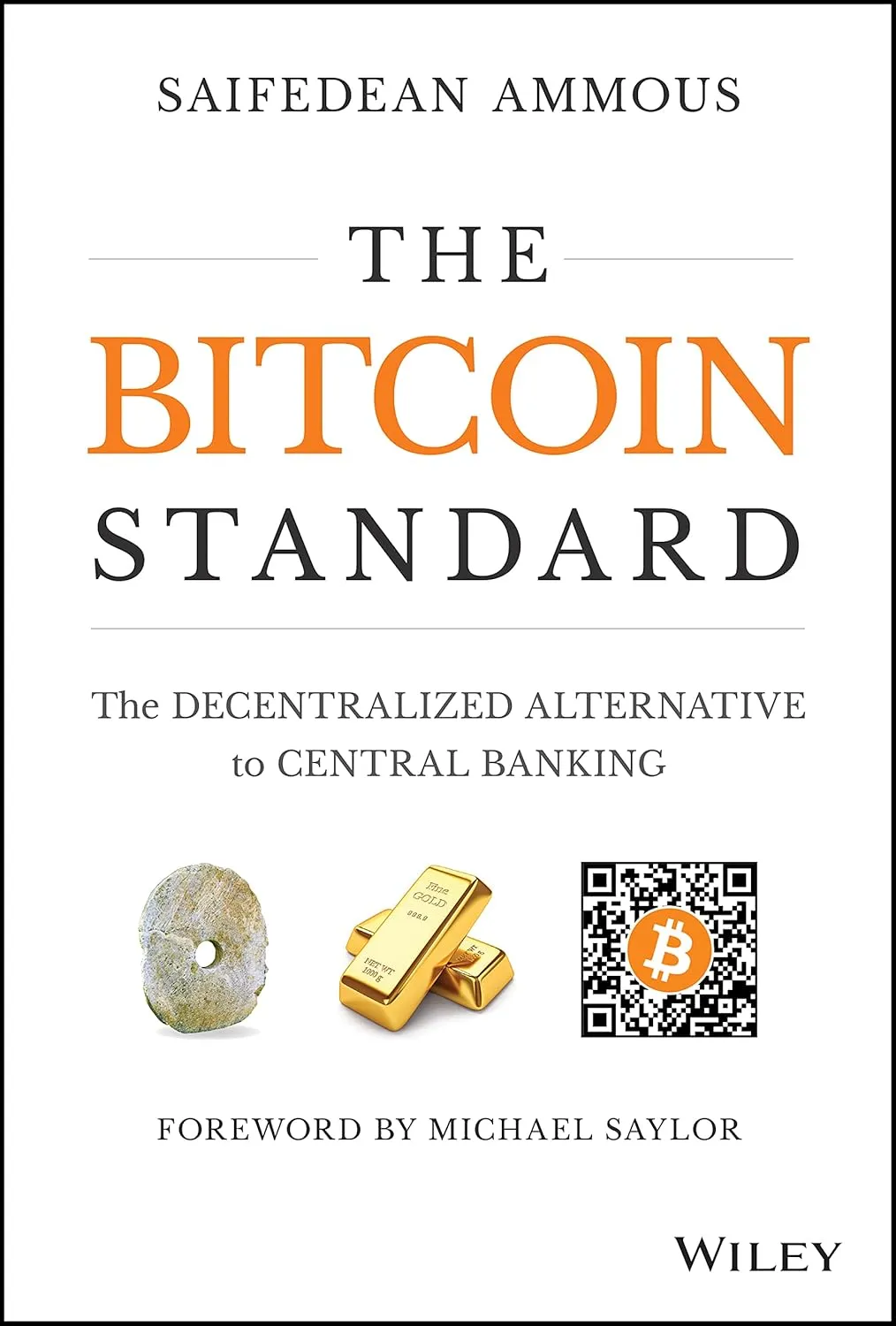
I first picked up The Bitcoin Standard in 2021 during a crypto bull run, expecting another price-charts-and-moon-talk book. What I got instead was a serious economic history lesson. Saifedean Ammous, an economist with a PhD from Columbia University, does not write about Bitcoin as a speculative bet. He argues it is the most credible candidate for a global sound money standard since the gold standard was abandoned in 1971. Whether you end up agreeing or not, this book forces you to think about money in ways you probably never have.
Book Details
| Attribute | Details |
|---|---|
| Title | The Bitcoin Standard |
| Author | Saifedean Ammous |
| Publisher | Wiley |
| Published | 2018 |
| Pages | 304 |
| Reading Level | Intermediate |
| Amazon Rating | 4.6/5 stars |
Get Your Copy
Hardcover: Buy on Amazon
Kindle: Buy on Amazon
About the Author
Saifedean Ammous holds a PhD in Sustainable Development from Columbia University and taught economics at the Lebanese American University. He is one of the most prominent academic advocates for Bitcoin and a proponent of Austrian economics. He later wrote The Fiat Standard (2021), extending his monetary analysis to critique the current fiat system. His politics are libertarian, his arguments are not balanced, and he has a habit of dismissing critics with memes rather than engagement. In 2025, when Nassim Taleb published a paper sharply criticizing Bitcoin, Ammous responded with "CRY HARDER" on social media. That tells you something about his intellectual style. But his monetary theory framework is worth engaging with seriously.
Part 1: The History and Economics of Money
What Makes Good Money?
Ammous opens with a treatment of monetary theory that stands on its own, independent of his Bitcoin conclusions. If you want a deeper dive into monetary systems, check our monetary policy glossary entry.
The functions of money:
| Function | Description |
|---|---|
| Medium of exchange | Facilitates trade without requiring coincidence of wants |
| Unit of account | Provides a common measure of value |
| Store of value | Allows present value to be preserved for future use |
All three functions are required for good money. Fiat currencies work well as media of exchange and units of account but have historically failed as stores of value over long periods because of inflation.
The salability of money:
Ammous introduces the concept of salability, which is how easily a money can be exchanged for goods and services:
| Salability Dimension | Gold | Fiat | Bitcoin |
|---|---|---|---|
| Across time (store of value) | High | Low-Medium | High |
| Across space (transferability) | Low | High | Very High |
| Across scales (divisibility) | Medium | High | Very High |
The hardness of money:
Ammous's most important concept is the stock-to-flow ratio, which measures how hard it is to increase the money supply.
Stock-to-Flow Ratio = Total Supply / Annual Production| Money | Stock-to-Flow | Implication |
|---|---|---|
| Salt | ~1x | Very easy to produce more; poor store of value |
| Copper | ~10x | Moderate; some store of value |
| Silver | ~50x | Good store of value |
| Gold | ~60-70x | Excellent store of value |
| Bitcoin (post-2020 halving) | ~56x | Comparable to gold; improving over time |
| Bitcoin (post-2024 halving) | ~112x | Exceeds gold |
Why high stock-to-flow matters:
A money with low stock-to-flow (salt, copper) loses value when supply increases. A large producer can devalue savings simply by mining more. Gold's high stock-to-flow means that even if gold mining doubled tomorrow, it would only increase supply by 1-2% annually. Not enough to meaningfully devalue existing holdings.
Bitcoin's stock-to-flow is programmatically increasing. The halving mechanism reduces new supply every 4 years, approaching the fixed cap of 21 million coins. After the April 2024 halving, Bitcoin's stock-to-flow now exceeds gold's. By 2028, it will roughly double again.
A History of Monetary Systems
Commodity money (prehistoric to 1914):
Various commodities served as money throughout history. The key insight: whatever commodity won the monetary competition tended to be the hardest, meaning the most difficult to inflate through new production.
Seashells worked as money in some Pacific island societies. When Europeans arrived with ships full of seashells, they instantly destroyed the monetary wealth of island populations. The lesson Ammous draws: any money whose supply can be easily expanded will eventually be inflated away.
The gold standard (1871-1914 classical; 1918-1971 modified):
The classical gold standard produced near-zero long-run inflation, international monetary stability, and long-run price stability that enabled long-duration capital investment. Low and predictable inflation meant individuals saved in money that held its value, businesses made long-duration investments confident that returns would not be inflated away, and international trade flourished without currency risk.
The transition to fiat (1971 to present):
Nixon's 1971 suspension of gold convertibility created the current system where all major currencies are backed by nothing except government decree and Federal Reserve management.
The results of fiat money (Ammous's analysis):
| Metric | Pre-Fiat (1900-1971) | Post-Fiat (1971-2024) |
|---|---|---|
| U.S. average inflation | ~1.5-2% | ~4% |
| Asset price volatility | Lower | Higher |
| Government debt/GDP | Lower | Much higher |
| Financial crises frequency | Lower | Higher |
| Income inequality | Lower | Higher (asset prices inflate) |
Ammous argues that fiat money's inflationary nature benefits governments (they can finance spending by inflating) and asset holders (asset prices inflate) while harming savers and workers. This is a testable empirical claim, and the evidence is at least partially supportive. The Federal Reserve's response to the 2020 pandemic, expanding the balance sheet by over $3 trillion, is exactly the kind of fiat flexibility Ammous criticizes.
Part 2: Bitcoin as Sound Money
Bitcoin's Monetary Properties
Scarcity:
Bitcoin has a hard cap of 21 million coins, programmed into the protocol and enforced by all nodes in the network. No authority can create additional bitcoin beyond this limit. This is unlike any previous money. Gold supply can grow with sufficient investment in mining. Fiat supply grows by central bank decision. Bitcoin supply growth is mathematically predictable and permanently decreasing.
The supply schedule:
| Period | New Bitcoin per Day | Annual Inflation Rate |
|---|---|---|
| 2009-2012 | 7,200 | ~25% |
| 2012-2016 | 3,600 | ~12% |
| 2016-2020 | 1,800 | ~4% |
| 2020-2024 | 900 | ~1.8% |
| 2024-2028 | 450 | ~0.85% |
| 2140 (final) | 0 | 0% |
Decentralization and censorship resistance:
Bitcoin transactions are validated by a distributed network of nodes worldwide. No single entity can block a valid transaction, freeze funds, or confiscate Bitcoin held in a properly secured wallet.
This property is most valuable in jurisdictions with hyperinflationary monetary policy (Venezuela, Zimbabwe, Turkey), authoritarian financial controls (capital controls, asset seizure), or corrupt banking systems (Lebanon, parts of sub-Saharan Africa). For citizens in stable democracies with sound monetary policy, this property has less immediate practical value.
The 2022 Canadian Freedom Convoy offered a real-world test case. Bitcoin donations to truckers were traceable on the public blockchain, and those identified faced consequences when their fiat accounts were frozen. Bitcoin's censorship resistance turned out to be more nuanced in practice than in theory. The funds were outside government reach, but the individuals were not.
Transferability:
Bitcoin can be transmitted anywhere in the world within minutes, at low cost, without requiring permission from any financial institution. This is qualitatively different from gold (which cannot easily be moved internationally) and fiat wire transfers (which require bank approval, carry high fees, and move slowly).
Verifiability:
Any Bitcoin transaction on the blockchain can be independently verified by anyone running a full node. Counterfeiting is cryptographically impossible. This is unlike gold (which requires physical testing) and fiat (which requires trust in banking institutions).
Bitcoin vs. Gold
Ammous argues Bitcoin is superior to gold as sound money because:
| Property | Gold | Bitcoin |
|---|---|---|
| Scarcity | Limited but not fixed | Absolutely fixed at 21M |
| Portability | Low (heavy, physical) | High (digital, weightless) |
| Divisibility | Limited (physically dividing gold is difficult) | Perfect (8 decimal places) |
| Verifiability | Requires physical testing | Cryptographically verifiable |
| Censorship resistance | Can be confiscated physically | Secured by cryptography |
| Supply predictability | Depends on mining economics | Mathematically predetermined |
Gold's advantages over Bitcoin:
| Property | Gold Advantage |
|---|---|
| 5,000-year track record | Bitcoin is only 16 years old |
| No dependency on internet or electricity | Bitcoin requires technical infrastructure |
| No private key management risk | Gold cannot be permanently lost by forgetting a password |
| Regulatory clarity | Gold is universally accepted; Bitcoin's regulatory status varies |
Peter Schiff and Ammous debated this directly at a Tether conference in early 2025. Schiff's core challenge was blunt: Bitcoin "has a price, but it doesn't have value." He argued that gold has continuous demand from industry, jewelry, and central banks independent of its price trajectory, while Bitcoin's demand is entirely contingent on the belief that its price will rise. Ammous countered with subjective value theory and Bitcoin's engineered scarcity, but he struggled to answer why Bitcoin should have value independent of speculative demand. This gap in Ammous's argument is real and the book does not close it.
Bitcoin's Investment Case
Ammous views Bitcoin primarily as sound money rather than a speculative investment. But his monetary analysis has investment implications. For a broader look at how crypto fits into a portfolio, see our article on crypto as an investment.
The monetization hypothesis:
If Bitcoin increasingly serves as a global store of value, its market cap should converge toward a fraction of global financial wealth:
| Scenario | % of Global Financial Assets | Implied Bitcoin Price |
|---|---|---|
| Niche adoption | 0.1% | ~$10,000-$20,000 |
| Significant adoption | 1% | ~$100,000-$200,000 |
| Gold parity | ~5% | ~$500,000+ |
| Global reserve currency | 10-20% | $1M+ |
These are scenario analyses, not predictions. They illustrate the range of possible outcomes.
The volatility problem:
Bitcoin's extreme price volatility (50-80% drawdowns are common) makes it poorly suited for the store of value function in its current form. Ammous argues this volatility is inherent in the monetization process and should decline as adoption grows and liquidity deepens. There is some evidence for this: Bitcoin's volatility has trended downward over time, though it remains far higher than gold or equities.
| Asset | Annual Volatility (approx.) |
|---|---|
| Bitcoin | 50-70% |
| Gold | 15-20% |
| S&P 500 | 15-20% |
| U.S. 30-year Treasury | 10-15% |
| Stablecoins | Near zero |
Where Ammous Gets It Wrong
The Environmental Critique
Bitcoin mining consumes enormous amounts of electricity, comparable to medium-sized countries. Ammous argues the energy use is justified by the monetary value created. Critics argue it is wasteful, particularly given climate concerns.
The current evidence is more nuanced than Ammous presents. Bitcoin mining increasingly uses renewable and stranded energy (estimated 50-75% of mining uses renewables). Mining is location-flexible and interruption-tolerant, which means it can monetize energy that would otherwise be wasted. But the comparison should not be Bitcoin vs. nothing. It should be Bitcoin vs. alternatives. Gold mining is also energy-intensive. The global banking system consumes vast amounts of electricity for data centers, branch offices, and ATM networks. The debate is genuine and unresolved, and Ammous does his readers a disservice by not engaging with it more seriously.
The Regulatory Risk
Bitcoin's censorship resistance is also a regulatory target. Governments can restrict exchange access, ban ownership (as China has done multiple times), tax gains aggressively, or require reporting that eliminates privacy benefits.
Ammous acknowledges this risk but argues that a sufficiently decentralized network is ultimately censorship-resistant. The historical evidence on this is thin. Bitcoin has not yet faced a coordinated crackdown by major economies simultaneously. The U.S. approved spot Bitcoin ETFs in January 2024, which brought institutional capital flowing in. But regulatory approval is not the same as regulatory permanence. A 2025 academic paper published on arXiv synthesized critiques from both Post-Keynesian and Austrian schools, arguing Bitcoin faces structural barriers to functioning as money, including scalability limits and a fragile market structure. Ammous would dismiss this, but the arguments deserve engagement.
The Deflation Problem
A fixed money supply in a growing economy means deflation. Deflation sounds good but historically produces problems. Debt becomes harder to service as real burdens increase. Consumers delay purchases expecting lower future prices. Investment declines.
Ammous argues this critique is based on Keynesian theory he rejects. He claims deflation under a gold-like standard was historically beneficial. There is some truth to this. The classical gold standard period did see real wage growth and price stability. But a 2025 essay called "The Toll Booth" made a devastating arithmetic case: because Bitcoin's supply is perfectly inelastic, every dollar of late-entrant capital is a direct subsidy to early holders. A sudden transition to a Bitcoin standard would trigger a deflationary spiral where fixed-rate debtors face exploding real burdens. The $13 trillion in outstanding U.S. mortgage debt does not vanish in a Bitcoin standard world.
Ammous never addresses this scenario. The honest assessment is that a gradual transition might work, with equity-based lending instruments emerging alongside Bitcoin. An abrupt transition would be catastrophic for anyone holding fiat-denominated debt. The book simply does not engage with this problem.
The Privacy Blind Spot
Ammous frames Bitcoin in the tradition of Mises and Hayek, quoting them extensively. But he omits half of what they stood for. For Mises and Hayek, economic freedom was not just about scarcity. It was equally about privacy and unobservability. Bitcoin's public ledger means every transaction is traceable. Without privacy, fungibility is endangered, and a central property of sound money is compromised. Ammous never addresses this. The Austrian School is reduced to a single dimension (money supply) while everything else disappears. This is a significant intellectual omission.
Portfolio Allocation Considerations
For investors considering Bitcoin as a portfolio allocation, I think about it this way:
Arguments for a small allocation (1-5%):
Arguments against:
Given the genuinely wide probability distribution of Bitcoin outcomes (including going to zero), a Kelly-based allocation would be small for most investors. Perhaps 1-3% for those with high risk tolerance who believe the monetization scenario has meaningful probability. I hold a small position myself, partly as a hedge against the fiat debasement scenario Ammous describes and partly as an acknowledgment that I could be wrong about the probability of success.
Strengths & Weaknesses
What I Found Valuable
Where the Book Falls Short
Who Should Read This Book
Highly Recommended For
Probably Not For
Frequently Asked Questions
Q: Does reading this mean I should buy Bitcoin?
A: No. It means you understand the strongest case for it. Form your own view by also reading critiques. The decision to allocate depends on your risk tolerance, time horizon, tax situation, and probability assessment. If you want a broader perspective, read our guide on crypto as an investment.
Q: Is the 21 million coin limit truly immutable?
A: No hard-coded rule is immutable in theory. It can be changed if a majority of miners and nodes agree. In practice, the community's strong consensus against changing the supply schedule makes it as close to immutable as any decentralized system can be. But "close to immutable" is not the same as "immutable."
Q: Has anything changed since the book was published in 2018?
A: A lot. Spot Bitcoin ETFs were approved in the U.S. in January 2024, bringing institutional capital. The 2024 halving reduced new supply further. The Lightning Network has grown but remains far from solving Bitcoin's scalability limitations. The deflation critique has gotten more sophisticated. And the privacy problem Ammous never addresses has become more visible as chain analysis tools have improved.
Final Verdict
Rating: 4.5/5
The Bitcoin Standard is the most intellectually rigorous case for Bitcoin as sound money available. Its monetary history and stock-to-flow framework are genuinely valuable regardless of your ultimate Bitcoin conclusion. The book's weaknesses are real: it is one-sided, it ignores privacy, and it does not engage seriously with deflation risks. But reading it is still the best way to understand the strongest possible case for Bitcoin. Required reading for any investor considering a Bitcoin allocation who wants to understand more than price charts.
Get Your Copy
Hardcover: Buy on Amazon
Kindle: Buy on Amazon
Prices current as of publication date. Free shipping available with Prime.