*Disclosure: This article contains affiliate links. If you purchase through these links, we may earn a commission at no additional cost to you. We only recommend books we genuinely believe in.
Quick Overview
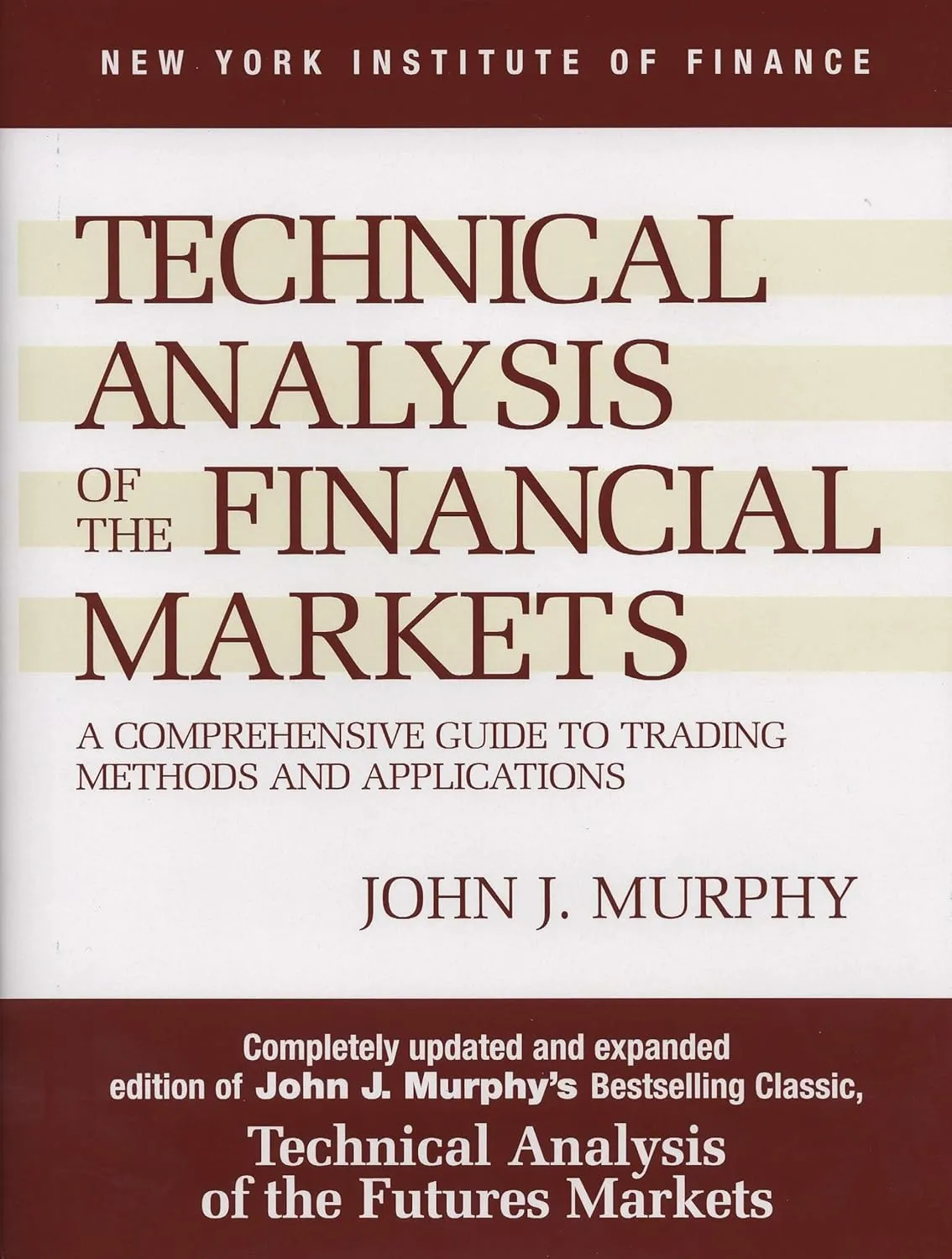
A 2023 study published in the Journal of Finance found that approximately 70% of daily trading volume in U.S. equity markets is now driven by algorithmic and quantitative strategies. Yet the chart patterns John Murphy documents in Technical Analysis of the Financial Markets, patterns first identified in 19th century commodity markets, continue to appear and continue to work. The reason is simple: behind every algorithm is a human who programmed it, and the psychological patterns that produce trends, reversals, and breakouts are embedded in the code itself. Murphy's book is the standard reference text for technical analysts worldwide, covering chart construction, trend analysis, volume, candlestick patterns, oscillators, moving averages, Elliott Wave theory, and intermarket analysis. If you are learning technical analysis or need a reference that covers every major concept in depth, this is the book.
Book Details
| Attribute | Details |
|---|---|
| Title | Technical Analysis of the Financial Markets |
| Author | John J. Murphy |
| Publisher | New York Institute of Finance |
| Published | 1999 (updated from 1986 original) |
| Pages | 576 |
| Reading Level | Intermediate |
| Amazon Rating | 4.7/5 stars |
Get Your Copy
Hardcover: Buy on Amazon
Kindle: Buy on Amazon
About the Author
John Murphy was a technical analyst at Merrill Lynch for many years, served as technical analysis advisor to CNBC, and has written several books on intermarket analysis and technical analysis. He is one of the most respected practitioners of the discipline and has made technical analysis accessible to mainstream audiences.
The Philosophy of Technical Analysis
Technical analysis rests on three foundational premises:
Premise 1: Market Action Discounts Everything
All information, fundamentals, sentiment, geopolitical events, is already reflected in the price. The analyst does not need to know why a stock is moving; the price itself contains the relevant information.
The contrast with fundamental analysis:
| Fundamental Analyst | Technical Analyst |
|---|---|
| Asks: "What is this worth?" | Asks: "Where is this going?" |
| Studies earnings, balance sheets | Studies price and volume |
| Values the business | Reads market supply/demand |
| Long-term orientation | All time frames |
| Buys cheap vs. intrinsic value | Buys strength, sells weakness |
Neither approach is universally superior. Most sophisticated practitioners incorporate both.
Premise 2: Prices Move in Trends
The most fundamental concept in technical analysis: once a trend is established, the price is more likely to continue in that direction than to reverse. This is why technical analysts buy breakouts and sell breakdowns: they are aligning with the trend.
The three trends:
| Trend | Duration | Description |
|---|---|---|
| Primary (major) | Months to years | The main bull or bear market |
| Secondary (intermediate) | Weeks to months | Corrections within the primary trend |
| Minor | Days to weeks | Short-term fluctuations |
Premise 3: History Repeats Itself
Human psychology drives market patterns. Since human psychology does not change, patterns that have worked historically tend to work again. Chart patterns like head-and-shoulders, double tops, and flag formations recur because they reflect consistent human emotional responses to price movements.
The Core Concepts
Trend Lines and Channels
The most basic tool: draw a line connecting at least two significant lows in an uptrend (or two highs in a downtrend). As long as price stays above the uptrend line, the trend is intact. A break below signals potential trend change.
Price channels:
Draw a parallel line above the uptrend line (connecting the highs). Price oscillates within the channel. Buying near the lower channel line and selling near the upper channel line is the basic channel trading strategy.
Key rules:
| Rule | Application |
|---|---|
| Need minimum 2 points to draw a line | More points = more reliable |
| Steeper trend lines break more easily | Shallow trends are more sustainable |
| Break of major trend line is significant signal | Not all breaks lead to reversals |
| Volume should increase on breakouts | Low-volume breakouts are suspect |
Support and Resistance
Support: a price level where buying interest has historically been strong enough to stop or reverse a decline.
Resistance: a price level where selling pressure has historically been strong enough to stop or reverse an advance.
The key insight: Support and resistance reverse roles. When support is broken, it becomes resistance. When resistance is broken, it becomes support.
Example:
$50 (was support: stock bounced here multiple times)
Stock breaks below $50
$50 (now becomes resistance: rallies fail here)
Why this works: Investors who bought at $50 support and held through the breakdown want to sell at break-even when price recovers to $50. This selling pressure creates the resistance.
The Major Chart Patterns
Murphy covers every significant chart formation in detail. The most important for practical application:
Head and Shoulders (Reversal Pattern):
| Component | Description |
|---|---|
| Left shoulder | Rally, then pullback |
| Head | Higher rally, then pullback |
| Right shoulder | Rally to approximately left shoulder level, then break |
| Neckline | Line connecting the two pullback lows |
| Target | Distance from head to neckline, projected below neckline break |
The head and shoulders is the most reliable reversal pattern in technical analysis. Volume typically decreases on the right shoulder formation (less buying enthusiasm than the head).
Double Top (Reversal Pattern):
Two peaks at approximately the same price level. The pattern completes when price breaks below the trough between the two peaks. Target: the height of the pattern projected below the breakdown.
Cup and Handle (Continuation Pattern):
A rounded bottom (the cup) followed by a smaller pullback (the handle). Breakout above the rim of the cup signals continuation of the prior uptrend. Target: depth of the cup added to the breakout point.
Flags and Pennants (Continuation Patterns):
Brief consolidations against the prior trend. After a sharp move (the flagpole), price consolidates in a tight range (the flag) before continuing in the original direction. These are among the most reliable and profitable patterns for short-term traders.
Moving Averages
Moving averages smooth price action, making trends easier to identify. They are the most widely used technical indicator.
Simple Moving Average (SMA)
The average closing price over N days. When price is above its moving average, the trend is up. When below, the trend is down.
Common moving average periods and their uses:
| Period | Use |
|---|---|
| 10-day | Very short-term; day traders and swing traders |
| 20-day | Short-term trend; swing traders |
| 50-day | Intermediate trend; most widely watched |
| 100-day | Medium-term trend |
| 200-day | Long-term trend; institutional benchmark |
The Golden Cross and Death Cross
Golden Cross: 50-day MA crosses above 200-day MA, a bullish signal that often marks the beginning of a sustained uptrend.
Death Cross: 50-day MA crosses below 200-day MA, a bearish signal that often marks the beginning of a sustained downtrend.
Historical performance of the Death Cross signal (S&P 500):
| Signal | Average Forward 12-Month Return | Hit Rate (positive return) |
|---|---|---|
| Death Cross | +1.4% | 51% |
| No signal | +10.2% | 70% |
The Death Cross is a lagging indicator: it fires after significant decline has already occurred. It is better used for risk management (reduce exposure after signal) than for market timing. A 2024 analysis by Bespoke Investment Group found that since 2000, Death Cross signals in the S&P 500 have been followed by positive 12-month forward returns 65% of the time, though average returns were below the unconditional average.
MACD (Moving Average Convergence Divergence)
MACD subtracts the 26-day EMA from the 12-day EMA. A 9-day EMA of the MACD (the signal line) is plotted alongside. Crossovers of MACD and signal line generate buy/sell signals.
MACD interpretation:
| Signal | Interpretation |
|---|---|
| MACD crosses above signal line | Bullish momentum increasing |
| MACD crosses below signal line | Bearish momentum increasing |
| MACD divergence from price (higher high in price, lower high in MACD) | Bearish divergence: potential reversal |
| MACD above zero | Uptrend |
| MACD below zero | Downtrend |
Oscillators and Momentum Indicators
RSI (Relative Strength Index)
Developed by J. Welles Wilder, RSI measures the magnitude of recent price changes to evaluate overbought/oversold conditions.
Formula:
RSI = 100 - (100 / (1 + RS))
RS = Average Gain over 14 periods / Average Loss over 14 periods
Interpretation:
| RSI Level | Signal |
|---|---|
| Above 70 | Overbought: potential reversal |
| 50-70 | Bullish momentum |
| 50 | Neutral |
| 30-50 | Bearish momentum |
| Below 30 | Oversold: potential reversal |
RSI divergence: When price makes a new high but RSI fails to make a new high, bearish divergence suggests the rally is losing momentum. This is one of the most reliable RSI signals.
Stochastic Oscillator
Measures where the closing price is relative to the high-low range over a specified period.
%K = 100 × (Close - Lowest Low over N periods) / (Highest High - Lowest Low over N periods)Readings above 80 indicate overbought; below 20 indicate oversold. Works best in range-bound markets; generates false signals in strong trends.
Candlestick Charts
Murphy dedicates extensive coverage to Japanese candlestick patterns, which provide more information about the battle between buyers and sellers than standard bar charts.
Candlestick anatomy:
          │  ← Upper shadow (high)
          │
  ┌────────┐  ← Body (open to close)
  │        │    White/green = close > open (bullish)
  │        │    Black/red = close < open (bearish)
  └────────┘
          │
          │  ← Lower shadow (low)
Key Single-Candle Patterns
| Pattern | Description | Signal |
|---|---|---|
| Doji | Open = Close (cross shape) | Indecision; potential reversal |
| Hammer | Small body, long lower shadow | Bullish reversal after downtrend |
| Shooting star | Small body, long upper shadow | Bearish reversal after uptrend |
| Marubozu | No shadows, full-body candle | Strong direction, continuation |
Key Multi-Candle Patterns
| Pattern | Candles | Signal |
|---|---|---|
| Engulfing | 2 candles; second body engulfs first | Reversal |
| Morning Star | 3 candles; gap down, doji/small body, gap up close | Bullish reversal |
| Evening Star | 3 candles; gap up, doji/small body, gap down close | Bearish reversal |
| Three White Soldiers | 3 consecutive bullish candles, each closing near high | Strong bullish continuation |
Volume Analysis
Murphy emphasizes that volume confirms price. Understanding the volume/price relationship is essential:
| Scenario | Interpretation |
|---|---|
| Price up + Volume up | Healthy uptrend; buyers in control |
| Price up + Volume down | Weak rally; potential reversal |
| Price down + Volume up | Distribution; sellers in control |
| Price down + Volume down | Weak selling; potential reversal |
| Price breakout + Volume surge | High-conviction breakout |
| Price breakout + Low volume | Suspect breakout; may fail |
On-Balance Volume (OBV): Adds volume on up days, subtracts on down days. OBV trending up while price is flat or down suggests accumulation (smart money buying before price rises). OBV trending down while price is flat suggests distribution.
Intermarket Analysis
Murphy's contribution beyond standard technical analysis: the relationships between different asset classes inform each other's analysis.
The four key intermarket relationships:
| Relationship | Normal Pattern | Exception |
|---|---|---|
| Bonds vs. Stocks | Bonds lead stocks (bond rally precedes stock rally) | Sometimes reverse during inflation spikes |
| Dollar vs. Commodities | Inverse (stronger dollar = weaker commodities) | Generally reliable |
| Dollar vs. Gold | Inverse (weaker dollar = higher gold) | Very reliable |
| Oil vs. Inflation | Positive (higher oil = higher inflation) | Strong historical relationship |
Application for long-term investors:
When treasury yields are rising (bond prices falling), historically headwinds for growth stocks. When the dollar is weakening, commodities and international equities tend to outperform. These relationships are imperfect but provide useful context for asset allocation decisions.
Practical Implementation
The Checklist Before Any Trade
Murphy's recommended verification process:
Only enter when most criteria align.
Strengths & Weaknesses
What We Loved
Areas for Improvement
Who Should Read This Book
Highly Recommended For
Probably Not For
Final Verdict
Rating: 4.7/5
Technical Analysis of the Financial Markets is the definitive reference text for anyone learning or practicing technical analysis. Its breadth, clarity, and practical focus make it the right book to read first and consult repeatedly. No competing text covers the full discipline as thoroughly.
If you trade or invest using charts, this is the book you keep on your desk. The patterns Murphy documents have survived the transition to algorithmic markets because the human psychology behind them has not changed. For a simpler approach that avoids technical analysis entirely, consider dollar-cost averaging into index funds instead.
Get Your Copy
Hardcover: Buy on Amazon
Kindle: Buy on Amazon
Prices current as of publication date. Free shipping available with Prime.