*Disclosure: This article contains affiliate links. If you purchase through these links, we may earn a commission at no additional cost to you. We only recommend books we genuinely believe in.
Quick Overview
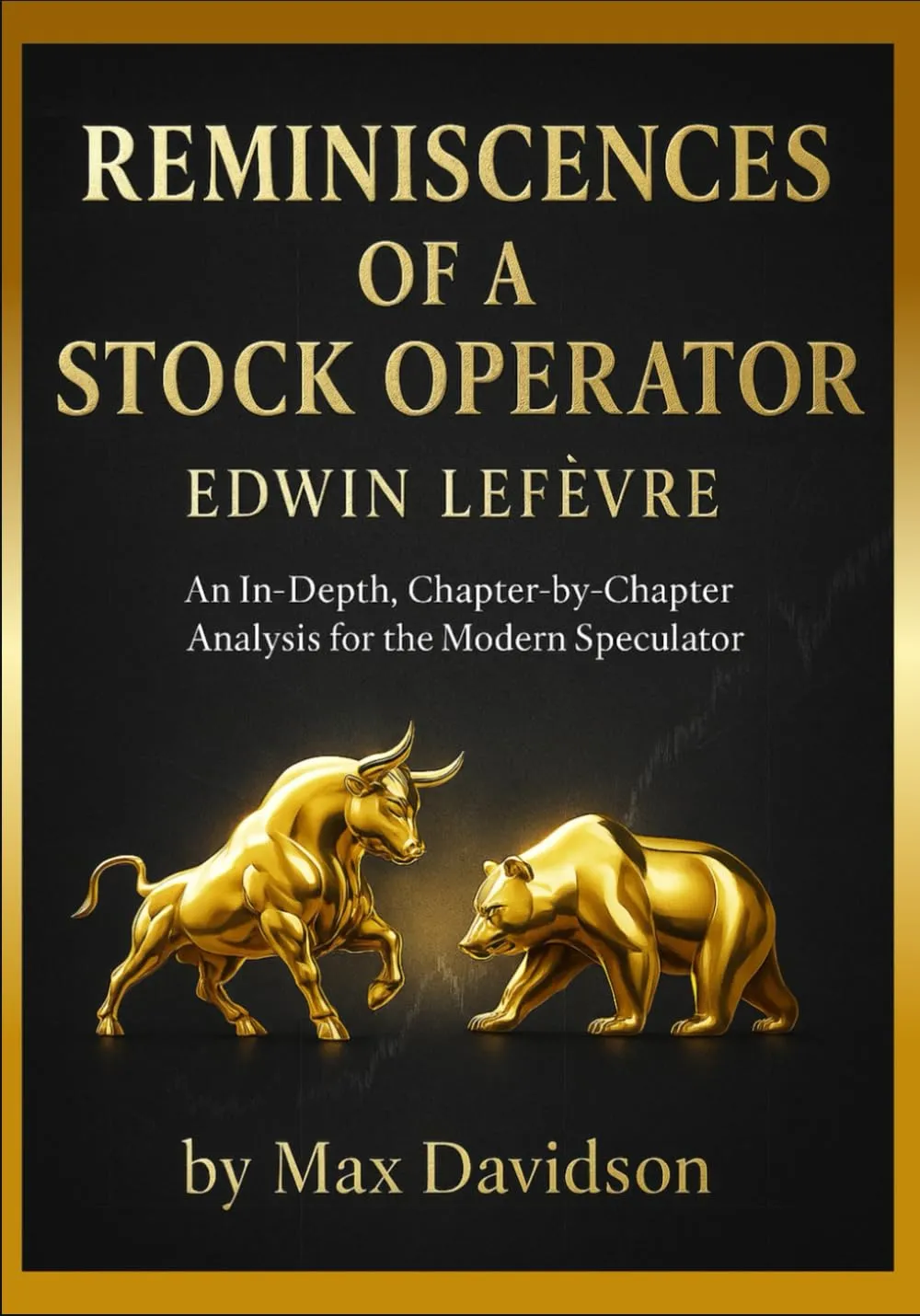
Jesse Livermore made and lost multiple fortunes, correctly predicted both the 1907 Panic and the 1929 Crash, and eventually died bankrupt by suicide in 1940. His story contains every lesson about speculation: the power of reading the tape, the psychology of the crowd, the critical importance of patience, and the tragic consequences of violating your own rules. Written in 1923 as the fictionalized autobiography of Livermore, Reminiscences of a Stock Operator has never gone out of print. Over 100 years later, traders still read it as the definitive text on market psychology. The question for 2026 is whether lessons from the bucket-shop era translate to algorithmic markets dominated by high-frequency trading and AI-driven analytics. The answer, as multiple recent analyses have argued, is that the psychology has not changed even as the technology has transformed beyond recognition.
Book Details
| Attribute | Details |
|---|---|
| Title | Reminiscences of a Stock Operator |
| Author | Edwin Lefèvre |
| Publisher | Wiley Investment Classics (various editions) |
| First Published | 1923 |
| Pages | 320 |
| Reading Level | Intermediate |
| Amazon Rating | 4.7/5 stars |
Get Your Copy
Annotated Edition: Buy on Amazon
Kindle: Buy on Amazon
Audiobook: Buy on Amazon
About Jesse Livermore
Jesse Livermore (1877-1940) left school at 14 to work as a board boy at a Boston brokerage, posting stock prices on a chalkboard. He began recording his own predictions in a notebook, noticing patterns in how prices moved. By 15, he was trading in "bucket shops" (illegal off-exchange betting operations) and making enough to support his family.
He moved to New York, was banned from all bucket shops in New England for winning too consistently, and began trading on the New York Stock Exchange. He made millions, lost them, made them again several times. He correctly sold short before the 1907 Panic and the 1929 Crash, earning enormous fortunes on both occasions. He died by suicide in 1940, having lost his final fortune through overtrading and personal turmoil.
The protagonist of this book is called "Larry Livingston," a thin disguise that Livermore himself acknowledged.
The Most Important Lessons from Livermore's Trading
Lesson 1: The Market Always Tells You What to Do. Listen to It.
Livermore's primary skill was reading "the tape," the telegraph ticker that printed every trade on the New York Stock Exchange in real time. He learned to detect patterns in price and volume behavior that revealed the intentions of large operators.
The modern translation: Price action contains information about the behavior of the largest, best-informed participants. A stock that refuses to decline on bad news is telling you something different from a stock that plunges on good news. Paying attention to how prices respond to news and catalysts is a form of market intelligence.
The key principle:
"The stock doesn't know you own it. It doesn't care. What matters is what the stock is doing, not what you want it to do."
Livermore watched how stocks behaved before making commitments. He looked for stocks that acted well (held firm, made new highs, recovered from selling) as signals of underlying strength. Stocks that "acted poorly" despite good news warned him away.
Lesson 2: Patience Is the Most Profitable Inaction
One of the book's most quoted passages:
"It was never my thinking that made the big money for me. It was always my sitting. Got that? My sitting tight! Men who can both be right and sit tight are uncommon."
Livermore identified two separate skills:
Most traders do the hard analytical work to identify a good trade, then exit too early out of nervousness. Livermore argues the real money is made in the holding, not the buying.
The pyramid of trading errors:
| Error | Frequency | Impact |
|---|---|---|
| Wrong direction | Common | Moderate (losses capped by stops) |
| Right direction, sold too early | Very common | Severe (miss the full move) |
| Right direction, sized too small | Common | Moderate (underperformance) |
| Right direction, held through reversal | Occasional | Severe (profits returned) |
Exiting a winning trade too early is the most common and most costly error. Livermore's insight: once you have a profit and conviction, do nothing. The temptation to take profits is the enemy of large gains.
Lesson 3: Cut Losses, Ride Winners. And Mean It.
Every trader knows the saying. Very few follow it consistently.
Livermore describes watching himself violate this rule repeatedly, always with the same result. He would take a small loss, watch the stock decline further, feel validated, then watch it recover and hit new highs, having sold near the bottom.
The cognitive trap that causes holding losers:
| Moment | Feeling | Action | Result |
|---|---|---|---|
| Buy at $50 | Confidence | Enter position | - |
| Falls to $45 | Mild concern | "It'll come back" | - |
| Falls to $40 | Discomfort | Still holding | - |
| Falls to $35 | Pain | Add more (averaging down) | - |
| Falls to $25 | Capitulation | Finally sell | Locked in 50% loss |
| Recovers to $55 | Rage and regret | Nothing | - |
The cognitive error is the break-even effect: the desire to get back to break-even prevents rational assessment of the position. Once a position is entered, the purchase price becomes an irrelevant sunk cost. The only question is: "Does this stock offer the best expected return from here, given my capital?"
Livermore's stop loss discipline:
Before entering any trade, Livermore identified the price at which his analysis was wrong. If the stock hit that price, he sold, regardless of how he felt about the position.
Lesson 4: The Big Money Is Made in the Big Swing, Not the Scalps
Livermore found he made far more money from major market turns than from the constant small trades most speculators pursued.
The math of different approaches:
| Approach | Trades/Year | Average Win | Win Rate | Annual Return |
|---|---|---|---|---|
| Scalping (Livermore early) | 200+ | 1-2% | 60% | Moderate |
| Swing trading (Livermore middle) | 30-50 | 5-15% | 55% | Better |
| Major trend (Livermore peak) | 3-5 | 30-100% | 70% | Exceptional |
Fewer, larger, well-timed trades consistently outperformed the exhausting activity of constant small trading. The key was having the patience to wait for the genuinely high-conviction situations.
Lesson 5: Trading With the Line of Least Resistance
Livermore developed the concept of "the line of least resistance," the direction markets naturally want to move given underlying supply and demand.
Application:
In a bull market, every dip is a buying opportunity. The line of least resistance is up.
In a bear market, every rally is a selling opportunity. The line of least resistance is down.
The most profitable traders align themselves with the line of least resistance rather than fighting it. The most common error: trying to buy cheap in a downtrend or sell expensive in an uptrend. The position is technically cheap but the tape says otherwise.
Modern version: Paul Tudor Jones's 200-day moving average filter (from Market Wizards) is essentially a quantification of Livermore's line of least resistance concept.
Lesson 6: The Danger of Tips and Hot Information
Livermore learned repeatedly that acting on tips, even from insiders, was dangerous:
"The only tip I ever profited on was the one I gave myself based on my own reading of the tape."
Why tips fail:
| Reason | Explanation |
|---|---|
| The tip is already priced in | Information travels faster than you think |
| The tipper may be wrong | Even insiders misjudge timing |
| You cannot manage a position you did not analyze | No framework for exit |
| Responsible analysis | Own research builds conviction to hold through volatility |
Acting on tips creates positions you cannot manage because you do not understand the thesis. When the position goes against you, you have no framework for deciding whether to hold or exit.
Lesson 7: Never Average Down Into a Losing Position
One of Livermore's most painful lessons, learned repeatedly:
"Don't try to buy at the bottom and don't try to sell at the top. It can't be done, except by liars."
Averaging down (buying more as a position falls) assumes your original analysis was right and the market is wrong. Sometimes this is correct. More often, the market is right and the analysis was flawed.
The averaging down disaster:
| Action | Capital Committed | Break-Even Price |
|---|---|---|
| Buy 100 shares at $50 | $5,000 | $50 |
| Add 100 shares at $40 | +$4,000 | $45 |
| Add 100 shares at $30 | +$3,000 | $40 |
| Stock falls to $20 | Total loss: $7,000 | - |
Each purchase felt rational in isolation. Combined, they turned a manageable loss into a disaster. Livermore's rule: never put more money into a position that is losing. Only add to positions that are winning.
The correct approach, pyramiding:
| Action | Capital Committed | Average Entry |
|---|---|---|
| Buy 100 shares at $50 | $5,000 | $50 |
| Stock rises to $60 | - | Confirm thesis |
| Add 75 shares at $60 | +$4,500 | $54.29 |
| Stock rises to $75 | - | Full position profitable |
| Add 50 shares at $75 | +$3,750 | $60.22 |
Each new purchase validates the thesis. The position is never at a loss from the averaged cost.
The Annotated Edition
The Wiley Investment Classics annotated edition (edited by Jon D. Markman) adds commentary throughout the text identifying which specific people and events correspond to the fictional names and descriptions. This context significantly enriches the reading experience for modern readers unfamiliar with early 20th century market history.
Key identifications:
| Book Character | Real Person | Historical Role |
|---|---|---|
| Larry Livingston | Jesse Livermore | The protagonist |
| "Old Turkey" | Unknown | Patience incarnate |
| J.L. Livermore | Livermore's real firm | Multiple references |
| The manipulation pools | Various market operators | Pre-SEC market context |
The Tragedy: Livermore's Failures
The book does not shy away from Livermore's repeated failures, which are as instructive as his successes:
Pattern of failure:
Livermore would make a fortune through disciplined application of his rules. Then, bored, overconfident, or responding to personal pressure, he would begin violating them:
Each major loss followed the same pattern: extended success followed by discipline breakdown followed by catastrophic loss.
The meta-lesson: Knowing the rules is not enough. Maintaining the psychological state to follow them consistently, year after year, through winning and losing periods, is the actual skill. And it is far more difficult than the analytical work.
Does Livermore Still Matter in 2026?
Multiple 2026 analyses have examined whether Livermore's principles translate to modern algorithmic markets. The consensus is nuanced: the psychology endures, but some tactics are obsolete.
What Still Works
A June 2026 analysis by SNBCHF argued that Livermore's 21 market rules remain prescient because human behavior has not changed. Market cycles repeat because human psychology repeats. The specific triggers change (AI valuations today, housing fifteen years ago, internet stocks the decade before that), but the underlying pattern of euphoria separating reality from fundamentals remains consistent. Livermore's rules about patience, cutting losses, and not fighting the tape are as valid in 2026 as they were in 1923.
A July 2026 analysis by UCTDI made a similar case, arguing that despite the proliferation of high-frequency trading and AI-driven analytics, the core psychological drivers (greed, fear, hope, impatience) remain constant. They manifest in herd behavior, in the irrational exuberance of bubbles, and in the capitulation of crashes. Even the most robust quantitative models can be overwhelmed by collective sentiment.
What Does Not Work
A 2026 critique by Megadata offered a sharp counterpoint. They argued that Livermore was not a genius trader but a glorified bucket-shop gambler with a crippling addiction to extreme position sizing who got spectacularly lucky during fat-tail market events. He went bankrupt four distinct times and died with liabilities that exceeded his assets.
The critique makes several valid points about tactical obsolescence:
Sitting tight is dangerous in HFT markets. Livermore's "sit tight" strategy worked when markets were fragmented, slow-moving, and dominated by localized order flows. In today's high-frequency environment, where algorithmic market makers sweep liquidity across dark pools in microseconds, sitting tight on a single position without dynamic risk rebalancing can be catastrophic. Applying paper-tape rules to an electronic order book is an invitation to get slaughtered.
Pyramiding raises average cost dangerously. If you buy 100 shares at $10, 200 shares at $15, and 400 shares at $20, your average cost is $17.14. A simple 15% correction from the $21 peak ($17.85) evaporates your entire gain, even though you were "right" about the directional movement from $10. Livermore's scale-in method forces maximum size right at the exhaustion point of a trend.
The Kelly Criterion exposes the math. John Kelly's formula for optimal bet sizing demonstrates that Livermore's extreme leverage made total ruin a near-certainty over a long enough timeline. He did not break the laws of financial gravity. He happened to be holding a massive short position when the floor fell out in 1929.
The Honest Assessment
Read Livermore for the psychology, not the tactics. The lessons about patience, cutting losses, avoiding tips, and the dangers of averaging down are universal because they describe human nature. The specific methods (tape reading, bucket-shop patterns, extreme leverage) are products of a market structure that no longer exists. As the arvy analysis put it: "An automated savings plan that simply keeps running through a crash 'sits' better than the most talented trader with emotions."
For a modern approach to disciplined investing, read our guide to dollar-cost averaging and consider a three-fund portfolio that does not require the psychological stamina Livermore possessed and still could not sustain.
Strengths & Weaknesses
What We Loved
Areas for Improvement
Who Should Read This Book
Highly Recommended For
Probably Not For
Frequently Asked Questions
Q: Is the annotated edition worth the premium over cheaper paperbacks?
A: Yes. The annotations by Jon Markman provide essential context that makes the narrative significantly more understandable and instructive.
Q: Can Livermore's tape-reading methods be applied in modern markets?
A: Not directly. Ticker tape and bucket shops no longer exist. The underlying principles (price action reflects the behavior of informed participants; stocks that act well despite bad news are strong; patience in winning positions) are fully applicable. The specific tactics need modern translation through volume analysis and order flow tools.
Q: Why did Livermore fail despite knowing the rules?
A: He was unable to maintain psychological discipline consistently. He identified the failure patterns himself but could not reliably prevent them under emotional pressure. This is the most instructive lesson of all: intellectual knowledge of correct behavior and consistent execution of it are separate skills.
Q: Is Livermore a role model or a cautionary tale?
A: Both, and the book is honest about this. He made $100 million in 1929 (roughly $1.8 billion in today's money) but went bankrupt four times and died broke. The 2026 critiques using the Kelly Criterion show that his extreme leverage made ruin a mathematical near-certainty. Read him for the psychological insights, not as a blueprint for position sizing.
Final Verdict
Rating: 4.7/5
Reminiscences of a Stock Operator is the most important trading psychology book ever written. Its lessons about patience, cutting losses, pyramiding winners, and the dangers of tips have not aged because they describe psychological patterns that do not change. The 2026 analyses confirm that while the specific tactics are obsolete in algorithmic markets, the psychological principles remain universal. Every serious trader should read it at least once. Most read it repeatedly. Just remember that Livermore died broke despite knowing every rule in the book. Execution, not knowledge, is the hard part. Use our investment return calculator to model a disciplined, lower-risk approach that does not require Livermore's leverage or his psychological stamina.
Get Your Copy
Annotated Edition: Buy on Amazon
Kindle: Buy on Amazon
Audiobook: Buy on Amazon
Prices current as of publication date. Free shipping available with Prime.