*Disclosure: This article contains affiliate links. If you purchase through these links, we may earn a commission at no additional cost to you. We only recommend books we genuinely believe in.
Quick Overview
Stanley Druckenmiller shorted $10 billion worth of British pounds and made $1 billion in a single day. Bill Lipschutz traded $250 billion in currencies daily for Salomon Brothers. William Eckhardt trained 23 novices to trade systematically and they collectively earned hundreds of millions.
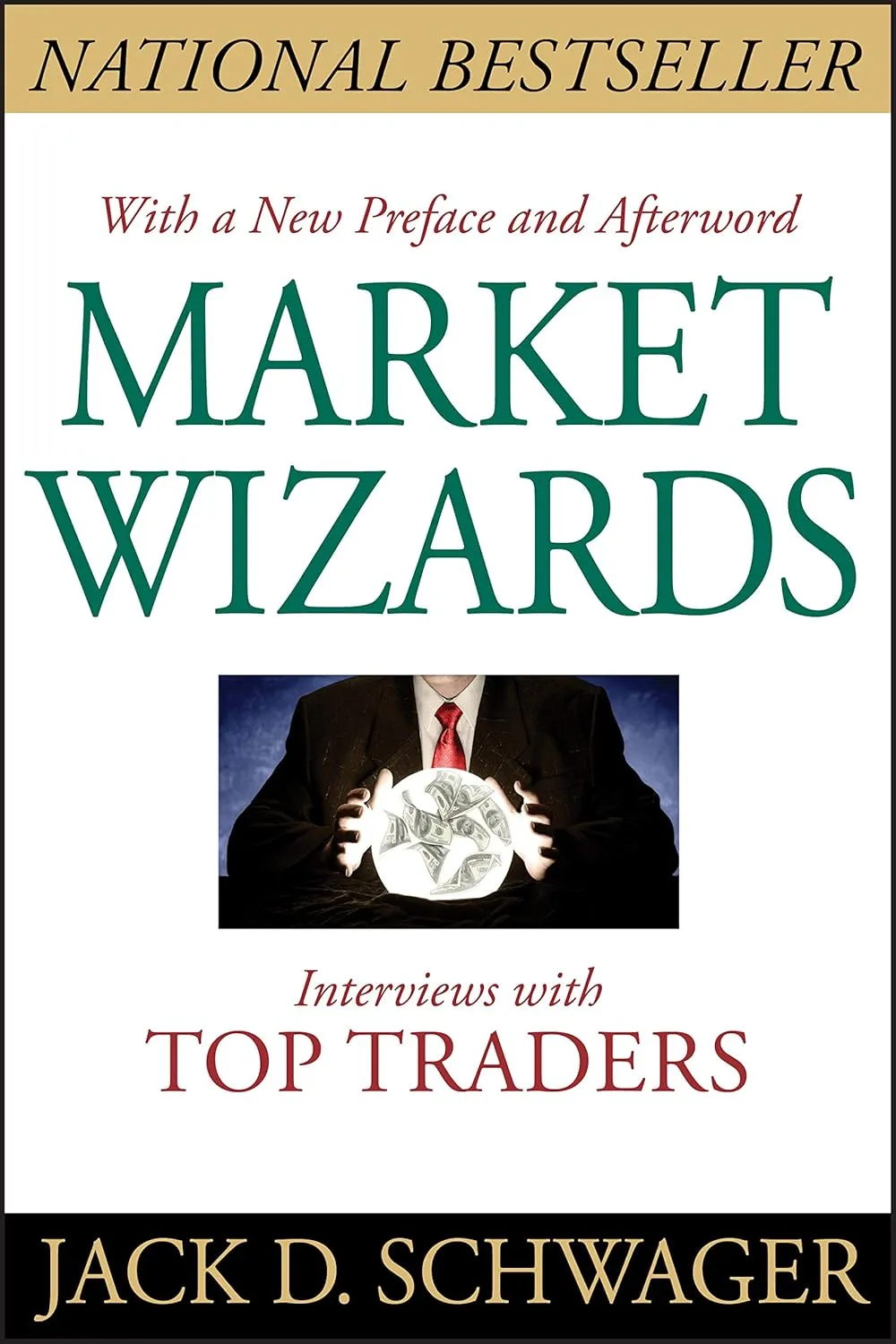
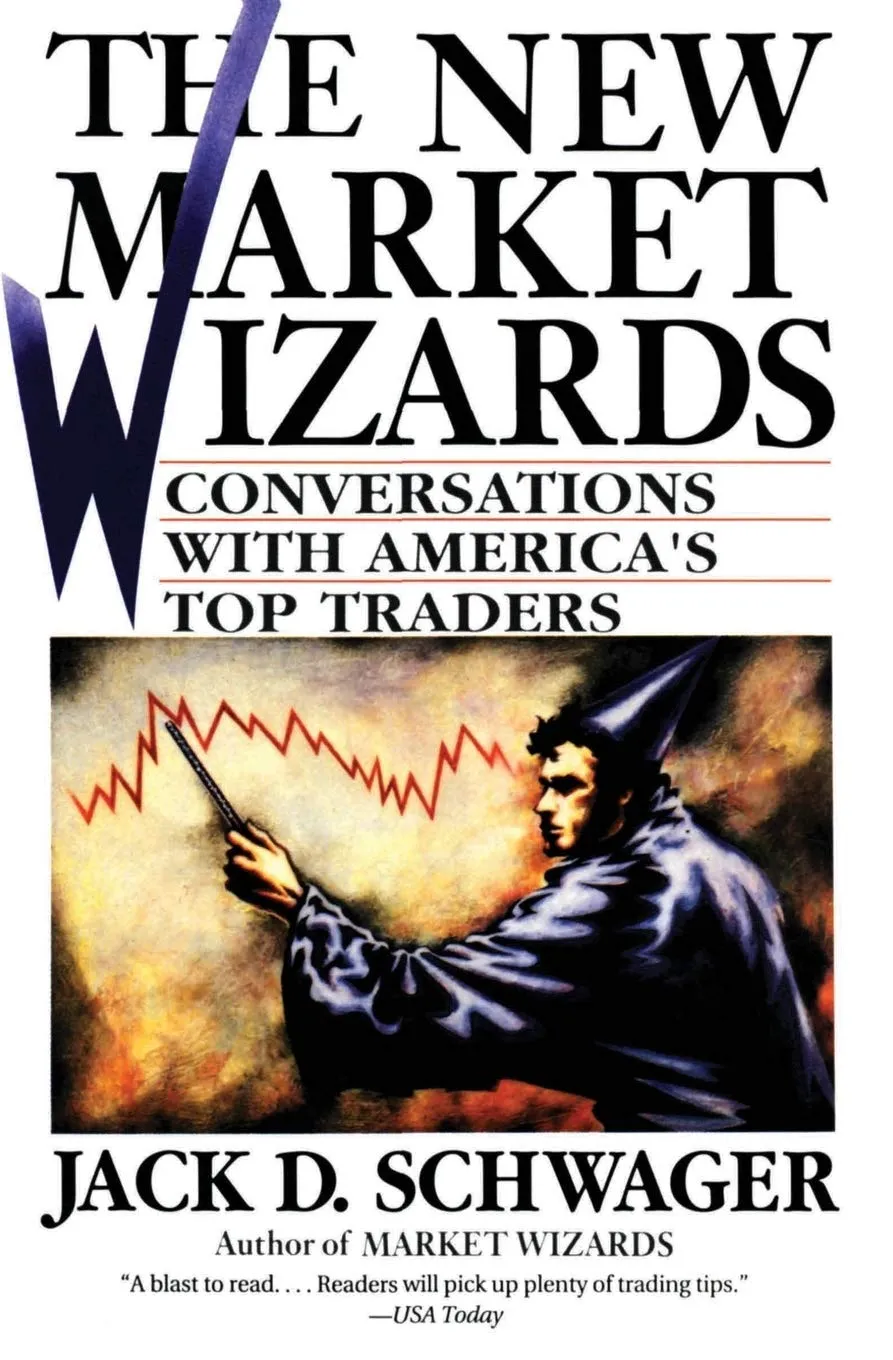
Published in 1992, The New Market Wizards follows the same interview format as Market Wizards (1989) but features a different cast of trading legends. Where the original focused heavily on futures traders of the 1970s-80s, the New Wizards include equity traders, currency specialists, and a new generation who came of age in the more complex markets of the late 1980s.
Three decades later, the trading landscape has transformed beyond recognition. Algorithmic trading now accounts for over 70% of U.S. equity volume. High-frequency firms execute trades in microseconds. Retail traders access institutional-grade tools through mobile apps. Yet the psychological principles these traders describe, the risk management frameworks they built, and the discipline they maintained through drawdowns remain the same. Technology changes; human psychology does not.
Book Details
| Attribute | Details |
|---|---|
| Title | The New Market Wizards |
| Author | Jack D. Schwager |
| Publisher | HarperBusiness |
| Published | 1992 |
| Pages | 493 |
| Reading Level | Intermediate |
| Amazon Rating | 4.6/5 stars |
Get Your Copy
Paperback: Buy on Amazon
Kindle: Buy on Amazon
The Featured Traders
Bill Lipschutz: The Sultan of Currencies
Lipschutz was Salomon Brothers' global head of foreign exchange in the late 1980s, trading $250 billion in currencies daily. He turned $12,000 in inherited stock into $250,000, then lost it all in one reckless options trade, then rebuilt from scratch to become one of the best FX traders alive.
His core lessons:
Lesson 1: Be willing to be wrong. "If I have a position going against me, I get right out. If they are going for me, I keep them. Risk control is everything."
Lesson 2: Think asymmetrically. "You have to be willing to make asymmetric bets, where the potential upside is substantially larger than the potential downside. And then size them correctly."
Lesson 3: The hardest part of trading. Lipschutz argues the psychological challenge of holding positions through normal volatility without being shaken out is the primary differentiator between good and great traders. Most traders who are analytically sound still fail because they cannot psychologically hold positions through the normal noise of markets.
Lipschutz on position sizing:
He managed currency positions worth hundreds of billions for Salomon. His framework: the size of any position should be calibrated to the amount of volatility you can handle psychologically, not just what your risk management formula says. If a position is large enough that you're checking prices constantly and making impulsive adjustments, it's too large for you regardless of what the math says.
Stanley Druckenmiller: The Soros Deputy
Druckenmiller managed the Quantum Fund for George Soros and is one of the most successful macro traders of all time. His most famous trade: the 1992 shorting of the British pound that earned $1 billion in one day.
The Black Wednesday Trade (September 16, 1992):
Background: The UK had joined the European Exchange Rate Mechanism (ERM) in 1990, fixing the pound's value against the German Deutsche Mark. The fixed rate was too high. The UK economy was in recession and needed looser monetary policy, but the ERM commitment required higher rates to defend the pound peg.
Druckenmiller's analysis:
The trade:
The result: $1 billion profit in a single day. The British government spent £3.3 billion defending the pound and failed. The UK withdrew from the ERM. Interest rates were cut. The UK economy subsequently outperformed those that remained in the ERM.
Investment lessons from Black Wednesday:
| Lesson | Application |
|---|---|
| Governments cannot fight markets indefinitely | Pegged exchange rates eventually break if fundamentally misaligned |
| Size appropriately to conviction | Soros and Druckenmiller sized their largest trade to match their highest conviction |
| Risk/reward must be asymmetric | Downside (pound stays strong, modest loss on short) vs. upside (devaluation, enormous gain) was clearly asymmetric |
| Political will is a finite resource | The UK could not sustain politically unpopular high interest rates to defend an overvalued currency |
Druckenmiller on concentration:
"I've never felt the urge to diversify. If you've done your homework and you have a high-conviction idea, why would you dilute it with your 20th-best idea? Diversification is for people who don't know what they're doing."
This contrasts sharply with passive index fund investing advice. But Druckenmiller is operating at a level of analysis and information depth where his view is internally consistent. For ordinary investors, diversification remains the rational default. For Druckenmiller, concentration in his highest-conviction trade was the rational choice given his edge.
Mark Ritchie: The Speculator
Ritchie traded commodities futures for 20 years with exceptional results. His interview covers the psychological development of a successful trader.
Ritchie on the three stages of trader development:
Stage 1: Learning the market. Understand how prices move, what drives supply and demand, how participants behave. This typically takes 2-5 years of actual trading with real money.
Stage 2: Learning yourself. Identify your specific psychological weaknesses. Are you prone to holding losers? Exiting winners too early? Trading too large? Each trader has specific failure modes. This stage requires honest self-examination and often requires losing money to identify the patterns.
Stage 3: Integration. Combine market knowledge with self-knowledge to develop a strategy that works with your psychology rather than against it. A trader who knows the market but has not done the psychological work will fail. A trader who has done the psychological work but lacks market knowledge will also fail. Both are required.
His risk management framework:
Ritchie uses a simple rule: never risk more than 2% of capital on any single trade. At this position size, you can have 20 consecutive losing trades and still have 66% of your capital. Recovery from 20 losses is psychologically and financially possible. Recovery from a 50% drawdown (caused by larger position sizes) is much harder.
The 2% rule compound effect:
| Consecutive Losses | Capital Remaining (2% risk per trade) |
|---|---|
| 5 | 90.4% |
| 10 | 81.7% |
| 15 | 73.9% |
| 20 | 66.8% |
| 30 | 54.5% |
Even 30 consecutive losses leave more than half the capital intact. With larger position sizes, far fewer losses produce catastrophic outcomes.
William Eckhardt: The Mathematician
Eckhardt was Richard Dennis's partner in the famous Turtle Trader experiment, where they trained 23 individuals with no trading background to follow a specific trend-following system. The Turtles went on to collectively earn hundreds of millions following the methodology.
Eckhardt's philosophy:
Eckhardt is unusual among market wizards for being entirely systematic. He does not use discretionary judgment. Every trade is defined by rules derived from historical data analysis.
2026 context: The Turtle experiment's trend-following principles have been codified into modern systematic trading strategies. Firms like AQR Capital Management and Man AHL run billion-dollar trend-following programs that share DNA with the Turtle system. The key difference: modern systems trade dozens of markets simultaneously with millisecond execution, whereas the Turtles tracked futures prices in newspapers. AQR's 2025 research on trend-following confirmed that the factor has delivered positive returns in 14 of the past 20 years, with particularly strong performance during market dislocations. The core insight Eckhardt describes, that rules-based systems outperform discretionary judgment over time, has been validated by decades of quantitative research.
His key insights:
On the edge: "You should have a demonstrable statistical edge. If you can't define your edge clearly enough to program it into a computer, you probably don't have one."
On human judgment: "The human brain is poorly adapted to probability. It finds patterns in noise and assigns confidence to them. For systematic trading, you must override this tendency with rules derived from genuine historical data."
On diversification for systematic traders: Unlike discretionary traders who concentrate in high-conviction ideas, systematic traders should trade the widest possible range of markets to diversify across strategy performance cycles. A trend-following system that performs poorly in choppy equity markets may perform well in trending commodity markets.
The Cross-Cutting Themes
Schwager summarizes the consistent themes across all his wizard interviews:
Theme 1: Every Wizard Has a Distinctive Edge
There is no single method shared among the best traders. Some are fundamental analysts, some are pure technicians, some are systematic quantitative traders, some trade based on supply/demand analysis in physical commodities. What they share is that each has identified a genuine edge and executes it with discipline.
The implication for would-be traders: Copying another trader's strategy rarely works because the psychological profile required to execute each strategy is different. The strategy must fit the trader.
Theme 2: Risk Management Is Universal
Regardless of strategy, all the wizards have rigorous risk management:
| Principle | Application |
|---|---|
| Define maximum loss before entry | Stop loss level determined before trade |
| Position size to volatility | Smaller positions in more volatile markets |
| Portfolio-level risk | Total portfolio risk limited regardless of individual positions |
| Avoid averaging down | Adding to losing positions is the most common catastrophic error |
| Protect against worst case | What if everything goes wrong simultaneously? |
Theme 3: Psychological Discipline Is the Differentiator
Technical analysis or fundamental analysis creates a tradeable edge. Psychological discipline converts that edge into long-run profits. Traders who cannot maintain discipline (holding losers, over-trading, abandoning systems during drawdowns) fail regardless of the quality of their analysis.
Theme 4: Losses Are Acceptable; Catastrophic Losses Are Not
Every wizard has losing trades. None has had a permanent catastrophic loss. The distinction: managed losses (defined, accepted, moved on from) versus unmanaged losses (holding hoping to break even, adding to losing positions, refusing to accept being wrong).
2026 relevance: The 2025-2026 market environment tested this principle severely. Momentum stocks delivered one of the strongest quarterly returns on record in Q2 2026, up more than 40%, driven by AI-related semiconductor and technology stocks. Traders who chased momentum without defined risk limits faced asymmetric downside when the inevitable reversals came. The wizards' discipline of defining maximum loss before entry, not after, remains the single most important differentiator between traders who survive and traders who blow up.
Comparison: Market Wizards vs. New Market Wizards
| Dimension | Market Wizards | New Market Wizards |
|---|---|---|
| Era | 1970s-80s traders | 1980s-90s traders |
| Primary markets | Futures, commodities | More equities, currencies |
| Famous trades | Turtles, Dennis | Black Wednesday (Druckenmiller) |
| Style diversity | Heavy trend-following | More strategy diversity |
| Overall quality | Slightly higher (original cast) | Nearly as good |
Both books are essential. Read Market Wizards first; New Market Wizards second.
Strengths & Weaknesses
What We Loved
Areas for Improvement
Who Should Read This Book
Highly Recommended For
Probably Not For
Final Verdict
Rating: 4.6/5
The New Market Wizards is an excellent companion to Market Wizards. The Druckenmiller and Eckhardt interviews alone justify reading it. Essential for anyone studying professional trading psychology and methodology.
The book's core lessons have survived the transition from open-outcry pits to algorithmic markets. The 2% risk rule Ritchie describes, the asymmetric thinking Lipschutz advocates, and the systematic discipline Eckhardt preaches all apply equally to a retail trader using a mobile app in 2026 as they did to floor traders in 1992. What has changed is the speed of execution and the sophistication of tools. What has not changed is the psychological discipline required to use them well.
For investors who prefer passive strategies, the risk management principles alone are worth the read. Pair this book with our investment return calculator to model how position sizing and loss avoidance affect long-term outcomes.
Get Your Copy
Paperback: Buy on Amazon
Kindle: Buy on Amazon
Prices current as of publication date. Free shipping available with Prime.