*Disclosure: This article contains affiliate links. If you purchase through these links, we may earn a commission at no additional cost to you. We only recommend books we genuinely believe in.
Quick Overview
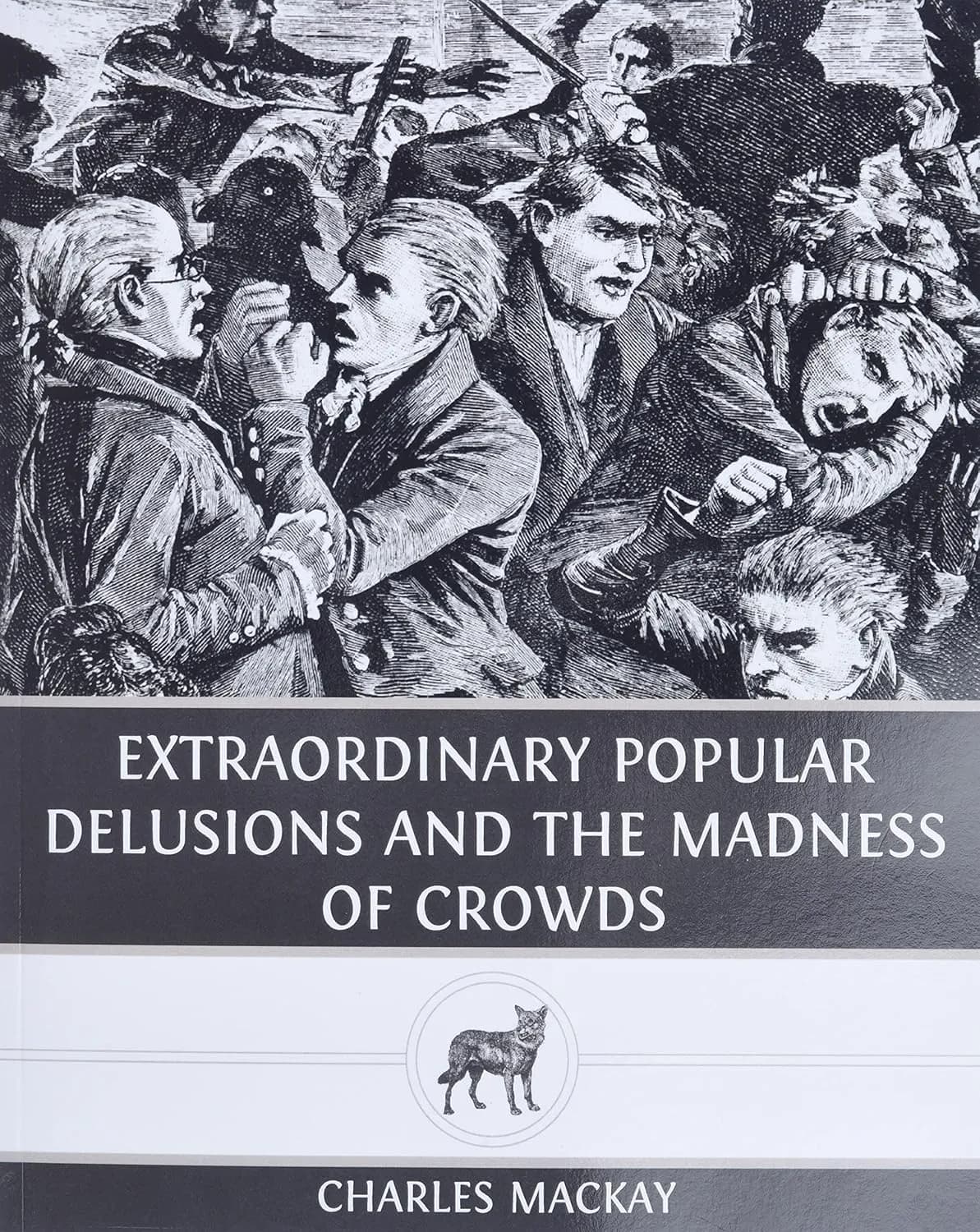
At the peak of the South Sea Bubble in 1720, an anonymous promoter opened a subscription for "a company for carrying on an undertaking of great advantage, but nobody to know what it is." He collected 2,000 pounds in five hours and vanished by afternoon. Read that in 2026 and try not to think of meme coins. Charles Mackay collected this anecdote and hundreds like it in 1841, producing the first systematic catalog of what happens when crowds lose their minds. His thesis fits in one sentence: "Men, it has been well said, think in herds; it will be seen that they go mad in herds, while they only recover their senses slowly, and one by one." Nearly 185 years later, that sentence remains the most quoted line in financial history, and the patterns Mackay documented are playing out in real time across crypto markets, meme stocks, and AI stock manias.
Book Details
| Attribute | Details |
|---|---|
| Title | Extraordinary Popular Delusions and the Madness of Crowds |
| Author | Charles Mackay |
| First Published | 1841 |
| Pages | 752 (full edition) |
| Reading Level | Intermediate |
| Amazon Rating | 4.5/5 stars |
Get Your Copy
Paperback: Buy on Amazon
Kindle: Buy on Amazon
About the Author
Charles Mackay (1814-1889) was a Scottish poet, journalist, and author who worked for The Illustrated London News. He wrote Extraordinary Popular Delusions at age 27, drawing on historical records, contemporary accounts, and his own eye for human absurdity. The book became a bestseller and has never gone out of print. Bernard Baruch credited it with helping him sell all his stock ahead of the 1929 crash. Mackay was, ironically, not immune to the manias he documented: as Tim Harford revealed, Mackay wrote an editorial in 1845 declaring that Railway Mania was not a bubble, that railways were "a necessity of the age" with "broad and secure" foundations. Shares crashed within weeks.
Key Concepts & Frameworks
The Tulip Mania (1634-1637)
Mackay's tulip mania chapter is the most famous financial history account ever written, and the most debated.
Tulips were introduced to Western Europe from the Ottoman Empire in the mid-16th century. By the early 17th century, unusual color patterns (caused by a virus not then understood) made certain bulbs status symbols among the Dutch wealthy. By 1634, a futures market had developed. Speculators traded contracts for bulbs not yet in existence.
| Bulb Variety | 1624 Price | 1637 Peak Price |
|---|---|---|
| Semper Augustus | 1,000 guilders | 6,000 guilders |
| Viceroy | 3 guilders | 900 guilders |
| Common bulbs | 0.1 guilder | 0.6 guilder |
At peak mania, a single Semper Augustus bulb reportedly sold for enough to buy a grand Amsterdam house. Workers reportedly sold their tools to fund speculation.
In February 1637, at a routine bulb auction in Haarlem, no buyers appeared at expected prices. Word spread. Within days, prices collapsed across all varieties. Contracts became worthless. Fortunes evaporated.
The modern revision: Subsequent research by Anne Goldgar and Peter Garber has found that Mackay substantially exaggerated the mania. Actual prices were lower than reported, fewer people were involved, and fewer fortunes were destroyed. The mania was real; Mackay's colorful details were partly invented.
The lesson that survives the revision: Even a smaller tulip mania demonstrates that futures markets for purely speculative assets can sustain prices far above any fundamental value, and that the collapse can be as sudden as the rise. The specific numbers matter less than the pattern. As Long Arc Research noted in 2026, "Read the South-Sea chapter and you encounter a man investing in a venture whose only selling point is its own mysteriousness. Read that in 2026 and try not to think of meme coins."
The Mississippi Scheme (1719-1720)
John Law was perhaps the most creative financial engineer in history. France in 1719 was effectively bankrupt from Louis XIV's wars. Law proposed converting government debt into shares of the Mississippi Company, which held a trading monopoly with France's North American territories.
Law established the Banque Generale, issued paper money backed by bank deposits, merged the bank with the Mississippi Company, and had government debt holders exchange bonds for shares. He then printed more money, which investors used to buy more shares, inflating prices further.
| Date | Mississippi Company Share Price |
|---|---|
| January 1719 | 500 livres |
| December 1719 | 10,000 livres |
| January 1720 | 20,000 livres (peak) |
In 13 months, shares rose 40x. Law was appointed Controller-General of Finance. Then investors tried to convert paper fortunes into gold and silver. There was far more paper than metal. The bank suspended convertibility. Confidence collapsed. By September 1720, shares were back near their starting point. Law fled France and died in Venice nine years later.
Despite the disaster, Law's innovations were eventually adopted worldwide: paper money, central banking, and government debt conversion to equity. The lesson: financial innovations that fail in their first iteration often succeed in their second or third.
The South Sea Bubble (1720)
The South Sea Bubble ran parallel to Law's Mississippi Scheme. The South Sea Company was granted a monopoly on British trade with South America in 1711. The monopoly was theoretical since Spain controlled South America. The real business was financial: converting British government debt into company shares.
The company used every available technique to inflate its share price: loans to buyers secured by the shares themselves (circular financing), bribery of government officials, optimistic press releases about trading prospects despite no actual trade, and share sales at rising prices to fund further promotion.
| Date | South Sea Company Share Price |
|---|---|
| January 1720 | 128 pounds |
| May 1720 | 550 pounds |
| June 1720 | 890 pounds |
| July 1720 (peak) | 1,050 pounds |
| December 1720 | 150 pounds |
During the mania, hundreds of bubble companies formed. One raised 500,000 pounds for "carrying on an undertaking of great advantage, but nobody to know what it is." Another sought 1,000,000 pounds for "a wheel of perpetual motion." Mackay noted that "every fool aspired to be a knave."
The Six Stages of Mass Mania
Based on Mackay's accounts, a consistent psychological pattern emerges:
| Stage | Characteristics |
|---|---|
| 1. Novelty | A new investment opportunity appears; early adopters benefit |
| 2. Public notice | Successes become widely known; more people investigate |
| 3. Enthusiasm | Media coverage intensifies; new participants flood in |
| 4. Greed | Rational analysis is suspended; price is justified by further price rises |
| 5. Peak | Late arrivals exhaust the supply of greater fools; distribution begins |
| 6. Panic | Early sellers have exited; remaining holders panic; prices collapse |
This pattern repeats in every bubble Mackay documents and in every subsequent bubble documented by Chancellor, Kindleberger, and Shiller.
Practical Applications
Applying Mackay to Modern Markets
Before investing in any strongly promoted asset, apply Mackay's pattern recognition test:
| Question | Red Flag Answer |
|---|---|
| Is the investment widely discussed in mainstream media? | Yes, broadly known opportunities are usually fully priced |
| Are ordinary non-investors excited about it? | Yes, peak retail enthusiasm marks tops |
| Are smart people explaining why old valuation rules do not apply? | Yes, "this time is different" precedes every crash |
| Has the price risen dramatically in a short period? | Yes, rapid appreciation attracts crowd psychology |
| Are people borrowing to invest? | Yes, leverage amplifies both gains and losses |
| Is the asset generating derivatives markets? | Yes, leverage instruments multiply speculative positions |
The Contrarian Challenge
Mackay's work has one clear investment lesson: when you observe the pattern of mass mania, move in the opposite direction. This is psychologically difficult. The social pressure to participate during manias is enormous. The person who does not participate in a rising market feels foolish. The person who sells early is ridiculed for "leaving money on the table." The contrarian is vindicated only after the collapse, by which time everyone has forgotten who said what before the peak.
The Expert Capitulation Signal
Mackay documents that during each mania, leading intellectuals and financial authorities endorsed the speculation. Sir Isaac Newton initially invested in the South Sea Bubble, sold at a profit, then reinvested near the peak and lost 20,000 pounds. Newton reportedly said: "I can calculate the motions of heavenly bodies, but not the madness of people."
The investment principle: expert consensus during a mania is not evidence that the mania is justified. It is evidence that experts are as susceptible to crowd psychology as anyone else. The most dangerous period of any bubble is when smart, respected people are providing intellectual justification for it.
Strengths & Weaknesses
What We Loved
Areas for Improvement
Who Should Read This Book
Highly Recommended For
Probably Not For
Comparison to Similar Books
vs. Irrational Exuberance by Robert Shiller
| Aspect | Mackay | Shiller |
|---|---|---|
| Era | 1841 | 2000 (updated through 2025) |
| Approach | Historical storytelling | Data-driven analysis |
| Scope | All crowd delusions | Financial bubbles specifically |
| Best for | Historical pattern recognition | Understanding current market valuation |
vs. Devil Take the Hindmost by Edward Chancellor
| Aspect | Mackay | Chancellor |
|---|---|---|
| Published | 1841 | 1999 |
| Scope | Financial + social manias | Financial speculation only |
| Analytical depth | Low (storytelling) | High (analytical) |
| Best for | Original source material | Analytical sophistication |
Implementation Guide
The Bubble Recognition Checklist
When evaluating any hot investment, work through these questions:
Frequently Asked Questions
Q: Is Mackay's account of tulip mania accurate?
A: No, not entirely. Anne Goldgar and Peter Garber independently found that Mackay greatly exaggerated the scale and effects. Actual prices were lower, fewer people were involved, and fewer fortunes were destroyed. The mania was real but smaller than Mackay reported. The pattern matters more than the specific numbers.
Q: Is this book relevant to crypto and meme stocks?
A: Directly. The South Sea Bubble company that raised money for "an undertaking of great advantage, but nobody to know what it is" is the 1720 equivalent of a meme coin. The six stages of mass mania map perfectly onto the 2021 crypto cycle, the meme stock frenzy, and the AI stock rally.
Q: Should I read the full 752-page edition?
A: Only if you want the complete work. The financial chapters (tulip mania, Mississippi Scheme, South Sea Bubble) are maybe 150 pages. An abridged edition focusing on those chapters gives you 90% of the value in a fraction of the reading time.
Final Verdict
Rating: 4.5/5
Extraordinary Popular Delusions is the primary-source layer of crowd psychology. Every modern treatment of speculative manias depends on it, whether it says so or not. The tulip, Mississippi, and South Sea chapters are irreplaceable. Despite some factual embellishment, Mackay's core observations about crowd psychology, contagion, and expert capitulation during manias are as valid in 2026 as in 1841. Read it for the pattern recognition, then read Shiller or Chancellor for the analytical framework that builds on it.
Get Your Copy
Paperback: Buy on Amazon
Kindle: Buy on Amazon
Prices current as of publication date. Free shipping available with Prime.