*Disclosure: This article contains affiliate links. If you purchase through these links, we may earn a commission at no additional cost to you. We only recommend books we genuinely believe in.
Quick Overview
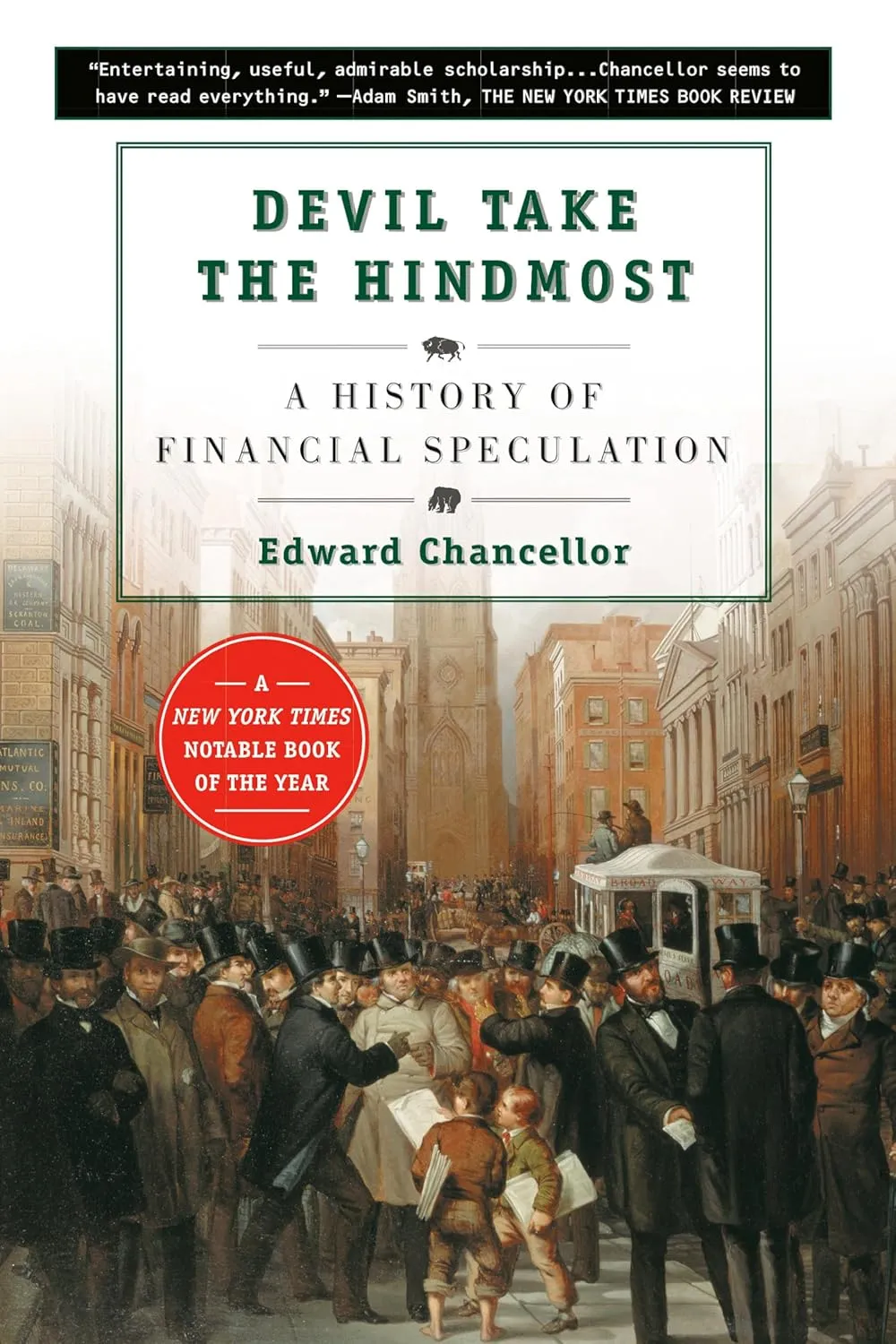
In a January 2026 paper co-authored with Jeremy Grantham, Edward Chancellor warned that the AI investment boom exhibits every classic sign of a speculative mania. He should know. He wrote the definitive history of financial speculation. Devil Take the Hindmost traces manias from 17th-century Amsterdam through the South Sea Bubble, railroad manias, the 1929 crash, the Japanese bubble, and the dot-com era. Chancellor demonstrates that speculation is not a modern aberration but a persistent feature of capitalist economies, and that the specific patterns of each mania are remarkably consistent across four centuries. In a 2024 interview with The Market NZZ, Chancellor said of the AI boom: "To me, today looks horribly similar to previous bubbles." He pointed to circular revenues (Microsoft investing in OpenAI, which then buys Microsoft cloud services), megalomaniac leaders hyping their industry, and nearly 90% of venture funding flowing into a single sector. The book that predicted the dot-com crash now reads as a warning about whatever bubble is inflating next.
Book Details
| Attribute | Details |
|---|---|
| Title | Devil Take the Hindmost: A History of Financial Speculation |
| Author | Edward Chancellor |
| Publisher | Plume |
| Published | 1999 |
| Pages | 368 |
| Reading Level | Intermediate |
| Amazon Rating | 4.5/5 stars |
Get Your Copy
Paperback: Buy on Amazon
Kindle: Buy on Amazon
About the Author
Edward Chancellor is a financial journalist, historian, and investment advisor. After writing Devil Take the Hindmost, he worked as a financial strategist at GMO (Jeremy Grantham's firm) where he wrote extensively on investment bubbles and valuation. He is the author of The Price of Time (2022), a history of interest rates. In January 2026, he co-authored a paper with Jeremy Grantham titled "Valuing AI: Extreme Bubble or New Golden Era?" arguing that the AI investment boom exhibits classic signs of a speculative mania. He also helped write Grantham's autobiography, The Making of a Permabear. He is widely regarded as one of the best historical analysts of speculative markets.
The Anatomy of a Speculative Mania
Chancellor identifies consistent characteristics across every speculative mania in history:
The Preconditions
1. Easy credit: Every major mania was preceded by an expansion of credit that made speculation more accessible.
2. A genuine new opportunity: Manias rarely occur around purely fraudulent opportunities. The railroads were genuinely transformative. The internet genuinely changed commerce. Japanese land scarcity was real. The speculative excess builds on a true foundation.
3. A plausible narrative: Each mania develops a story that explains why this time is different, why old valuation metrics do not apply and new ones are needed.
4. New participants: Retail investors who have no experience with the cycle's darker phase enter near the peak, having seen only the gains.
The Development Pattern
| Stage | Characteristics |
|---|---|
| Quiet accumulation | Informed early investors buy as credit expands |
| Public excitement | Media coverage increases; narrative spreads |
| Mass participation | Retail investors enter; new financial products created |
| Euphoria | Valuations detach from fundamentals; skeptics dismissed |
| Distribution | Informed investors exit; maintain appearances of commitment |
| Collapse | Credit contracts; forced selling; narrative collapses |
| Aftermath | Fraud exposed; regulations enacted; industry restructured |
The Historical Manias
Amsterdam: The World's First Stock Exchange (1630s-1690s)
Amsterdam created the institutional infrastructure for modern capitalism: the world's first joint-stock company (VOC, 1602), the world's first securities exchange (1611), short selling, options, futures, margin lending, and market manipulation. All the features of modern markets existed in 17th-century Amsterdam.
The tulip mania (1634-1637):
Chancellor's tulip account goes deeper than most. The mania occurred in a specific context:
The futures market was the crucial innovation: it allowed speculation far beyond the physical supply of bulbs. Contracts on future-delivery bulbs circulated among speculators who had no intention of taking physical delivery, pure financial speculation on price.
The collapse:
In February 1637, a routine bulb auction in Haarlem failed to attract buyers at the asking price. Word spread. Within days, the entire futures market collapsed. Most contracts were never fulfilled. The Dutch legal system, overwhelmed by the volume of contract disputes, ultimately refused to enforce many of the futures contracts, treating them as gambling debts.
The enduring lessons:
The South Sea Bubble (1720)
Chancellor provides the most thorough account of the South Sea Bubble available in a popular book.
The structural mechanics:
The South Sea Company was granted a monopoly on British trade with South America. The real business never amounted to much. Spain controlled South America and had no interest in granting access to British traders. The real business was financial engineering: the company was converting British government debt into South Sea shares.
The convertibility mechanism:
Britain's government had accumulated enormous debt from the wars of the previous two decades. The South Sea Company offered to take over this debt in exchange for shares. Holders of government bonds could exchange them for South Sea shares. The company's profits (ostensibly from the trade monopoly) would service the converted debt.
Why the price spiral:
The company itself controlled the share price during the conversion phase. It lent money to buyers of its own shares (using the shares as collateral). Rising share prices made the collateral more valuable, allowing more lending, which funded more buying, which drove prices higher. A perfectly circular price inflation that required continuously rising prices to function.
When the circle broke:
When the directors began selling their own shares in August 1720, the market detected the distribution. The Bank of England refused to extend further credit. The price collapsed from £1,000 to £150 within weeks.
The human consequences:
The investment lesson:
When insiders begin selling while publicly encouraging buying, distribution is underway. The specific mechanism (share lending, convertibility) can make this difficult to detect. Watching for insider selling relative to insider buying is a valuable signal.
The Railroad Manias (1825, 1845, 1860s, 1890s)
Chancellor is among the first historians to document that there were multiple distinct railroad manias, not just one. Each mania funded genuine railroad construction. Each also massively overbuilt routes and overpriced securities. Each ended in widespread bankruptcy.
The pattern:
| Phase | Activity |
|---|---|
| Innovation | First railways prove commercially viable |
| Enthusiasm | Projectors propose hundreds of new lines |
| Parliamentary approval | Government authorizes most proposed lines |
| Capital raising | Share subscriptions oversubscribed |
| Construction frenzy | Tens of thousands of workers employed |
| Rate wars | Too many lines compete for traffic |
| Bankruptcy | Most lines cannot service their construction debt |
| Reorganization | Strongest lines absorb weaker ones at distressed prices |
The railroad investors who did best were not those who bought the original shares at peak enthusiasm. They were those who bought the reorganized companies' bonds at distressed prices after the crash.
Application to modern technology:
The internet bubble of 1995-2000 followed this pattern precisely. Enormous overinvestment in fiber optic infrastructure. Most companies went bankrupt. The fiber, however, remained, purchased in bankruptcy by successors who deployed it at zero marginal cost. The technological transformation was real; the share prices at peak were not justified. Chancellor noted in a 2025 podcast that an engineer at Bell Labs named Andrew Odlyzko published a paper around the 2000 peak laying out the true demand growth for fiber optic capacity. The accurate figures existed, in print, in real time, and "no one paid attention to it." The market preferred the exciting number to the correct one.
The 1920s and the 1929 Crash
Chancellor's account of the 1920s mania is enriched by comparison to the earlier manias:
New financial products of the 1920s:
The leverage amplification:
Investment trusts of the 1920s used leverage, borrowing to increase their share portfolios. When the market rose 50%, a 2x leveraged trust rose 100%. When the market fell 50% in 1929-1932, a 2x leveraged trust was wiped out.
Goldman Sachs Trading Corporation:
Goldman created multiple investment trusts in 1929, raising money from the public and investing it in other investment trusts (including other Goldman trusts). When the crash came, this pyramid of leverage amplified losses spectacularly. Goldman Sachs's reputation did not recover until after World War II.
The Japanese Bubble (1985-1990)
Japan's experience provides the most instructive modern case study because it combined stock market and real estate mania simultaneously, and the aftermath (the "Lost Decade") shows what happens when policy fails to address the bust.
The scale of Japanese asset inflation (1985-1990):
| Asset | Price Change |
|---|---|
| Tokyo Stock Exchange (Nikkei) | +238% |
| Tokyo commercial real estate | +300%+ |
| Imperial Palace grounds | Estimated value: more than entire California |
At peak, the total notional value of all Japanese real estate was five times the total value of all U.S. real estate, despite Japan being 1/25th the land area.
The crash:
The Bank of Japan raised rates in 1989. The Nikkei peaked at 38,916 in December 1989. By August 1992 it had fallen to 14,309, a 63% decline. Real estate followed more slowly but fell equally dramatically.
The aftermath, the Lost Decade:
Japan's policy response to the bust was inadequate:
Japan's Nikkei did not recover its 1989 peak for 35 years, until 2024. Real estate in many areas never recovered.
The investment lesson:
Asset price bubbles of sufficient size can produce multi-decade recoveries. The Great Depression, Japan's Lost Decade, and other post-bubble periods demonstrate that "just wait for the recovery" requires more patience than most investors realize. This is an argument for never paying prices that require perfect execution of an optimistic scenario. For more on how market crashes affect your portfolio, read our guide on what happens to investments in a stock market crash.
The Consistent Warning Signs Across All Manias
Chancellor distills the common warning signs:
Quantitative Warning Signs
| Indicator | Warning Level |
|---|---|
| Market P/E ratio | Above 25x (vs. long-run average ~15x) |
| Price-to-book ratio | Above 3x market-wide |
| Shiller CAPE ratio | Above 30x |
| Price-to-GDP ratio (Buffett Indicator) | Above 150% |
| IPO volume | Multi-year record highs |
| Margin debt | Record highs as % of market cap |
Qualitative Warning Signs
| Sign | Description |
|---|---|
| New valuation metrics | Old metrics "don't apply anymore" |
| Taxi driver tips | Unsophisticated investors confidently recommending specific stocks |
| Magazine cover curse | Mainstream media celebrates the mania's leaders |
| Extrapolation of recent returns | "It's gone up every year for five years" |
| Complexity as justification | New financial products whose complexity obscures risk |
| Demographic destiny narratives | "Baby boomer investing will keep markets high forever" |
Speculation: Beneficial or Destructive?
Chancellor engages the genuine debate about speculation's social value:
The case for speculation:
The case against speculation:
Chancellor's balanced conclusion:
Speculation is inseparable from capitalism. Attempts to eliminate it (Bubble Act of 1720, short-selling bans) typically fail and harm legitimate market functioning. The better approach: maintain adequate capital requirements, limit leverage, ensure disclosure, and educate investors about historical patterns.
Strengths & Weaknesses
What We Loved
Areas for Improvement
Who Should Read This Book
Highly Recommended For
Probably Not For
Frequently Asked Questions
Q: Is this better than Manias, Panics, and Crashes for understanding bubbles?
A: Different strengths. Kindleberger's book provides the theoretical framework (Minsky model) and systematic analysis. Chancellor provides richer narrative detail and qualitative warning signs. Read both for the complete picture.
Q: Is Japan's experience relevant to other countries?
A: Directly relevant. Japan's Lost Decade provided the template for what to avoid post-2008. Bernanke's Fed acted aggressively in 2008-2009 partly to avoid Japan's policy errors. The lesson applies wherever credit-financed asset bubbles of sufficient size develop. Chancellor's 2024 interview with The Market NZZ drew explicit parallels between the AI infrastructure buildout and the dot-com fiber optic glut, noting that in both cases the technology was real but the investment returns were poor. For practical steps to protect your portfolio during market turbulence, see our guide on what happens when the market crashes.
Final Verdict
Rating: 4.6/5
Devil Take the Hindmost is the richest narrative history of speculative manias available. Its consistent warning signs, the Japanese bubble account, and the railroad mania analysis provide genuinely valuable investment education. Every investor who wants to recognize bubble conditions before they become obvious should read it.
Chancellor's more recent work confirms the patterns he documented in 1999 are still repeating. If you want to understand why bubbles keep happening and why smart people keep getting caught in them, this book is the best starting point. For a practical guide to staying invested through the inevitable downturns, read our piece on the real cost of waiting to invest.
Get Your Copy
Paperback: Buy on Amazon
Kindle: Buy on Amazon
Prices current as of publication date. Free shipping available with Prime.