
What Is an Index Fund and Why Does Everyone Recommend Them?
Index funds are the most widely recommended investment for beginners and experts alike. Here's exactly what they are, how they work, and why the evidence behind them is so compelling.

If you've spent any time reading about investing, you've encountered the same recommendation over and over: buy index funds. From Warren Buffett to personal finance bloggers to your financially savvy coworker, the advice is consistent. But what actually is an index fund, why does it outperform most alternatives, and how do you use one?
This is the complete plain-English explanation: no jargon, no assumptions, no hand-waving.
What Is an Index?
Before understanding index funds, you need to understand what an index is.
A stock market index is a list of companies selected according to specific rules, used to represent the performance of a portion of the market. You've heard of the major ones:
- S&P 500: The 500 largest publicly traded U.S. companies by market capitalization. Companies like Apple, Microsoft, Amazon, Nvidia, and Berkshire Hathaway.
- Dow Jones Industrial Average (DJIA): 30 large U.S. companies, the oldest and most quoted index, though less comprehensive than the S&P 500.
- Russell 2000: 2,000 smaller U.S. companies.
- Total Stock Market Index: Essentially all publicly traded U.S. companies, over 3,500.
- MSCI World Index: Large and mid-cap stocks across 23 developed countries.
An index is not something you can invest in directly. It is a measurement that tells you how a group of stocks is performing overall.
What Is an Index Fund?
An index fund is an investment fund designed to replicate the performance of a specific index by holding all (or nearly all) of the stocks in that index in the same proportions.
If the S&P 500 index consists of 500 companies, and Apple represents 7% of the index's total value, an S&P 500 index fund holds approximately 7% of its assets in Apple stock. When the composition or weighting of the index changes, the fund adjusts automatically.
The critical distinction: an index fund is passively managed. Nobody is deciding which stocks to buy or sell based on analysis or predictions. The fund simply mirrors the index, mechanically and continuously.
This is the opposite of an actively managed fund, where professional portfolio managers research companies, make predictions, and decide which stocks to own in an attempt to beat the market.
Why Index Funds Beat Most Actively Managed Funds
Here is the surprising finding that changed how most serious investors think about the market: actively managed funds, on average, underperform index funds over long time periods.
This is not opinion. It is the conclusion of decades of academic research and industry data.
The S&P SPIVA Scorecard tracks the performance of actively managed funds against their benchmark indexes. The year-end 2025 results for U.S. large-cap equity funds:
| Time Period | % of Active Large-Cap Funds That Underperformed the S&P 500 |
|---|---|
| 1 year | 79% |
| 3 years | 67% |
| 5 years | 89% |
| 10 years | 90% |
| 20 years | 93% |
Over a 20-year period, 93% of actively managed U.S. large-cap equity funds underperform a simple S&P 500 index fund. The 2025 results were particularly brutal for active managers: 79% underperformed in a single year, the fourth-worst showing in the 25-year history of the SPIVA study, as large-cap dominance made it exceptionally difficult for stock pickers to keep up.
Why? Several compounding reasons:
Fees. Actively managed funds charge 0.5% to 1.5% per year in management fees. Index funds typically charge 0.03% to 0.20%. On a $100,000 portfolio, a 1% annual fee costs $1,000/year, and that fee compounds against you every year.
Trading costs. Active funds trade frequently, generating transaction costs and triggering taxable events (in non-retirement accounts) that drag on returns.
The efficient market problem. Stock prices already reflect publicly available information. Professional analysts are trying to find mispriced stocks in a market where millions of other smart analysts are doing the same. Consistently finding an edge is extraordinarily difficult.
Manager turnover and style drift. Even a fund with a genuinely skilled manager faces risks if that manager leaves, or if the fund grows too large to execute its strategy effectively.
The Fee Math: How Much Expense Ratios Cost Over Time
The expense ratio is the annual fee charged as a percentage of your invested assets. It is deducted automatically; you never write a check. But the long-term impact is enormous.
Assume a $10,000 initial investment, $300/month contributions, 8% gross annual return over 30 years:
| Fund Type | Expense Ratio | Final Portfolio Value | Fees Paid (opportunity cost) |
|---|---|---|---|
| Index fund | 0.03% | $448,700 | ~$1,300 |
| Low-cost active | 0.50% | $422,100 | ~$27,900 |
| Average active fund | 1.00% | $397,000 | ~$52,000 |
| High-cost active | 1.50% | $373,600 | ~$76,400 |
The 1.47 percentage point difference between a 0.03% index fund and a 1.50% active fund costs you $75,100 over 30 years on a modest investment. On larger portfolios, this number grows proportionally.
The Most Popular Index Funds: A Comparison
| Fund | Index Tracked | Expense Ratio | Brokerage | Min. Investment |
|---|---|---|---|---|
| FXAIX (Fidelity 500 Index) | S&P 500 | 0.015% | Fidelity | $0 |
| FZROX (Fidelity Zero Total Market) | Total U.S. Market | 0.00% | Fidelity only | $0 |
| VTI (Vanguard Total Stock Market ETF) | Total U.S. Market | 0.03% | Any brokerage | ~$1 (fractional) |
| VOO (Vanguard S&P 500 ETF) | S&P 500 | 0.03% | Any brokerage | ~$1 (fractional) |
| SWTSX (Schwab Total Stock Market Index) | Total U.S. Market | 0.03% | Schwab | $0 |
| VTSAX (Vanguard Total Stock Market Admiral) | Total U.S. Market | 0.04% | Vanguard | $3,000 |
FZROX deserves special mention: it has a 0.00% expense ratio, truly free to own. The catch is it is only available at Fidelity and uses a proprietary index rather than a standard one. For most investors, this makes no practical difference.
Index Funds vs. Individual Stocks
A common question: why not just buy the best individual stocks instead of the whole index?
The answer is risk and selectivity. When you buy an index fund, you own a diversified slice of the entire market. When you own individual stocks, your return depends entirely on how those specific companies perform.
Consider: if you had bought only Enron, Lehman Brothers, or Blockbuster, you would have lost everything. If you owned the S&P 500 when those companies failed, you barely felt it, because each was a small fraction of the total.
More importantly, picking which individual stocks will outperform is genuinely difficult. Even professional stock analysts with full-time research teams rarely beat the index consistently over a decade. As a part-time investor managing your own portfolio, the odds are even harder.
Index funds do not try to win. They try to keep up with the market, and because almost nobody beats the market consistently, "keeping up" actually beats most investors over time.
What an Index Fund Does NOT Do
It does not protect you from market downturns. An S&P 500 index fund fell 38% in 2008 and 34% in early 2020. If the market drops, your index fund drops with it.
It does not guarantee returns. Historical averages are not promises. The U.S. stock market has averaged roughly 10% per year over the long run, but there are multi-year periods of flat or negative performance.
It does not eliminate the need for discipline. The most common way investors destroy index fund returns is by selling during downturns and buying back after recovery, locking in losses and missing the rebound.
How to Actually Buy an Index Fund
- Open a brokerage or retirement account. Fidelity, Schwab, or Vanguard are the top choices for index fund investing.
- Search for your chosen fund (e.g., type "FXAIX" or "VTI" in the search bar).
- Enter the dollar amount you want to invest. With fractional shares at Fidelity or Schwab, you can invest any amount, including $25.
- Place a market order (buys at current price) or a limit order (buys only at a price you specify).
- Set up automatic purchases. Most brokerages let you schedule recurring buys on a set schedule, the simplest way to invest consistently.
That is the entire process. Index fund investing does not require ongoing management, research, or monitoring. The main job after buying is to not sell when the market falls.
Real-World Examples
Example: Marcus, 29, teacher, uses a Roth IRA
Situation: Marcus opened a Roth IRA at Fidelity with $500 and wanted the simplest possible approach.
What he did: He put 100% of his Roth IRA into FZROX (Fidelity Zero Total Market Fund, 0.00% expense ratio) and set up a $200/month automatic investment.
Result: His portfolio tracks the entire U.S. stock market with zero annual fees. Over 35 years at historical returns, his $200/month grows to approximately $486,000, all tax-free in a Roth IRA. He has never needed to research a stock.
Example: Linda, 47, HR manager, reviewing her 401(k)
Situation: Linda had been defaulted into a target-date fund with a 0.62% expense ratio. She found her plan also offered a Fidelity S&P 500 index fund at 0.015%.
What she did: She moved her existing balance and future contributions to the index fund. On her $180,000 balance, switching from 0.62% to 0.015% saves approximately $1,080/year in fees that now compound in her favor instead.
Result: Over 18 remaining years to retirement, that fee difference compounds to approximately $38,000 in additional portfolio value, from a 20-minute change in her 401(k) portal.
The Bottom Line
An index fund is a fund that owns everything in a specific market index, charges minimal fees, and requires no active management. The reason everyone recommends them is not marketing. It is that 93% of actively managed large-cap funds underperform them over 20 years, and the compounding fee advantage is mathematically substantial.
You do not need to understand every company in the S&P 500 to benefit from its collective performance. You just need to own it, keep owning it through downturns, and let decades of compounding do the work.
For a deeper dive into how to build a complete portfolio using index funds, see What Is Asset Allocation and Why Does It Matter?. If you are just starting out, read How to Start Investing at 16: A Complete Guide and How Compound Interest Works for Teens.
This post is for informational purposes only and does not constitute financial advice. Past performance of any index does not guarantee future results.
Savvy Nickel Team
Financial education expert dedicated to making complex money topics simple and accessible for everyone.
Recommended Articles

ETF vs Mutual Fund: What's the Difference?
ETFs and mutual funds both let you own hundreds of stocks at once, but they differ in ways that matter for taxes, costs, and how you invest. Here is the clear breakdown.

What Happens to Your Investments When the Market Crashes?
Market crashes feel catastrophic in the moment, but understanding what actually happens to your portfolio, and what investors who came out ahead did differently, changes everything.

How to Open a Brokerage Account Step by Step
Opening a brokerage account is easier than most people expect. Here is a complete walkthrough, what to choose, what you will need, and exactly what to do once it is open.
Run the Numbers
Free calculators related to this article.
Investment Return Calculator
See how a lump sum or regular contributions grow over time at any return rate. Compare nominal returns against inflation-adjusted results to get an honest picture of your real gains.
Open calculator →Compound Interest Calculator
See exactly how your money grows over time with compound interest. Enter your starting amount, monthly contributions, interest rate, and time horizon to watch your wealth build.
Open calculator →Dividend Calculator
Project your dividend income year by year, track your yield on cost, and see how reinvesting dividends accelerates portfolio growth. Includes tax adjustments and dividend growth.
Open calculator →Recommended Books
Related Glossary Terms
ETF
An ETF is a basket of securities that trades on an exchange like a single stock. The global ETF market hit $23 trillion in 2026. Learn how ETFs work.
Expense Ratio
An expense ratio is the annual fee charged by a mutual fund or ETF as a percentage of your investment, covering management, administration, and operational costs. The asset-weighted average fell to 0.32% in 2025, saving investors $6.8 billion.
S&P 500
The S&P 500 is a stock market index tracking 500 large US publicly traded companies, representing about 80% of total US market capitalization. As of August 2026, the index trades near 7,674 with a year-to-date return of approximately 13%.
Bear Market
A bear market is a sustained decline of 20% or more in asset prices from recent highs, driven by investor pessimism, economic weakness, and falling corporate earnings. The average bear market lasts about 13 months and falls 36%.
Index Fund
An index fund is a passively managed investment fund that tracks a market index like the S&P 500, offering broad diversification at minimal cost by holding the same securities in the same proportions as the index.
Broker
A broker is a licensed intermediary who executes buy and sell orders for securities, real estate, or other assets on behalf of clients, earning a commission or fee for the service.
Recommended Podcasts
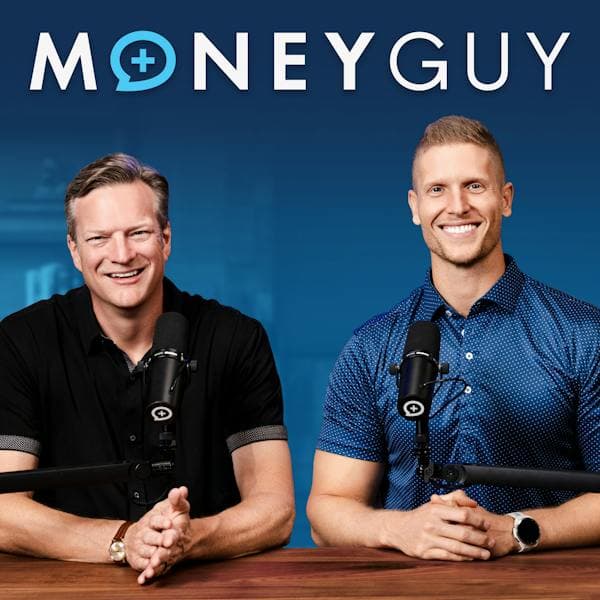
The Money Guy Show
by Brian Preston, CPA/CFP & Bo Hanson, CFA/CFP
Two fee-only financial advisors break down the Financial Order of Operations, a 9-step wealth-building framework. 617K YouTube followers and a 4.8 Apple rating.
All Things Investing
by Aaron Powell & rotating co-hosts
A weekly show that breaks down ETFs, three-fund portfolios, and index investing without the fluff. Season 3 running as of August 2026, 30+ episodes deep.
The Investing for Beginners Podcast
by Andrew Sather & Stephen Morris (with Evan Raidt)
A value investing show for beginners that explains stock analysis in plain English. Running since 2017 with a focus on fundamentals, financial statements, and avoiding common mistakes.