
What Is an S&P 500 Index Fund and Should You Just Put Everything In It?
The S&P 500 is the benchmark most investors measure themselves against, and rarely beat. Here is what it actually is, how index funds track it, and whether a single fund is really enough.

The S&P 500 index fund is the most recommended investment in personal finance. Ask ten financial writers, educators, or advisors what a beginner should invest in and at least eight will say some version of "a low-cost S&P 500 index fund." John Bogle built Vanguard around this idea. Warren Buffett has publicly recommended it for most investors.
So what exactly is it? And is "just put everything in an S&P 500 fund" actually the right answer, or a simplification that leaves out important context?
What the S&P 500 Actually Is
The S&P 500 (Standard & Poor's 500) is an index, a list of 500 large publicly traded U.S. companies, weighted by market capitalization. It is maintained by S&P Dow Jones Indices and updated periodically as companies grow, shrink, or become ineligible.
It is not a fund you can buy directly. It is a benchmark, a measuring stick. When the news says "the market was up 1.2% today," they almost always mean the S&P 500.
What makes a company eligible for the S&P 500:
- Incorporated in the U.S.
- Market cap of at least $18.0 billion (as of 2025 criteria)
- Positive earnings in the most recent quarter and over the trailing four quarters
- Listed on a U.S. exchange (NYSE, Nasdaq)
- Public float of at least 10% of shares
The result is a broad cross-section of large American business: technology, healthcare, financials, consumer goods, industrials, energy, and more.
Current top holdings in the S&P 500 (approximate, as of June 30, 2026):
| Company | Approximate Weight |
|---|---|
| Nvidia (NVDA) | ~7.1% |
| Apple (AAPL) | ~6.2% |
| Microsoft (MSFT) | ~4.1% |
| Amazon (AMZN) | ~3.8% |
| Alphabet (GOOGL + GOOG) | ~6.4% combined |
| Broadcom (AVGO) | ~2.6% |
| Meta (META) | ~2.1% |
| Tesla (TSLA) | ~1.9% |
| Micron Technology (MU) | ~1.9% |
| Top 10 total | ~36% |
The index is market-cap weighted, meaning larger companies have larger influence. When Nvidia stock rises, the index rises more than when a smaller company rises by the same percentage. Notably, Micron Technology displaced Berkshire Hathaway from the top 10 in the first half of 2026, reflecting the surge in semiconductor stocks. (See live S&P 500 holdings data.)
What an S&P 500 Index Fund Is
An S&P 500 index fund is a fund that holds shares in all 500 companies in the index in roughly the same proportions. When you buy one share of an S&P 500 index fund, you effectively own a tiny slice of all 500 companies at once.
The fund does not try to pick the best companies or time the market. It simply mirrors the index. This is called passive investing.
The major S&P 500 index funds:
| Fund | Ticker | Type | Expense Ratio | Minimum |
|---|---|---|---|---|
| Fidelity 500 Index Fund | FXAIX | Mutual fund | 0.015% | $0 |
| Vanguard S&P 500 ETF | VOO | ETF | 0.03% | 1 share (~$530) |
| iShares Core S&P 500 ETF | IVV | ETF | 0.03% | 1 share |
| SPDR S&P 500 ETF | SPY | ETF | 0.0945% | 1 share |
| Schwab S&P 500 Index Fund | SWPPX | Mutual fund | 0.02% | $0 |
These funds all do essentially the same thing. The differences are minor: expense ratio, whether it is an ETF or mutual fund, and minimum investment. At Fidelity or Schwab, you can start with $1. At Vanguard via VOO, you need the price of one share.
The Historical Performance Case
The reason the S&P 500 is so widely recommended is not opinion. It is data.
S&P 500 average annual returns (total return including dividends):
| Period | Approximate Average Annual Return |
|---|---|
| 10 years (2015-2025) | ~13.0% |
| 20 years (2005-2025) | ~10.5% |
| 30 years (1995-2025) | ~10.7% |
| Since 1926 (nearly 100 years) | ~10.0 to 10.5% |
Source: Macrotrends historical S&P 500 data
For context: the average actively managed U.S. large-cap fund has underperformed the S&P 500 over virtually every 15 to 20 year period measured. According to the SPIVA U.S. Scorecard, roughly 88% of active large-cap funds underperformed the S&P 500 over the 20 years ending 2024.
That is the core case for passive index investing: most professionals who try to beat the market fail to do so consistently after fees. A simple index fund, held passively, beats the majority of active managers over the long run.
What $10,000 invested in an S&P 500 index fund grows to (at 10% average annual return):
| Years | Value |
|---|---|
| 10 | $25,937 |
| 20 | $67,275 |
| 30 | $174,494 |
| 40 | $452,593 |
This is why starting early matters so much. The compounding multiplier grows exponentially with time.
What Happened in the First Half of 2026
The S&P 500 delivered a 10.2% total return in the first half of 2026, but that single number hides significant internal divergence. The first quarter was rough, with a -4.3% total return matching the worst quarter since early 2025. The second quarter bounced back with a 15.2% gain.
What makes 2026 notable is that market leadership shifted. For the past several years, the "Magnificent Seven" (Apple, Nvidia, Microsoft, Amazon, Tesla, Alphabet, and Meta) drove the majority of the index's returns. In H1 2026, three of the seven posted negative returns, with Microsoft falling 22.5% and Meta declining 14.5%. The other 493 companies contributed a combined 10.2 percentage points to the index's return.
The S&P 500 Equal Weight Index, which gives every stock the same influence regardless of size, returned 12.1%, outpacing the cap-weighted index's 10.2%. Small-cap stocks surged 23.9% and mid-caps returned 17.3%, both far exceeding large-cap returns. This broadening of market participation, if it continues, would mark a meaningful shift from the narrow concentration of 2023 to 2025. (Read the RBC Wealth Management H1 2026 recap.)
Should You Just Put Everything In It?
This is where honest nuance matters. "Put everything in an S&P 500 fund" is excellent advice for many investors and incomplete advice for others.
The case for 100% S&P 500
- Simplicity: One fund, one decision, zero ongoing management
- Low cost: Expense ratios below 0.02 to 0.03% mean fees are essentially irrelevant
- Diversification within the fund: 500 companies across all major U.S. sectors
- Long track record: Nearly 100 years of data supporting long-term returns
- Behavioral benefit: Fewer moving parts means fewer temptations to tinker
For a young investor (20s to 30s) with a 30+ year time horizon, an all-S&P 500 portfolio is genuinely defensible. The long runway allows recovery from any bear market, and the simplicity reduces the chance of behavioral mistakes.
What a 100% S&P 500 portfolio misses
International stocks. The S&P 500 is exclusively U.S. companies. The U.S. represents roughly 60 to 65% of global market capitalization. International stocks, developed markets (Europe, Japan, Australia) and emerging markets (China, India, Brazil), make up the rest. There have been extended periods (such as 2000 to 2010) where international stocks outperformed U.S. stocks significantly. Holding only the S&P 500 bets entirely on U.S. outperformance indefinitely.
Small and mid-cap stocks. The S&P 500 covers only large-cap U.S. companies. Smaller companies have historically delivered higher long-term returns (with higher short-term volatility), a phenomenon called the "small-cap premium." The H1 2026 data illustrates this: small caps returned 23.9% versus the S&P 500's 10.2%. A total market index fund (like FSKAX or VTI) captures these along with large caps.
Bonds. For investors approaching retirement or with shorter time horizons, holding some bonds reduces portfolio volatility. An all-stock portfolio can lose 30 to 50% in a severe bear market. Bonds partially cushion that drop.
The concentration risk. As of June 2026, the top 10 holdings in the S&P 500 represent approximately 36% of the index. A significant concentration in a handful of large tech companies means the index is not as diversified as "500 companies" implies. The H1 2026 performance divergence, where the 10 largest stocks rose only 1.1% on average while the rest of the index carried the returns, demonstrates this risk in real time.
The Practical Verdict
For most people under 40 with a retirement time horizon: An S&P 500 index fund is an excellent core holding, possibly the only holding needed for years. The simplicity and track record are compelling.
For a more complete portfolio: A slight expansion adds international exposure and potentially small-cap coverage:
| Simple two-fund version | Allocation |
|---|---|
| S&P 500 index fund (FXAIX / VOO) | 80% |
| International index fund (FZILX / VXUS) | 20% |
| Three-fund version | Allocation |
|---|---|
| Total US market fund (FSKAX / VTI) | 60% |
| International index fund (FZILX / VXUS) | 30% |
| Bond index fund (FXNAX / BND) | 10% |
These are not dramatically different in expected outcome for a young investor. The S&P 500 alone is not wrong, but it is a subset of what a global index portfolio holds. The H1 2026 data, where equal-weight and small-cap indices outperformed the cap-weighted S&P 500, is a reminder that concentration cuts both ways.
Real-World Examples
Example: Sofia, 23, starting her first investment account
Situation: Sofia opened a Roth IRA at Fidelity and was overwhelmed by the fund choices. She had $200 to start.
What she did: She put 100% in FXAIX (Fidelity's S&P 500 fund, 0.015% expense ratio) and set up a $200/month automatic investment. She decided to revisit her allocation at 30 when she had more capital and understanding.
Why this was right for her: A 23-year-old with 40+ years to retirement, starting with a simple S&P 500 fund, is making an excellent decision. Perfect is the enemy of good. She started, which is the most important thing.
Example: Derek, 35, had been holding cash for years
Situation: Derek had $22,000 in a savings account earning 4.5% APY. He wanted to invest but felt paralyzed by choices.
What he did: He split it between VOO (70%) and VXUS (30%), a simple two-fund U.S. plus international portfolio. He automates $500/month going forward.
The reasoning: At 35, he has a 30-year horizon. The international allocation hedges against U.S. underperformance. The simplicity means he will not be tempted to change allocations based on short-term news.
The One Number to Remember
Over the past 30 years, a $1,000/month investment in an S&P 500 index fund (at 10% average annual return) would have grown to approximately $2.3 million.
No stock picking, no timing the market, no complex strategy. Just consistent investment in a fund that mirrors 500 large American companies, held without interruption. The power is in the consistency and the time, not the complexity.
For a comparison of the S&P 500 versus total market funds and when each fits, see What Is an Index Fund and Why Do They Beat Most Investors?. For how expense ratio affects these long-term returns, see What Is Expense Ratio and Why Does 1% Matter So Much?. And for the behavioral side of why most investors underperform the index itself, How Often Should You Check Your Investment Portfolio? covers the discipline that makes passive investing actually work.
This post is for informational purposes only and does not constitute financial advice. Past performance of the S&P 500 does not guarantee future results. H1 2026 performance data sourced from RBC Wealth Management and Proactive Advisor Magazine. Holdings data as of June 30, 2026, from SlickCharts and SPY ETF holdings. All investment involves risk, including the possible loss of principal.
Savvy Nickel Team
Financial education expert dedicated to making complex money topics simple and accessible for everyone.
Recommended Articles

What Is an Index Fund and Why Does Everyone Recommend Them?
Index funds are the most widely recommended investment for beginners and experts alike. Here's exactly what they are, how they work, and why the evidence behind them is so compelling.

Bull Markets vs Bear Markets: What They Mean and How Long They Last
Bull markets last 4-5 years on average. Bear markets last 9-11 months. Here is what 90 years of data says about market cycles, recovery times, and why the asymmetry favors patient investors.

Index Funds vs ETFs: Which Is Better for Beginners in 2026
Index funds and ETFs both track the same indexes for the same low fees. ETFs are more tax-efficient in taxable accounts. Index mutual funds are easier to automate. Here is how to choose.
Run the Numbers
Free calculators related to this article.
Investment Return Calculator
See how a lump sum or regular contributions grow over time at any return rate. Compare nominal returns against inflation-adjusted results to get an honest picture of your real gains.
Open calculator →Compound Interest Calculator
See exactly how your money grows over time with compound interest. Enter your starting amount, monthly contributions, interest rate, and time horizon to watch your wealth build.
Open calculator →Dividend Calculator
Project your dividend income year by year, track your yield on cost, and see how reinvesting dividends accelerates portfolio growth. Includes tax adjustments and dividend growth.
Open calculator →Recommended Books
Related Glossary Terms
Index Fund
An index fund is a passively managed investment fund that tracks a market index like the S&P 500, offering broad diversification at minimal cost by holding the same securities in the same proportions as the index.
S&P 500
The S&P 500 is a stock market index tracking 500 large US publicly traded companies, representing about 80% of total US market capitalization. As of August 2026, the index trades near 7,674 with a year-to-date return of approximately 13%.
ETF
An ETF is a basket of securities that trades on an exchange like a single stock. The global ETF market hit $23 trillion in 2026. Learn how ETFs work.
Bear Market
A bear market is a sustained decline of 20% or more in asset prices from recent highs, driven by investor pessimism, economic weakness, and falling corporate earnings. The average bear market lasts about 13 months and falls 36%.
Expense Ratio
An expense ratio is the annual fee charged by a mutual fund or ETF as a percentage of your investment, covering management, administration, and operational costs. The asset-weighted average fell to 0.32% in 2025, saving investors $6.8 billion.
Broker
A broker is a licensed intermediary who executes buy and sell orders for securities, real estate, or other assets on behalf of clients, earning a commission or fee for the service.
Recommended Podcasts
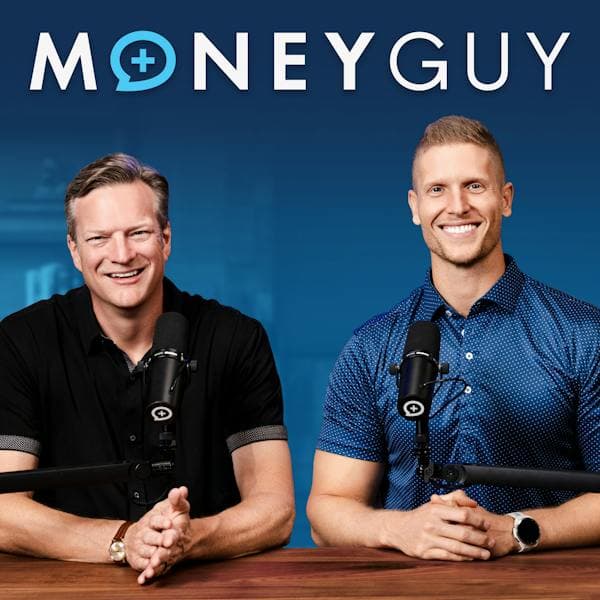
The Money Guy Show
by Brian Preston, CPA/CFP & Bo Hanson, CFA/CFP
Two fee-only financial advisors break down the Financial Order of Operations, a 9-step wealth-building framework. 617K YouTube followers and a 4.8 Apple rating.
Financial Feminist
by Tori Dunlap
Tori Dunlap hosts the number one money podcast for women, covering debt payoff, investing, and salary negotiation. New episodes every Tuesday from Her First 100K.
The Personal Finance Podcast
by Andrew Giancola
Andrew Giancola's Master Money show covers budgeting, investing, and side income with a systems-first approach. 350K monthly downloads and a 4.7 Apple rating.