
How to Financially Survive a Long-Term Illness
The average SSDI benefit in 2026 is $1,630 per month, replacing about 40% of income. Initial applications are denied 64% of the time. The Medicare waiting period is 24 months. Here is the financial survival plan.

The Social Security Administration reports that 1 in 4 of today's 20-year-olds will become disabled before reaching retirement age. Disability is not a rare event. It is a statistical probability that most Americans fail to plan for. The Council for Disability Awareness estimates that the average long-term disability lasts 34.6 months, nearly 3 years of lost income, increased medical costs, and financial restructuring.
The financial impact is severe and multidimensional. Income drops immediately. Employer sick leave provides 1 to 2 weeks. Short-term disability covers 3 to 6 months at 50 to 70% of salary. SSDI, if approved, provides approximately 40% of pre-disability income. Healthcare costs increase. The average disabled individual spends $5,000 to $15,000 per year in out-of-pocket medical costs. Housing, transportation, and daily living may require modifications costing $5,000 to $30,000 or more.
And the SSDI approval process takes 1 to 3 years, during which you receive no benefits. Initial applications are denied approximately 64% of the time. The first appeal (reconsideration) is denied approximately 87% of the time. The hearing before an Administrative Law Judge, which takes 12 to 18 months to schedule, has a 45 to 55% approval rate. During the entire wait, you are living on savings, employer disability insurance, and family support.
If you are searching for how to financially survive a long-term illness, this guide covers the financial survival plan: income replacement layers, SSDI application and timeline, the 24-month Medicare waiting period and how to bridge it, long-term care costs in 2026, disability insurance, and how to build a financial safety net before illness strikes.
Income Replacement Layers
The 5 layers of disability income
- Emergency fund: 3 to 6 months of expenses. The first line of defense. Most people do not have enough.
- Employer sick leave: 1 to 2 weeks. Brief but immediate.
- Short-term disability insurance: 3 to 6 months at 50 to 70% of salary. Covers pregnancy, surgery recovery, temporary conditions.
- Long-term disability insurance: 5 to 10 years or until retirement at 50 to 80% of salary. Costs 1 to 3% of annual salary. Employer group plans run $30 to $60 per month. Individual plans run $167 to $500 per month on a $200,000 salary.
- SSDI: approximately 40% of pre-disability income. The average monthly SSDI benefit in 2026 is $1,630, after a 2.8% COLA, according to the SSA 2026 COLA Fact Sheet. The maximum is $4,152 per month. The 2026 SGA limit is $1,690 per month for non-blind individuals. The 64% denial rate on initial application means most applicants wait 1 to 3 years for approval.
The gap
Employer sick leave ends in 1 to 2 weeks. Short-term disability ends in 3 to 6 months. SSDI does not start for at least 5 months (the SSDI waiting period) and approval takes 1 to 3 years. The gap is months 6 through approval, potentially 12 to 36 months, with no income except long-term disability insurance (if you have it) and savings.
SSDI Application and Timeline
Qualification requirements
- Medical condition that prevents substantial gainful activity (SGA: earning more than $1,690 per month in 2026 for non-blind, $2,830 for blind, per the SSA SGA page)
- Condition expected to last at least 12 months or result in death
- Earned enough work credits (typically 20 credits in the last 10 years, approximately 5 years of work)
The approval timeline
- Initial application: denied approximately 64% of the time
- Reconsideration (first appeal): denied approximately 87% of the time
- ALJ hearing: 12 to 18 months to schedule, 45 to 55% approval rate
- Total time from application to approval: 1 to 3 years
- During this period: no SSDI benefits
Back pay
If approved, you receive back pay from the date of disability onset, minus the 5-month waiting period. For example, if an application is filed January 2026 and approved at an ALJ hearing in June 2028, that is approximately 24 months of back pay. At the average 2026 benefit of $1,630 per month, the lump sum is approximately $39,120. This lump sum can rebuild depleted savings and pay off debt accumulated during the wait.
The 24-Month Medicare Waiting Period
The most dangerous gap
After SSDI is approved, beneficiaries do not immediately receive Medicare. Federal rules require a 24-month waiting period from the date of disability entitlement. Medicare starts in month 25 of SSDI entitlement, which is month 30 from the onset date. Exceptions: ALS (Medicare begins the same month as SSDI) and end-stage renal disease (shorter condition-specific waiting period).
Bridging the gap
- COBRA: 18 months standard, extended to 29 months for SSDI recipients. Cost: $500 to $700 per month individual, $1,400 or more per month family. You pay the full premium plus a 2% admin fee.
- ACA Marketplace: qualifying life event (loss of employer coverage) triggers a 60-day special enrollment. Premium tax credits based on income. On disability income, subsidies can make premiums very low.
- Medicaid: means-tested. If income is low enough, full coverage immediately. In most states, SSI recipients automatically get Medicaid.
- SSI plus SSDI concurrent benefits: if the SSDI benefit is very low, SSI fills the gap. SSI provides Medicaid immediately. The 2026 SSI federal benefit rate is $994 per month for an individual, per the SSA 2026 COLA Fact Sheet.
Long-Term Care Costs in 2026
The $129,575 per year crisis
According to the CareScout 2025 Cost of Care Survey (released March 2026, the most recent national data), the national median cost of a private room in a nursing home is $129,575 per year ($10,798 per month, $355 per day). A semi-private room costs $114,975 per year ($9,581 per month, $315 per day). About 70% of Americans turning 65 will need long-term care at some point.
Medicare does NOT cover long-term custodial care. Medicare covers up to 100 days of skilled nursing after a qualifying hospital stay. In 2026, days 1 through 20 are fully covered after you pay the $1,736 Part A deductible. Days 21 through 100 require a $217 per day copay, according to CMS 2026 cost data. After day 100, you pay all costs. Fewer than 11% of Americans over 65 have long-term care insurance.
Medicaid spend-down
To qualify for Medicaid long-term care, the ill spouse's assets must be below $2,000. The Community Spouse Resource Allowance (CSRA) lets the healthy spouse keep assets up to a maximum of $162,660 in 2026, per the Medicaid spousal impoverishment standards. The minimum CSRA is $32,532.
A couple with $500,000 in savings (excluding the home, which is exempt while the healthy spouse lives there) must spend down approximately $337,340 ($500,000 minus $162,660 CSRA) before the ill spouse qualifies. At $129,575 per year for a private nursing home room, this takes approximately 2.6 years of private-pay care before Medicaid begins.
Long-term care insurance
Traditional LTCI offers a $150 to $300 per day benefit, a 2 to 5 year benefit period, and a 30 to 180 day elimination period. Annual premiums for a healthy 55-year-old couple run $3,000 to $4,500 per year with 3% inflation protection. The sweet spot for buying LTCI is when you have $200,000 to $2,000,000 in assets. Below $200,000, Medicaid will cover it. Above $3 million, you can self-fund.
The Financial Survival Plan
Before illness (preparation)
- Build your emergency fund to 6 months minimum (12 months ideal for higher-risk occupations).
- Get long-term disability insurance while healthy (1 to 3% of salary). Once health issues develop, coverage is unavailable or prohibitively expensive.
- Consider long-term care insurance at age 55 to 60 if your assets are $200,000 to $2,000,000.
- Keep health insurance continuous. Gaps create coverage denials.
During illness (survival)
- Apply for SSDI immediately. The clock starts at application, not onset.
- Apply for SSI simultaneously if income is very low. This gets you Medicaid immediately.
- Elect COBRA or an ACA Marketplace plan to bridge the Medicare gap.
- Cut expenses to absolute minimum.
- Communicate with creditors. Many offer disability hardship programs.
- If you have LTD insurance, file the claim immediately. Do not wait for SSDI.
For automating your emergency fund contributions, read our guide on how to set up automatic investing.
Disability Income Sources: What They Cover and When
| Source | Replacement Rate | Duration | Wait Period | Cost | Key Limitation |
|---|---|---|---|---|---|
| Emergency fund | 100% of expenses | 3 to 6 months | None | Your savings | Limited by what you saved |
| Employer sick leave | 100% of salary | 1 to 2 weeks | None | Employer-paid | Very short duration |
| Short-term disability | 50 to 70% of salary | 3 to 6 months | 1 to 2 weeks | $10 to $50 per month | Short duration, percentage cap |
| LTD (employer) | 50 to 70% of salary | 5 to 10 years or to 65 | 3 to 6 months | $30 to $60 per month | Offset by SSDI, taxable if employer-paid |
| LTD (individual) | 50 to 80% of salary | 5 to 10 years or to 65 | 3 to 6 months | $167 to $500 per month | Medical underwriting, cost |
| SSDI | approximately 40% of salary | To retirement age | 5 months | FICA taxes | 64% initial denial, 1 to 3 year process |
| SSI | $994 per month (2026) | Indefinite | 1 month | None | Income and asset limits ($2,000) |
| Workers' comp | 66% of salary | Varies by state | Varies | Employer-paid | Only work-related injuries |
Three Real Disability Scenarios
Example 1: 48-year-old with MS, employer-sponsored LTD insurance
A 48-year-old earning $85,000 per year is diagnosed with multiple sclerosis. She has employer-sponsored long-term disability insurance at 60% replacement, which is $4,250 per month.
Timeline: employer sick leave (2 weeks), short-term disability (3 months at 60% equals $4,250 per month), long-term disability kicks in at month 4 ($4,250 per month for 5 years or to age 65). She applies for SSDI immediately. Initial application: denied (64% rate). Reconsideration: denied (87% rate). ALJ hearing: scheduled 18 months later, approved. SSDI benefit: $1,900 per month.
LTD insurance offsets: her LTD policy reduces by the SSDI amount, so she receives $2,350 from LTD plus $1,900 from SSDI, totaling $4,250 per month. Medicare starts at month 30 from onset. During the gap, she elects COBRA at $650 per month for 29 months. Total COBRA cost: $18,850. Back pay from SSDI: approximately $34,200 (18 months multiplied by $1,900). This covers the COBRA costs with $15,350 remaining.
The lesson: employer-sponsored LTD insurance is the critical bridge. Without it, she would have lived on $0 income from month 4 until SSDI approval at month 18. With LTD, she maintained 60% income replacement throughout.
Example 2: 55-year-old with stroke, no disability insurance
A 55-year-old earning $60,000 per year with no disability insurance suffers a stroke. He has $20,000 in savings and no employer sick leave beyond 1 week.
Timeline: savings cover 4 months of expenses ($5,000 per month). He applies for SSDI immediately. Initial application: denied. Reconsideration: denied. ALJ hearing: 20 months later, approved.
During the 20-month wait: he lives on $20,000 savings (4 months), then relies on family support and a part-time job he can do from home ($1,200 per month). SSDI benefit: $1,400 per month. Back pay: approximately $21,000 (15 months multiplied by $1,400, after the 5-month waiting period). Medicare starts at month 30. During the gap, he qualifies for Medicaid because his income is now low enough.
Total income after approval: $1,400 per month SSDI equals $16,800 per year. Pre-disability income: $60,000. Replacement rate: 28%.
The lesson: without disability insurance, SSDI replaces only 28% of pre-disability income. The 20-month wait with no income devastated his savings. Disability insurance at 1 to 3% of salary ($600 to $1,800 per year) would have provided $3,000 to $4,800 per month during the wait. The cost of not having it: $60,000 to $96,000 in lost income over 20 months. For planning at this life stage, read our guide on the financial checklist for turning 50.
Example 3: 72-year-old with Alzheimer's needing nursing home care
A 72-year-old with Alzheimer's needs nursing home care. Cost: $129,575 per year for a private room. Assets: $400,000 in savings, $250,000 home.
Medicare covers 20 days of skilled nursing after a qualifying hospital stay, then $217 per day copay for days 21 through 100. After day 100: $0 coverage. The family pays privately at $129,575 per year.
Medicaid spend-down: the couple must spend down to $2,000 (ill spouse) plus $162,660 CSRA (healthy spouse) equals $164,660. They have $400,000 in savings (excluding the home, which is exempt while the healthy spouse lives there). Spend-down amount: $400,000 minus $162,660 equals $237,340. At $129,575 per year, this takes approximately 1.8 years of private-pay care before Medicaid begins.
After spend-down: the healthy spouse keeps $162,660 in savings, the home, and their income. The ill spouse's care is covered by Medicaid.
The lesson: long-term care costs destroy retirement savings. Without LTC insurance ($3,000 to $4,500 per year at age 55), a couple with $400,000 in savings will spend $237,340 on nursing home care before Medicaid kicks in. The healthy spouse is left with $162,660. LTC insurance purchased at 55 for $4,000 per year over 17 years ($68,000 total) would have covered 3 years of care at $200 per day ($219,000 in benefits). The math favors insurance. For broader financial emergency preparation, read our guide on how to financially prepare for a natural disaster.
Common Mistakes
Not having disability insurance. 1 in 4 of today's 20-year-olds will be disabled before retirement. LTD insurance costs 1 to 3% of salary. Not having it is the most expensive mistake you can make.
Waiting to apply for SSDI. The clock starts at application, not onset. The 5-month waiting period and 1 to 3 year approval process mean every day of delay costs you.
Not applying for SSI simultaneously. SSI can provide Medicaid immediately. SSDI alone leaves you without healthcare for 30 months.
Not understanding the Medicare 24-month waiting period. SSDI approval does not mean Medicare starts. Plan for 30 months without Medicare (5-month SSDI wait plus 24-month Medicare wait).
Not electing COBRA extended coverage. SSDI recipients get 29 months of COBRA, not 18. This bridges part of the Medicare gap.
Not having an emergency fund. The gap between disability onset and SSDI approval can be 1 to 3 years. Savings are the only income during this period if you have no LTD insurance.
Buying long-term care insurance too late. Premiums at 55 are $3,000 to $4,500 per year. At 65, they are much higher or coverage is unavailable. Buy at 55 to 60.
Assuming Medicare covers long-term care. It does not. Medicare covers 100 days of skilled nursing only. Custodial care (help with activities of daily living) is not covered.
Not communicating with creditors. Most lenders offer disability hardship programs. Silence leads to defaults, collections, and credit damage.
Not planning for the healthy spouse. Medicaid spend-down can leave the healthy spouse with as little as $162,660. LTC insurance protects both spouses. For a values-based approach to planning, read our guide on how to set financial goals that align with what you actually care about. For financial catastrophe recovery, read our guide on what to do if you lose everything financially.
Prepare Before the Doctor Says Stop
Financially surviving a long-term illness requires preparation before illness and navigation during. Before: build a 6 to 12 month emergency fund, get long-term disability insurance while healthy (1 to 3% of salary), consider LTC insurance at 55 to 60 if assets are $200,000 to $2,000,000, and keep health insurance continuous. During: apply for SSDI immediately (64% initial denial, 1 to 3 year process, 40% income replacement), apply for SSI simultaneously for Medicaid, elect COBRA (29 months for SSDI recipients) or an ACA Marketplace plan, cut expenses to a survival budget, and communicate with creditors.
The 24-month Medicare waiting period is the most dangerous gap. Bridge it with COBRA, ACA, or Medicaid. Long-term care costs: $129,575 per year median for a private nursing home room. Medicare does not cover custodial care. Medicaid requires spend-down to $2,000 (individual) with a CSRA up to $162,660 (healthy spouse). LTC insurance: $3,000 to $4,500 per year for a 55-year-old couple. The average long-term disability lasts 34.6 months. Without LTD insurance, you face 1 to 3 years with no income during the SSDI approval process. With LTD insurance, you maintain 50 to 80% income replacement throughout.
The 2026 SSDI average benefit is $1,630 per month. The SGA limit is $1,690 per month. The SSI federal benefit rate is $994 per month. The Medicare SNF copay for days 21 through 100 is $217 per day. These are the numbers that determine your financial survival.
Do three things this month. Check if you have long-term disability insurance through your employer. If not, get an individual policy quote while you are healthy. It costs 1 to 3% of your salary. Build your emergency fund to at least 6 months of expenses. If you already have 6, aim for 12. This is your income during the SSDI approval gap. If you are 55 to 60 with $200,000 to $2,000,000 in assets, get a long-term care insurance quote. The median nursing home costs $129,575 per year. Medicare does not cover it.
The most important financial decision you can make for long-term illness protection is buying disability insurance while you are healthy. Once you develop health issues, coverage is unavailable or prohibitively expensive. A 48-year-old earning $85,000 with LTD insurance maintains $4,250 per month throughout disability. A 55-year-old earning $60,000 without LTD insurance lives on $0 for 20 months during the SSDI approval process, then receives $1,400 per month (28% replacement). The difference is not luck. It is preparation. Disability insurance at 1 to 3% of salary is the cheapest insurance you will ever buy for the most likely catastrophic event you will face.
This post is for informational purposes only and does not constitute financial, legal, or medical advice. SSDI, SSI, Medicare, and Medicaid rules are complex and subject to change. Consult a qualified benefits counselor, social security attorney, or financial advisor before making decisions about disability and long-term care planning.
Tags
Savvy Nickel Team
Financial education expert dedicated to making complex money topics simple and accessible for everyone.
Recommended Articles

How to Handle a Financial Windfall Without Ruining Your Life
A Florida Lottery study found large cash transfers only postpone bankruptcy for those in financial trouble. Sudden wealth syndrome causes stress, anxiety, and guilt. The 5-step plan: pause, pay taxes, build a team, pay off debt, invest the rest. Here is how.

What Expats Need to Know About US Taxes and Retirement Accounts
The US is one of two countries that taxes citizens worldwide. The 2026 FEIE excludes $132,900 on Form 2555. FBAR required for foreign accounts over $10,000. PFIC rules tax foreign mutual funds at 37% plus interest. Here is the expat tax guide.

How to Protect Your Finances During a Divorce
Dividing a 401(k) without a QDRO can cost $80,000 to $140,000 in taxes and penalties. 9 states split assets 50/50. 41 states use equitable distribution. Alimony is not deductible post-2018. Here is the financial checklist for divorce.
Run the Numbers
Free calculators related to this article.
Life Insurance Needs Calculator
Calculate how much life insurance your family actually needs using the DIME method and income replacement approach. See why most Americans are underinsured and what coverage really costs.
Open calculator →Savings Goal Calculator
Find out exactly how much you need to save each month to reach any financial goal by your target date. Enter your goal amount, current savings, and time frame to get a clear monthly savings plan.
Open calculator →College Savings Calculator
Find out how much to save each month to reach your college cost target by the time your child starts school. Plan ahead with projected tuition costs and see how a 529 plan accelerates your savings.
Open calculator →Recommended Books



Related Glossary Terms
Disability Insurance
Disability insurance replaces a portion of your income if illness or injury prevents you from working. Only about 4 in 10 American workers have private disability coverage, leaving roughly 60% exposed to income loss. Individual policies typically cost 1% to 3% of annual income.
insurance-rider
A rider is an optional add-on to an insurance policy that expands or modifies your coverage. Learn which riders are worth the cost and which are oversold in 2026.
Key Person Insurance
Key person insurance is a life or disability policy a business purchases on a critical employee, with the company as beneficiary. In 2026, VC-mandated coverage is surging and AI underwriting is cutting premiums for low-risk key persons.
Waiting Period
A waiting period is the time you must wait after purchasing an insurance policy or after experiencing a disability or illness before coverage or benefits begin. It prevents adverse selection and reduces moral hazard.
Health Insurance
Health insurance is coverage that pays for medical expenses, including doctor visits, hospital stays, surgeries, and prescriptions, in exchange for a monthly premium, using deductibles, copays, and coinsurance to share costs between you and the insurer.
Income
Income is money received on a regular basis from work, investments, or business activities. It is the starting point for every financial decision, from paying bills to building long-term wealth.
Recommended Podcasts
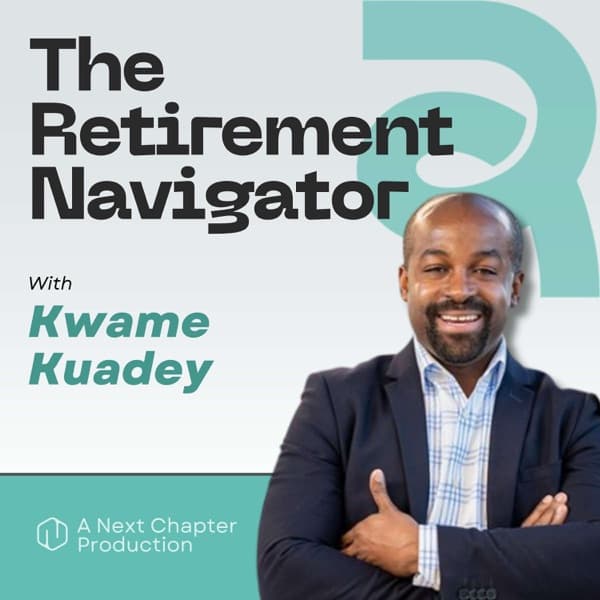
The Retirement Navigator
by Kwame Kuadey
Kwame Kuadey hosts The Retirement Navigator for adults 55 and up, covering Social Security, Medicare, and the non-financial side of retirement. Weekly episodes with research-backed interviews from Boston College's Center for Retirement Research.

Retirement GPS
by Ryan Zacharczyk & Zane Belcak
Ryan Zacharczyk, CFP, hosts Retirement GPS from Zynergy Retirement Planning. Weekly episodes on safe distribution rates, tax traps, and the Retirement Red Zone, with a focus on the final year before retirement.

The Retirement and IRA Show
by Jim Saulsbury & Chris Stein
Jim and Chris answer listener questions on Social Security, RMDs, Roth conversions, and IRA strategy. Over 2600 episodes, twice weekly, with deep technical detail on the PROMISE Act and survivor benefits.