*Disclosure: This article contains affiliate links. If you purchase through these links, we may earn a commission at no additional cost to you. We only recommend books we genuinely believe in.
Quick Overview
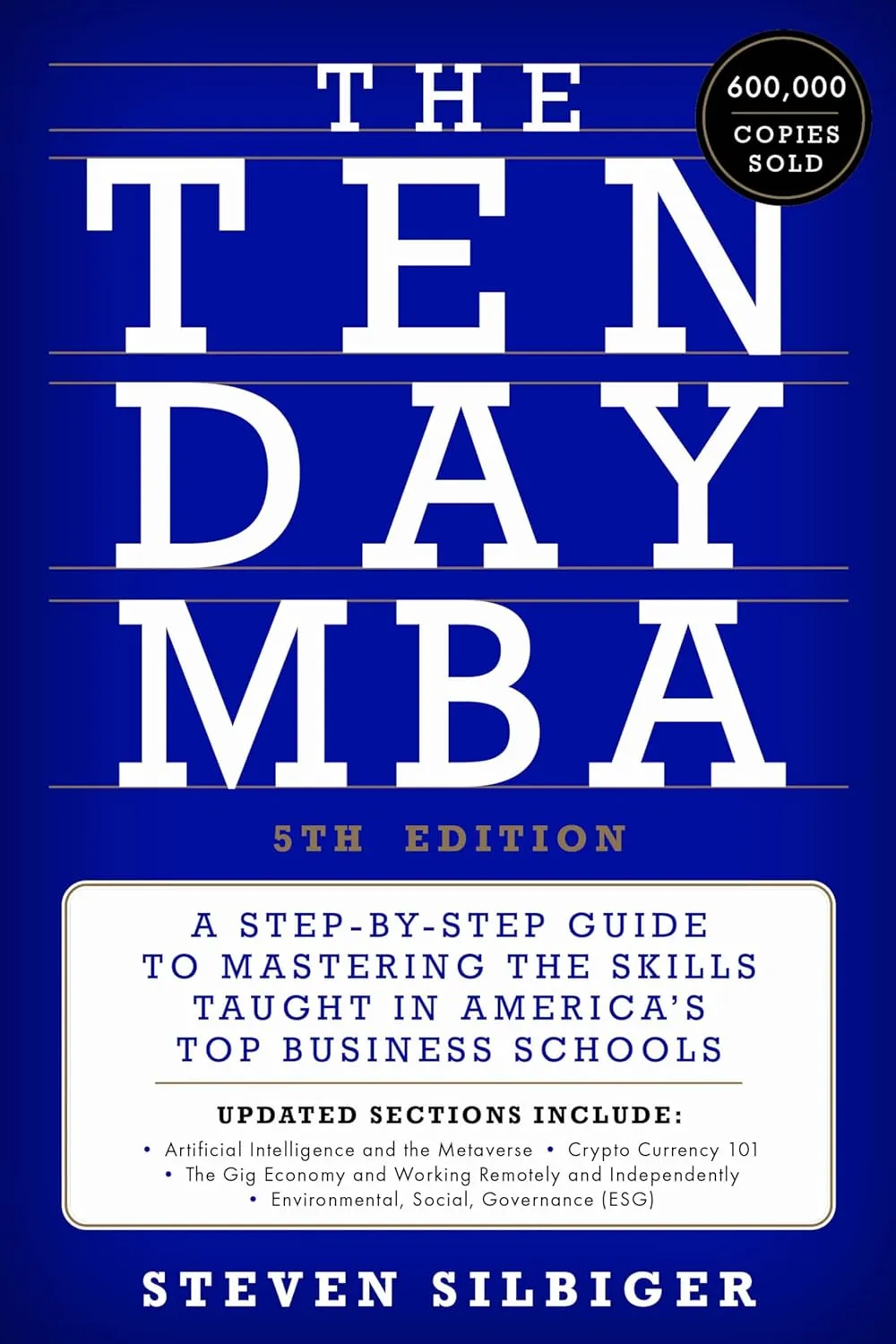
Steven Silbiger attended the Goizueta Business School at Emory University. Frustrated by the inefficiency of the MBA curriculum, good material buried in two years of coursework, case discussions, and credential signaling, he wrote The Ten-Day MBA as a condensed, direct transmission of the core content. A 2024 Graduate Management Admission Council survey found that the median cost of a top-tier MBA program exceeds $200,000 in tuition and foregone salary, while starting salary premiums for MBA graduates have narrowed to 40-60% over undergraduate holders, down from 80%+ in the 2000s. For investors, entrepreneurs, and professionals who want MBA-level business literacy without the cost and time commitment, this is the single most efficient resource available. Now in its fourth edition, it covers all ten subjects in the MBA core: marketing, ethics, accounting, organizational behavior, quantitative analysis, finance, operations, economics, strategy, and entrepreneurship.
Book Details
| Attribute | Details |
|---|---|
| Title | The Ten-Day MBA (4th Edition) |
| Author | Steven Silbiger |
| Publisher | HarperBusiness |
| First Published | 1993; 4th Edition 2012 |
| Pages | 352 |
| Reading Level | Intermediate |
| Amazon Rating | 4.4/5 stars |
Get Your Copy
Paperback: Buy on Amazon
Kindle: Buy on Amazon
About the Author
Steven Silbiger received his MBA from Emory University's Goizueta Business School and his undergraduate degree from the University of Virginia. He worked in marketing and management consulting. The Ten-Day MBA arose from notes he took in business school, condensed into a reference he could actually use. It has sold over one million copies.
Day 1: Marketing
The Marketing Framework
Silbiger structures marketing around the classic 4Ps (Product, Price, Place, Promotion), extended with consumer behavior and segmentation analysis.
Consumer behavior framework:
Before the 4Ps, understand who you are selling to:
| Factor | Questions to Answer |
|---|---|
| Demographics | Age, income, education, family status |
| Psychographics | Lifestyle, values, attitudes |
| Behavior | Usage frequency, brand loyalty, price sensitivity |
| Needs | Functional needs, emotional needs, social needs |
Market segmentation process:
The perceptual map:
A visual tool for understanding how customers perceive your product relative to competitors on key dimensions:
           HIGH PRICE
                │
     Luxury ●  │   ● Premium
              \ │  /
POOR ─────────┼─────────── GOOD
   QUALITY    /│\   QUALITY
             / │ \
  Budget ●  │   ● Value
                │
           LOW PRICE
By mapping where you and competitors sit, you can identify underserved positions and positioning opportunities.
The product life cycle:
| Stage | Strategy |
|---|---|
| Introduction | Build awareness; invest in education |
| Growth | Build market share; competitive pricing |
| Maturity | Defend share; reduce costs; differentiate |
| Decline | Harvest cash; consider exit |
Day 2: Ethics
The Ethical Decision Framework
Silbiger presents four ethical frameworks for analyzing business decisions:
| Framework | Question | Limitation |
|---|---|---|
| Utilitarian | Does this produce the greatest good for the greatest number? | Hard to measure "greatest good" |
| Rights | Does this respect individual rights? | Rights can conflict |
| Fairness (Rawls) | Would this be fair from behind the "veil of ignorance" (not knowing your position)? | Highly idealistic |
| Common good | Does this serve the community as a whole? | Community interests conflict |
The stakeholder analysis:
Any business decision affects multiple stakeholders with potentially conflicting interests:
| Stakeholder | Primary Interest |
|---|---|
| Shareholders | Return on investment |
| Employees | Job security, fair compensation, meaningful work |
| Customers | Quality, value, honest dealing |
| Suppliers | Fair contracts, payment on time |
| Community | Jobs, environmental responsibility |
| Regulators | Compliance with law |
Ethical decisions consider the effects on all stakeholders, not just shareholders.
Day 3: Accounting
The Three Financial Statements (MBA Style)
Silbiger covers the income statement, balance sheet, and cash flow statement with an emphasis on analytical ratios:
The DuPont Analysis:
One of the most powerful frameworks for decomposing return on equity:
ROE = Net Profit Margin × Asset Turnover × Equity Multiplier

Where:
Net Profit Margin = Net Income / Revenue
Asset Turnover = Revenue / Total Assets
Equity Multiplier = Total Assets / Shareholders' Equity
Why DuPont analysis is powerful:
It reveals the drivers of profitability. Two companies with identical ROE may achieve it very differently:
| Company | Net Margin | Asset Turnover | Equity Multiplier | ROE |
|---|---|---|---|---|
| Luxury brand | 20% | 0.5x | 2.0x | 20% |
| Discount retailer | 2% | 5.0x | 2.0x | 20% |
Same ROE, entirely different business models. The luxury brand earns margin; the retailer earns volume. Understanding which driver produces ROE guides competitive analysis.
Key accounting ratios:
| Category | Ratio | Formula |
|---|---|---|
| Profitability | Gross margin | Gross Profit / Revenue |
| Profitability | Operating margin | Operating Income / Revenue |
| Liquidity | Current ratio | Current Assets / Current Liabilities |
| Leverage | Debt/equity | Total Debt / Equity |
| Efficiency | Asset turnover | Revenue / Total Assets |
| Valuation | P/E ratio | Price / Earnings per Share |
Day 4: Organizational Behavior
Motivation Theory
Silbiger covers the major motivation theories with their management applications:
Maslow's Hierarchy of Needs:
| Level | Need | Management Implication |
|---|---|---|
| 1 | Physiological | Adequate pay |
| 2 | Safety | Job security, safe conditions |
| 3 | Social | Team environment, belonging |
| 4 | Esteem | Recognition, responsibility |
| 5 | Self-actualization | Challenging work, growth |
Herzberg's Two-Factor Theory:
| Factor Type | Examples | Effect |
|---|---|---|
| Hygiene factors | Salary, conditions, security | Absence causes dissatisfaction; presence does not motivate |
| Motivators | Achievement, recognition, growth, responsibility | Presence motivates; absence does not cause dissatisfaction |
Management implication: You cannot motivate employees by improving hygiene factors (paying more, better office). Motivation requires providing motivators (meaningful work, recognition, growth). Poor hygiene factors will demotivate; good hygiene factors merely prevent demotivation.
Leadership Styles
| Style | When Effective |
|---|---|
| Authoritarian | Crisis situations requiring fast decisions; highly structured tasks |
| Democratic | Complex problems requiring creativity; high-skill teams |
| Laissez-faire | Highly capable, self-directed professionals |
| Coaching | Developing less experienced employees |
The most effective leaders adjust their style to the situation and the specific employee's skill and motivation level.
Day 5: Quantitative Analysis
Decision Analysis
Silbiger introduces expected value analysis for business decisions:
The decision tree:
Decision Point → Option A → Outcome 1 (probability × payoff)
                           → Outcome 2 (probability × payoff)
              → Option B → Outcome 1 (probability × payoff)
                           → Outcome 2 (probability × payoff)
Example:
| Option | Probability Success | Payoff Success | Probability Failure | Payoff Failure | Expected Value |
|---|---|---|---|---|---|
| Launch new product | 40% | $5M | 60% | -$1M | +$1.4M |
| Improve existing product | 70% | $2M | 30% | -$0.5M | +$1.25M |
Expected value of new product launch: (0.40 × $5M) + (0.60 × -$1M) = $2M - $0.6M = $1.4M
Expected value of improvement: (0.70 × $2M) + (0.30 × -$0.5M) = $1.4M - $0.15M = $1.25M
On expected value, launch the new product. But the new product has higher variance (risk): if risk-averse, the improvement may be preferred.
Net Present Value (NPV):
NPV = Σ [Cash Flow(t) / (1 + r)^t] - Initial Investment

Where r = discount rate (cost of capital)
Any project with positive NPV creates shareholder value. Among competing positive-NPV projects, select the highest NPV.
The IRR (Internal Rate of Return):
The discount rate that makes NPV = 0. Accept projects where IRR exceeds the cost of capital.
Day 6: Finance
Capital Structure
The central question: how much debt vs. equity should a company use?
The Modigliani-Miller theorem:
In a perfect world (no taxes, no bankruptcy costs), capital structure is irrelevant: the value of the firm is determined by its assets and earnings, not how it is financed.
Why capital structure matters in practice:
The tax shield: Interest on debt is tax-deductible. A company with $100M in debt at 5% saves:
Annual tax savings = $100M × 5% × 35% tax rate = $1.75M/yearThis tax shield increases firm value. More debt = more tax shield = higher firm value (to a point).
Bankruptcy costs: Too much debt creates risk of financial distress. Bankruptcy destroys value through legal costs, lost customers, employee departures, and supplier credit restrictions.
The optimal capital structure:
Optimal Debt = The level where the marginal tax shield = marginal increase in bankruptcy probabilityIndustries with stable cash flows (utilities, consumer staples) can support more debt. Industries with volatile cash flows (technology, biotech) should use less.
WACC (Weighted Average Cost of Capital):
WACC = (E/V × Re) + (D/V × Rd × (1-T))

Where:
E = Equity market value
D = Debt market value
V = E + D (total firm value)
Re = Cost of equity
Rd = Cost of debt
T = Tax rate
WACC is the discount rate used for NPV calculations. Projects must earn above WACC to create value.
Valuation Methods
| Method | Formula | Best For |
|---|---|---|
| DCF | PV of future free cash flows | Any cash-generating business |
| Comparable companies | EV/EBITDA, P/E vs. peers | Established businesses with peers |
| Precedent transactions | Premium to pre-deal price vs. history | M&A analysis |
| Asset-based | Net asset value | Asset-intensive businesses |
Day 7: Operations
Process Analysis
The bottleneck principle:
The throughput of any system is limited by its slowest step (the bottleneck). Improving any step other than the bottleneck does not improve overall throughput.
Example:
| Step | Capacity (units/hour) |
|---|---|
| Step 1: Raw material processing | 100 |
| Step 2: Assembly | 60 (bottleneck) |
| Step 3: Quality check | 80 |
| Step 4: Packaging | 90 |
Overall throughput: 60 units/hour (the bottleneck). Investing in Steps 1, 3, or 4 produces no improvement. Only investing in Step 2 increases throughput.
The Theory of Constraints:
Goldratt's framework: always identify and exploit the bottleneck before doing anything else. After exploiting, if the bottleneck moves to another step, repeat.
Inventory Management
Just-in-Time (JIT):
Minimize inventory by producing only what is needed, when it is needed. Benefits: reduced carrying costs, reduced obsolescence, faster response to demand changes. Requirements: reliable suppliers, flexible production, accurate demand forecasting.
Economic Order Quantity (EOQ):
EOQ = √(2 × Annual Demand × Ordering Cost / Holding Cost per Unit)Balances ordering costs (fixed cost per order placed) against holding costs (cost of carrying inventory) to find the optimal order size.
Day 8: Economics
Microeconomics for Business
Price elasticity of demand:
Price Elasticity = % Change in Quantity / % Change in Price| Elasticity | Interpretation | Pricing Implication | |
|---|---|---|---|
| E | > 1 (elastic) | Price increase reduces total revenue | Don't raise prices |
| E | < 1 (inelastic) | Price increase raises total revenue | Can raise prices profitably |
| E | = 1 (unit elastic) | Price change leaves revenue unchanged | Neutral |
Game theory basics:
The prisoner's dilemma applied to business: why oligopolies tend toward cooperation (explicit or tacit) to maintain prices above competitive levels, and why this cooperation is inherently unstable.
Porter's Five Forces:
| Force | Impact on Industry Profitability |
|---|---|
| Threat of new entrants | High threat = lower profits |
| Threat of substitutes | High threat = lower profits |
| Buyer power | High power = lower profits |
| Supplier power | High power = lower profits |
| Industry rivalry | High rivalry = lower profits |
Industries with low scores on all five forces (barriers to entry, few substitutes, fragmented buyers and suppliers, low rivalry) earn above-average long-run returns. Examples: defense contractors, regulated utilities, pharmaceutical companies with patent-protected blockbusters.
Day 9: Strategy
The Strategic Planning Framework
The SWOT Analysis:
| Internal | External |
|---|---|
| Strengths | Opportunities |
| Weaknesses | Threats |
The most useful application: match strengths to opportunities (SO strategies) and shore up weaknesses that allow threats to materialize (WT strategies).
Competitive Advantage Sources (Porter):
| Source | Requires | Examples |
|---|---|---|
| Cost leadership | Superior efficiency; scale; process innovation | Walmart, Southwest Airlines |
| Differentiation | Unique value customers will pay premium for | Apple, luxury brands |
| Focus (niche) | Serve specific segment better than broad competitors | Whole Foods (premium food), USAA (military families) |
The mistake: "stuck in the middle," neither cheapest nor most differentiated. Companies that try to be both often fail at both.
The BCG Matrix:
| Market Share | High Growth | Low Growth |
|---|---|---|
| High | Stars (invest) | Cash Cows (harvest) |
| Low | Question Marks (select) | Dogs (divest) |
Portfolio analysis framework: allocate investment based on competitive position and market growth. Cash Cows fund Stars; Question Marks require decision; Dogs should be exited.
Day 10: Entrepreneurship
The Business Plan Framework
Silbiger covers the essential business plan components:
| Section | Key Questions |
|---|---|
| Executive Summary | What is the opportunity? Why is this team right? |
| Market Analysis | How large is the market? What is the competitive landscape? |
| Product/Service | What does it do? Why is it better? |
| Go-to-Market | How will you acquire customers? What is the CAC? |
| Operations | How will you deliver the product/service? |
| Team | What are their relevant credentials and track records? |
| Financial Projections | Revenue model, P&L, cash flow, funding needs |
| Funding Ask | How much do you need? How will you use it? |
The business model canvas:
A one-page framework covering:
The Value for Investors
How MBA Knowledge Applies to Stock Analysis
Each of the ten days maps directly to investment analysis:
| MBA Day | Investment Application |
|---|---|
| Marketing | Understanding a company's competitive positioning and pricing power |
| Accounting | Reading financial statements; spotting manipulation |
| Finance | Valuation (DCF, comparables); understanding capital structure |
| Economics | Industry structure (Porter's Five Forces); pricing dynamics |
| Strategy | Identifying durable competitive advantages (moats) |
| Operations | Evaluating operational efficiency; capital intensity |
| Quantitative | Probability-weighted scenario analysis |
A full MBA-level framework for business analysis is essential for stock pickers. This book provides the foundations efficiently. For investors who want to apply these concepts, our guide on value investing fundamentals shows how to use them in practice.
Strengths & Weaknesses
What We Loved
Areas for Improvement
Who Should Read This Book
Highly Recommended For
Probably Not For
Final Verdict
Rating: 4.4/5
The Ten-Day MBA is the most efficient single-volume MBA education available. Its coverage of marketing, accounting, finance, strategy, and operations is thorough enough to be genuinely useful for investors and entrepreneurs alike. The DuPont analysis, Porter's Five Forces, and NPV/capital structure sections alone justify the investment.
If you want MBA-level business literacy without spending $200,000 and two years, this book delivers the core content in a fraction of the time. For investors who want to apply MBA frameworks to stock analysis, pair this with our guide on fundamental analysis. For entrepreneurs, our budget calculator helps put the financial concepts into practice.
Get Your Copy
Paperback: Buy on Amazon
Kindle: Buy on Amazon
Prices current as of publication date. Free shipping available with Prime.