*Disclosure: This article contains affiliate links. If you purchase through these links, we may earn a commission at no additional cost to you. We only recommend books we genuinely believe in.
Quick Overview
A schoolteacher built a million-dollar portfolio. Not through stock picking, not through real estate, not through crypto. Through index funds, frugality, and patience.
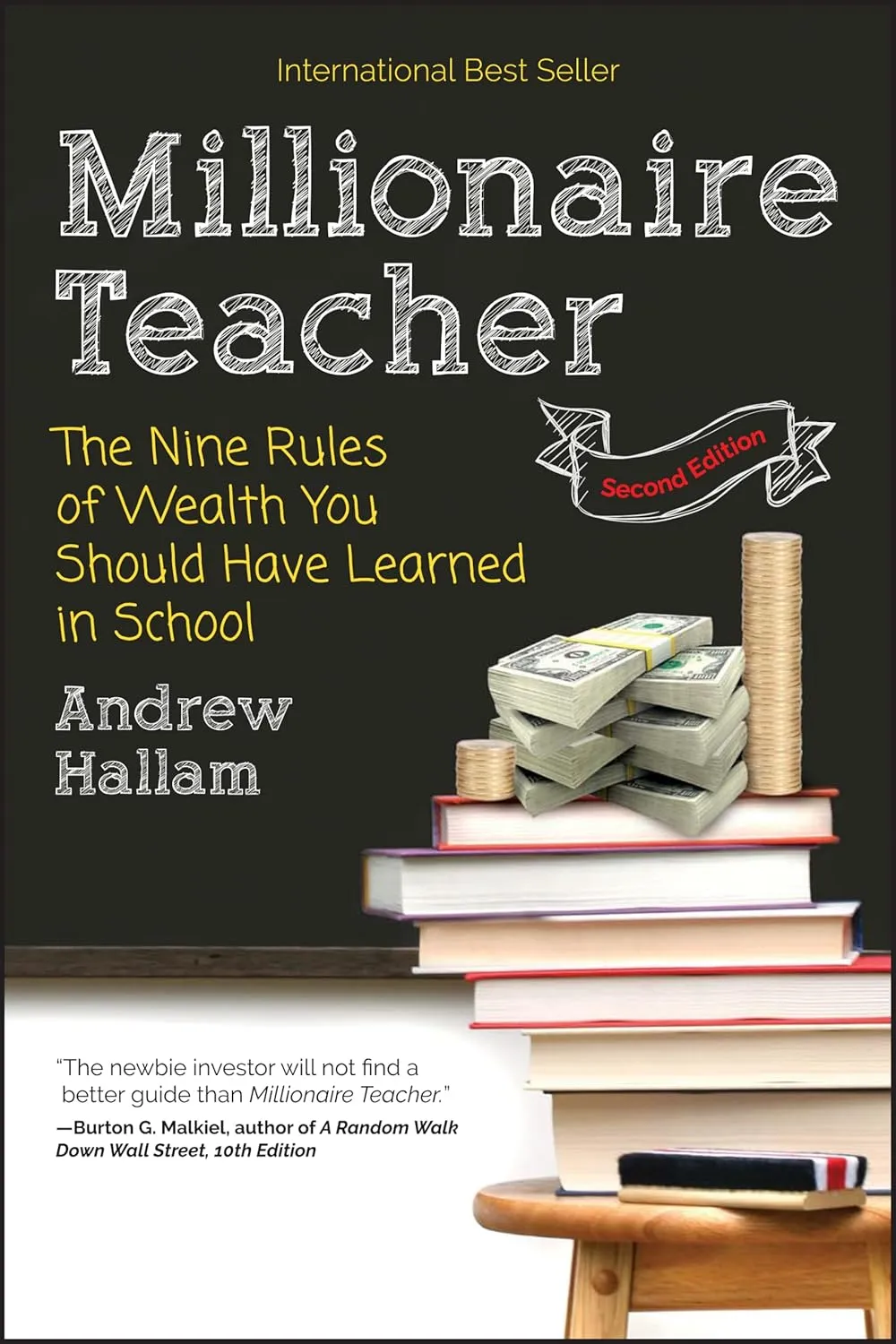
Andrew Hallam was an English teacher at an international school in Singapore who built a million-dollar investment portfolio on a teacher's salary. His book distills what he learned into nine rules of wealth, structured around the core principle that ordinary earners can achieve extraordinary financial outcomes through index fund investing, frugality, and patience. It is the most inspiring and accessible index investing guide written from a non-American perspective, with specific sections for Canadian, Australian, British, Singaporean, and expat investors.
The 2026 investment landscape has only made his case stronger. Vanguard's total stock market index fund (VTSAX) charges 0.04% annually, meaning a $100,000 investment costs $40 per year in fees. Fidelity offers zero-fee index funds. Robo-advisors like Betterment and Wealthfront provide automated portfolio management for 0.25% or less. The barriers to implementing Hallam's strategy have effectively vanished.
Book Details
| Attribute | Details |
|---|---|
| Title | The Millionaire Teacher |
| Author | Andrew Hallam |
| Publisher | Wiley |
| First Published | 2011 |
| Second Edition | 2017 |
| Pages | 240 |
| Reading Level | Beginner |
| Amazon Rating | 4.6/5 stars |
Get Your Copy
Paperback: Buy on Amazon
Kindle: Buy on Amazon
About the Author
Andrew Hallam was born in Canada, taught English at international schools in Singapore and elsewhere, and began investing in his early 20s. He reached millionaire status in his 30s on a teacher's salary through frugal living and consistent index fund investing. He now writes the Balance Junkie column for AssetBuilder.com and speaks internationally about personal finance. His follow-up book, Millionaire Expat, expands on the international investing guidance. His approach is grounded in academic research (he cites Fama, French, Bogle, and Swensen) but delivered in the voice of someone who has actually done it on an ordinary income.
The Nine Rules of Wealth
Rule 1: Spend Like You Want to Grow Rich
Hallam's first rule challenges the assumption that spending is the path to happiness. He observed that most millionaires he knew spent far less than their income, not because they had to, but because they had divorced spending from status.
The frugality-wealth correlation:
Hallam draws on the same research as The Millionaire Next Door: most millionaires live well below their means. The visible rich (luxury cars, large houses, expensive clothes) are often not wealthy. They are high-income earners who consume most of what they earn. The invisible rich save aggressively and let compound interest do the rest.
What to spend on:
Hallam distinguishes between consumption that erodes wealth (depreciating assets, status spending) and consumption that builds life quality:
What to avoid:
| Wealth-Eroding Spending | Why |
|---|---|
| New luxury vehicles | Depreciate rapidly; high insurance and maintenance |
| Designer clothing | Premium for brand, not quality |
| Frequent restaurant meals | No compounding return |
| Home upgrades beyond comfort | Marginal utility decline above a threshold |
Rule 2: Use the Greatest Investment Ally You Have
Compound interest is Hallam's "greatest ally." He makes the same case as every other wealth-building author but does so with particular clarity through his own story.
Hallam's personal compounding demonstration:
He started investing at 19 with $100/month. By 38, with consistent additions and a diversified index portfolio, he had passed $1 million. The math:
| Age | Monthly Contribution | Portfolio Value (8% return) |
|---|---|---|
| 19 | $100 | $1,200 |
| 25 | $200 | $22,000 |
| 30 | $500 | $84,000 |
| 35 | $800 | $280,000 |
| 38 | $1,000 | $500,000+ |
| 40 | $1,200 | $1,000,000+ |
The key: he never stopped. Bear markets, job changes, moves to different countries: the automatic contributions continued. Use our compound interest calculator to model your own trajectory.
Rule 3: Small Percentages Pack Big Punches
The most important practical chapter: investment costs compound against you as powerfully as investment returns compound for you.
The cost compounding demonstration:
| $100,000 invested | After 30 years at 8% gross return |
|---|---|
| Total market index (0.04% expense ratio) | $970,000 |
| Typical actively managed fund (1.2% expense ratio) | $745,000 |
| High-fee financial advisor + active fund (2.0%) | $614,000 |
The difference between 0.04% and 2.0% is $356,000 on a $100,000 initial investment, 356% more money from the lower-cost option. The 2026 fee landscape has improved further: Fidelity's FSKAX charges 0.015%, and several Fidelity ZERO index funds charge literally 0.00%. The expense ratio gap between index funds and active funds has widened, not narrowed.
Fee comparison (Hallam's updated numbers):
| Investment Vehicle | Typical Annual Cost |
|---|---|
| Vanguard Total Market ETF (VTI) | 0.03% |
| Fidelity Total Market (FSKAX) | 0.015% |
| iShares MSCI EAFE (EFA) | 0.07% |
| Typical active U.S. equity fund | 0.8-1.2% |
| Typical actively managed international fund | 1.0-1.5% |
| Financial advisor + active fund | 1.5-2.5% total |
Rule 4: Conquer the Enemy in the Mirror
Hallam identifies behavioral biases as the investor's primary enemy. He covers the standard catalog (overconfidence, recency bias, loss aversion) but adds a specific focus on how financial advisor relationships can amplify these biases.
The financial advisor incentive problem:
Most financial advisors in Canada, Australia, the UK, and the U.S. earn commissions or asset-based fees that are highest on the products worst suited to clients:
| Product | Advisor Compensation | Client Return |
|---|---|---|
| High-fee active fund | High (trailer fees/commissions) | Below index |
| Low-cost index fund | Low or zero | Market return |
| Insurance-wrapped investment products | Very high | Significantly below market |
Hallam's advice: understand how your advisor is paid before following any recommendation. A fee-only, fiduciary advisor (paid a flat fee or hourly rate, not commissions) is far better aligned with your interests.
The behavioral self-assessment:
Hallam asks readers to answer honestly: can you watch your portfolio fall 30-50% and not sell? If not, you need either:
Rule 5: Build Mountains of Money With a Responsible Portfolio
Hallam's core investment recommendation: a three-fund portfolio of low-cost index ETFs.
The standard three-fund portfolio:
| Fund | Allocation | What It Holds |
|---|---|---|
| Domestic stock market index | 33% | All stocks in your home country |
| International stock market index | 34% | All stocks in developed international markets |
| Bond market index | 33% | Government and corporate bonds |
Adjust stock/bond ratio based on age and risk tolerance:
| Investor Profile | Stock % | Bond % |
|---|---|---|
| Young (20s), high risk tolerance | 80-90% | 10-20% |
| Mid-career (40s), moderate tolerance | 60-70% | 30-40% |
| Pre-retirement (55+), lower tolerance | 40-60% | 40-60% |
| Retired, conservative | 30-50% | 50-70% |
Rule 6: Sample a "Round-the-World" Ticket to Indexing
The most unique aspect of this book: Hallam provides country-specific guidance for investors outside the United States.
Canadian investors:
| ETF | What It Holds | Exchange | Expense Ratio |
|---|---|---|---|
| VCN (Vanguard Canada) | All Canadian stocks | TSX | 0.05% |
| VXC (Vanguard) | Global ex-Canada stocks | TSX | 0.22% |
| VAB (Vanguard) | Canadian bonds | TSX | 0.09% |
Accounts: TFSA (Tax-Free Savings Account) first, then RRSP, then non-registered.
British investors:
| ETF | What It Holds | Expense Ratio |
|---|---|---|
| VUKE (Vanguard UK) | UK stocks | 0.09% |
| VWRL (Vanguard) | Global stocks | 0.22% |
| IGLT (iShares) | UK government bonds | 0.07% |
Accounts: ISA (Individual Savings Account) first, £20,000 annual contribution limit, completely tax-free.
Australian investors:
| ETF | What It Holds | Expense Ratio |
|---|---|---|
| VAS (Vanguard) | Australian stocks | 0.07% |
| VGS (Vanguard) | International stocks | 0.18% |
| VAF (Vanguard) | Australian bonds | 0.10% |
Accounts: Superannuation (retirement) accounts first; then personal accounts with franking credit optimization.
Rule 7: No, You Don't Have to Invest and Then Run
Hallam addresses a common objection: passive investing feels passive and boring. He argues this is a feature, not a bug.
The active vs. passive scorecard:
| Metric | Active Investors | Passive Index Investors |
|---|---|---|
| Annual fund returns vs. market | Underperform by 1-2% annually | Match market (minus tiny fee) |
| Time required | 10-20+ hours per month | 1-2 hours per year (rebalancing) |
| Stress | High | Low |
| Long-term wealth outcome | Below index | Near index |
| Transaction costs | High | Negligible |
Rebalancing once per year is the only required action. Set up automatic contributions and rebalance the portfolio back to target allocations annually.
Rule 8: Peek Inside a Pilferer's Playbook
Hallam exposes the financial products and practices designed to extract money from investors rather than build it.
Products to avoid:
| Product | The Pitch | The Reality |
|---|---|---|
| Whole life insurance | Insurance + investment | High fees; low returns; illiquid |
| Variable annuities | Tax-deferred investment | High surrender charges; expensive |
| Currency-linked notes | Capital protection | Complex fee structures; poor returns |
| Hedge funds (for retail investors) | Superior returns | High fees; typically underperform |
| Actively managed fund of funds | Diversification | Double-layer fees; guaranteed underperformance |
The loaded mutual fund math:
A 5.75% front-end load means that on a $10,000 investment, $575 immediately goes to the salesperson before a single dollar of investment return is earned. The investment starts at $9,425. Combined with 1.2% annual fees, the long-run return is dramatically below the index.
Rule 9: Avoid Seduction
The final rule: avoid being seduced by compelling investment narratives, market predictions, or guaranteed-return promises.
Warning signs of investment fraud:
| Red Flag | Example |
|---|---|
| Guaranteed high returns | "12% guaranteed return" |
| Returns too consistent | No monthly losses ever |
| Pressure to invest quickly | "Limited time offer" |
| Unregistered products | Cannot verify with regulatory authority |
| Reluctance to provide documentation | "Trust me" |
The Madoff lesson:
Bernie Madoff ran the largest Ponzi scheme in history ($65 billion) for decades. His funds reported consistent 10-12% annual returns with almost no losing months. Red flags that were ignored:
The investment seduction principle: If an investment seems too good to be true, ask for the prospectus, verify registration with the SEC or equivalent regulator, and consult a fee-only advisor before investing.
Hallam's Personal Story
One of the book's most valuable elements is Hallam's candor about his own journey. He shares:
This transparency is rare in personal finance books and makes the advice more credible than abstract principles.
His lifestyle during accumulation:
Strengths & Weaknesses
What We Loved
Areas for Improvement
Who Should Read This Book
Highly Recommended For
Probably Not For
Frequently Asked Questions
Q: Is this book better than The Simple Path to Wealth for U.S. investors?
A: The Simple Path to Wealth is more tailored to U.S. investors. The Millionaire Teacher is superior for Canadian, Australian, and UK investors due to its country-specific guidance.
Q: What is the single most important takeaway?
A: Investment costs compound against you as powerfully as investment returns compound for you. A 1% annual fee difference compounds to hundreds of thousands of dollars over a lifetime. Minimize costs.
Q: Do I need a financial advisor after reading this book?
A: For most readers, no. The three-fund portfolio implemented through low-cost index ETFs requires no active management beyond annual rebalancing. If you want professional guidance, seek a fee-only, fiduciary advisor only.
Final Verdict
Rating: 4.6/5
The Millionaire Teacher is the best index investing book for non-U.S. readers and an excellent beginner guide for anyone. Its international perspective, honest personal story, and fee impact analysis make it uniquely valuable. The pilferer's playbook chapter alone may save readers more money than the book costs.
The 2026 investment landscape has made Hallam's case even stronger. With Fidelity offering zero-fee index funds and robo-advisors automating portfolio management for 0.25% or less, the barriers to implementing his nine rules have effectively disappeared. If you are starting from zero and want one book that covers frugality, index fund mechanics, fee avoidance, and country-specific guidance, this is it. Pair it with our investment return calculator to project your own path.
Get Your Copy
Paperback: Buy on Amazon
Kindle: Buy on Amazon
Prices current as of publication date. Free shipping available with Prime.