*Disclosure: This article contains affiliate links. If you purchase through these links, we may earn a commission at no additional cost to you. We only recommend books we genuinely believe in.
Quick Overview
Most value investing books end with "buy good companies at cheap prices." That advice is useless if you cannot find those companies in the first place. John Mihaljevic built his career solving exactly that problem.
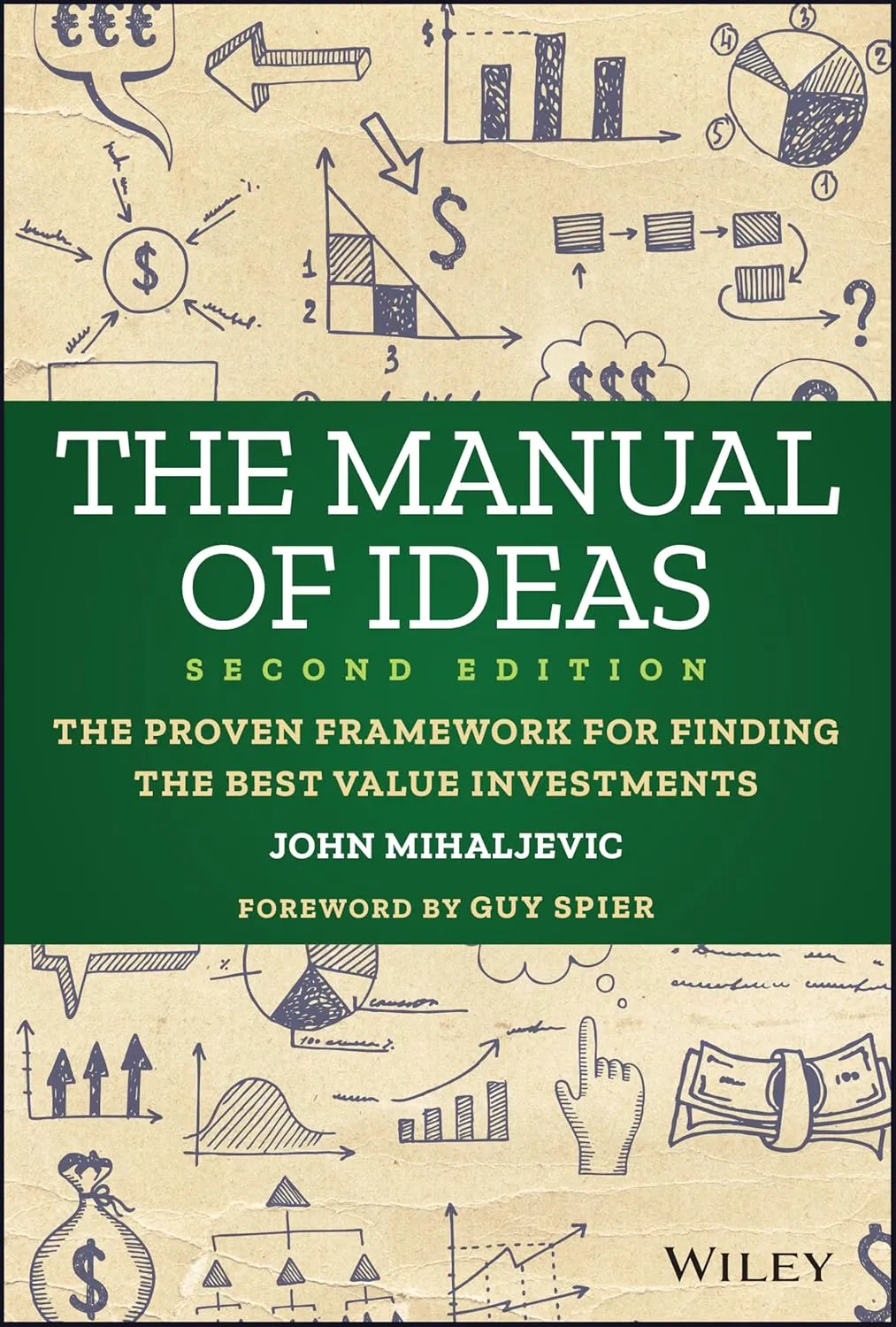
The second edition (August 2025) of The Manual of Ideas catalogs nine distinct sourcing methodologies for value investment ideas, each suited to different market conditions and investor skill sets. The updated edition adds insights from more than 100 exclusive interviews with leading fund managers, including Warren Buffett, Tom Gayner, and Joel Greenblatt. New tables, charts, and real-life case studies bring each approach to life. For serious active investors who already understand valuation basics, this is the practitioner's guide to finding opportunities before others do.
Book Details
| Attribute | Details |
|---|---|
| Title | The Manual of Ideas |
| Author | John Mihaljevic |
| Publisher | Wiley |
| Published | 2013 (2nd ed. 2025) |
| Pages | 384 |
| Reading Level | Advanced |
| Amazon Rating | 4.5/5 stars |
Get Your Copy
Hardcover: Buy on Amazon
Kindle: Buy on Amazon
About the Author
John Mihaljevic, CFA, is a former hedge fund analyst and portfolio manager who founded The Manual of Ideas publication in 2007. He now serves as Managing Editor of Latticework.com and Chairman of MOI Global, a community of intelligent investors united by a passion for lifelong learning. The publication has been featured in The Wall Street Journal, Barron's, and Forbes.
He is a trained capital allocator who studied under Yale University Chief Investment Officer David Swensen and served as Research Assistant to Nobel Laureate James Tobin. He holds a BA in Economics, summa cum laude, from Yale and is a CFA charterholder. He is a winner of the Value Investors Club prize for best investment idea and resides near Zurich, Switzerland.
The Nine Idea Generation Frameworks
The book's core contribution: a systematic taxonomy of value investment approaches, each with its own logic, tools, and appropriate market conditions.
Framework 1: Deep Value: Ben Graham's Net-Nets
The original Graham approach: buy stocks trading below net current asset value (NCAV).
The calculation:
NCAV = Current Assets - Total Liabilities

Net-Net opportunity: Stock price < NCAV × 0.67 (2/3 of liquidation value)
Why it works:
At these prices, you are buying the liquidation value of the business at a discount. Even if the business is terrible, the assets you own are worth more than you paid. Graham called this a "margin of safety" in its purest form.
Why it is rare:
In efficient modern markets, genuine net-nets are mostly found in:
The screening criteria:
| Criterion | Value |
|---|---|
| Price / NCAV | Below 0.67x |
| Current ratio | Above 2.0x |
| Debt/equity | Below 0.5x |
| Insider ownership | Any positive ownership preferred |
| Market cap | Small (typically below $100M) |
Historical performance:
Graham's empirical studies showed net-net portfolios earned 15-20% annually versus 11-12% for the market. More recent academic studies confirm the anomaly persists but is smaller (about 3-5% annual excess return in the U.S.) and larger in Japan and emerging markets.
A 2025 study published in the Review of Financial Economics (Xiao & Kim) examined NCAV portfolios from 1969 to 2019 using 648 unique firms. The value-weighted NCAV portfolio earned an average monthly return of 1.94%, delivering a statistically significant alpha of 1.09% per month (13.9% annually) even after controlling for the Fama-French five factors. However, the strategy's profitability declined in the 2004-2019 period, consistent with increased institutional participation and evolving factor exposures.
A January 2026 backtest on QuantConfirm covering 2009-2025 found that pure NCAV strategies still generate excess returns but require strict quality filters to avoid value traps. In 2026, genuine net-nets are concentrated almost exclusively in companies with market caps below $50 million, OTC markets, and certain international ADRs. The micro-cap universe remains the last reservoir of statistical undervaluation in U.S. equities.
Framework 2: Sum of the Parts: Hidden Assets
Some companies are worth more broken apart than as a whole. The market prices them as a consolidated entity, but the individual pieces would attract higher valuations separately. This is where analyzing the balance sheet carefully pays off.
What creates sum-of-parts opportunities:
| Situation | Why Misvalued |
|---|---|
| Conglomerate discount | Market discounts diversified companies vs. focused peers |
| Hidden real estate | Prime real estate owned by operating companies often under-valued on balance sheet |
| Non-core investments | Stakes in other companies at deep discounts to market value |
| Pension overfunding | Company has more pension assets than liabilities (a hidden asset) |
| Intellectual property | Patents, trademarks not fully reflected in earnings |
| Deferred tax assets | Future tax benefits not fully valued by market |
The analysis process:
Example framework:
| Segment | Revenue | EBITDA | Multiple | Value |
|---|---|---|---|---|
| Consumer division | $500M | $80M | 10x | $800M |
| Industrial division | $300M | $40M | 7x | $280M |
| Healthcare division | $200M | $35M | 12x | $420M |
| Real estate | N/A | N/A | N/A | $150M (market value) |
| Sum of parts | $1,650M | |||
| Net debt | -$300M | |||
| Intrinsic value | $1,350M | |||
| Market cap | $900M (33% discount) |
Framework 3: Greenblatt's Magic Formula
Joel Greenblatt's Magic Formula screens for companies with high earnings yields (cheap) AND high return on invested capital (good businesses):
The calculation:
Earnings Yield = EBIT / Enterprise Value

Return on Invested Capital = EBIT / (Net Working Capital + Net Fixed Assets)
The ranking process:
Historical performance:
Greenblatt's back-tested data (presented in The Little Book That Still Beats the Market) showed approximately 30% annual returns from 1988-2004. More recent implementations show more modest but still market-beating returns of 3-5% annually. The strategy has become more crowded since publication, and in the 2025-2026 market environment, value as a factor has shown renewed strength after years of growth dominance. According to a A Wealth of Common Sense analysis in July 2026, value beat growth in both 2025 and the first half of 2026, suggesting the factor rotation that began in 2024 has staying power.
Mihaljevic's additions:
The Manual of Ideas extends the Magic Formula by recommending:
Framework 4: Jockey Stocks: Following Superinvestors
Some investors have demonstrated unusual skill over long periods. Following their disclosed positions (13-F filings) provides a ready-made idea generation pipeline.
The 13-F universe:
All institutional investors managing over $100 million in U.S. equities must file quarterly 13-F reports disclosing their holdings. This creates a public database of positions held by the world's best investors.
Key superinvestors tracked by the MOI community:
| Investor | Firm | Known Style |
|---|---|---|
| Warren Buffett | Berkshire Hathaway | Quality at fair price; long-term holding |
| Seth Klarman | Baupost Group | Deep value; special situations |
| Howard Marks | Oaktree Capital | Credit cycles; distressed debt |
| Joel Greenblatt | Gotham Capital | Spin-offs; special situations |
| Prem Watsa | Fairfax Financial | Deep value; macro hedging |
| Bruce Berkowitz | Fairholme | Concentrated; out-of-favor financials |
| Bill Ackman | Pershing Square | Activist; large-cap value |
The 13-F limitations:
The jockey research process:
2026 update on 13-F tracking: The SEC's 13-F filing threshold remains at $100 million in U.S. equities, and the 45-day delay persists. However, several platforms now offer real-time tracking of superinvestor portfolios, including WhaleWisdom, Dataroma, and MOI Global's own Latticework platform. The second edition of the book adds updated guidance on using these tools, though the fundamental limitation remains: 13-F filings reveal what was bought, not why.
Framework 5: Spinoffs and Corporate Events
Companies emerging from restructuring events (spinoffs, mergers, bankruptcies, rights offerings) often trade at prices disconnected from intrinsic value due to forced or uninformed selling. The spin-off phenomenon is one of the most well-documented market inefficiencies.
The spinoff opportunity:
When a parent company spins off a subsidiary:
This mandatory selling is not price-sensitive: it happens regardless of valuation. The result: spinoffs systematically trade at discounts to intrinsic value for 6-18 months post-separation.
The spinoff screening criteria:
| Signal | Why Positive |
|---|---|
| Parent retains stake in spinoff | Suggests parent believes spinoff will appreciate |
| Management goes to spinoff | Talented managers choose the better business |
| Insiders buy spinoff shares | Informed insiders buying after separation |
| Spinoff is small vs. parent | More index selling pressure; larger discount |
| Spinoff is in different industry | More forced selling from mismatched mandates |
The Joel Greenblatt spinoff data:
Greenblatt documented in You Can Be a Stock Market Genius that spinoffs outperform the market by approximately 10% per year on average in the two years following separation.
Framework 6: International Value: Global Cheap
While U.S. stocks receive intensive coverage, international markets, particularly emerging markets and smaller developed markets, offer opportunities where analyst coverage is sparse and price discovery is less efficient.
The international value opportunity:
| Market | Why Underresearched | Typical Discount |
|---|---|---|
| Japan small-cap | Language barrier; cultural dividend aversion | 20-40% P/B discount |
| Korean small-cap | Chaebols dominate attention; small-caps neglected | 30-50% discount |
| Eastern Europe | Political risk premium; low coverage | Varies |
| Frontier markets | Difficult access; high uncertainty | Large; but also higher risk |
Japan's persistent undervaluation:
Japanese companies famously hold large cash hoards relative to market cap. A Japanese company with ¥100B in net cash trading at a market cap of ¥120B is offering the business for ¥20B regardless of its actual earnings power. This structural undervaluation persists due to:
Activist pressure in Japan:
Elliott, ValueAct, and other activist investors have increasingly targeted Japanese companies with large cash hoards, pushing for buybacks and dividends. Early investors in these situations capture both the discount and the activist catalyst.
Framework 7: Emerging Markets Value
Similar to international value but in developing economies with additional political, currency, and institutional risks, offset by larger discount to intrinsic value.
The EM value framework:
| Risk Factor | Mitigation |
|---|---|
| Currency risk | Invest in companies that earn in stronger currencies |
| Political risk | Diversify across countries; avoid state-controlled companies |
| Governance risk | Focus on companies with majority foreign institutional ownership |
| Liquidity risk | Limit position size; longer holding horizon |
| Accounting risk | Apply additional skepticism to reported financials |
Framework 8: Activist Stakebuilding
Investing alongside or in anticipation of activist investor campaigns.
The activist investment thesis:
When an activist investor (Carl Icahn, Elliott Management, ValueAct, etc.) acquires a significant stake in an undervalued company, they typically push for:
The activism itself creates a catalyst that can unlock value that would otherwise take years to materialize.
The investment strategy:
| Approach | Description | Risk |
|---|---|---|
| Invest before activist | Buy when valuation is cheap before activist arrives | No catalyst guarantee |
| Invest when activist files 13D | Buy on public disclosure (immediate price jump often occurs) | Overpay if market has fully priced the upside |
| Follow after initial run | Invest after initial reaction, before campaign resolves | Overpay if resolution fails |
The 13D signal:
When an investor acquires more than 5% of a company's shares, they must file a 13D disclosure within 10 days. This disclosure reveals activist intentions. Studies show stocks targeted by activists outperform the market by 6-8% annually over the following year on average.
Framework 9: The Kelly Criterion for Position Sizing
Mihaljevic incorporates position sizing rigorously, something most value investing books ignore. This connects directly to risk management principles that separate professional from amateur investors.
The Kelly formula:
f* = (bp - q) / b

Where:
f* = fraction of portfolio to invest
b = net odds (how much you win per dollar risked)
p = probability of winning
q = probability of losing (1 - p)
Example:
| Parameter | Value |
|---|---|
| Upside (b) | 2x (you win $2 for every $1 risked) |
| Probability of winning (p) | 0.60 |
| Probability of losing (q) | 0.40 |
| Kelly fraction | (2×0.60 - 0.40) / 2 = 40% |
Full Kelly (40% of portfolio in one idea) is aggressive. Most professional investors use "half Kelly" (20%) or "quarter Kelly" (10%) to reduce variance. The second edition adds discussion of how position sizing interacts with portfolio concentration and diversification in modern markets where correlation between assets can spike during stress events.
The diversification implication:
A half-Kelly portfolio with 10-15 ideas produces:
The MOI Research Process
Mihaljevic describes the research workflow used by the best value investors:
Step 1: Idea Sourcing
Use one or more of the nine frameworks to generate a list of candidates.
Step 2: Quick Elimination
Rapid screening eliminates most candidates:
Step 3: Deep Analysis
For survivors, conduct thorough fundamental analysis:
Step 4: Thesis Articulation
Write out the investment thesis as if presenting to a skeptical fund committee:
Step 5: Position Sizing
Apply Kelly or fractional Kelly to determine appropriate position size based on:
Strengths & Weaknesses
What We Loved
Areas for Improvement
Who Should Read This Book
Highly Recommended For
Probably Not For
Final Verdict
Rating: 4.5/5
The Manual of Ideas is the most comprehensive framework for professional value investment idea generation available. Its nine frameworks, spinoff analysis, superinvestor tracking, and Kelly position sizing together constitute a complete idea-to-portfolio pipeline. The second edition (2025) adds 100+ fund manager interviews and updated case studies that refresh the material for the current market environment. Essential for serious active investors.
If you already understand valuation basics and want to move from theory to execution, this book bridges that gap. Pair it with our investment return calculator to model potential outcomes of ideas you generate using the frameworks.
Get Your Copy
Hardcover: Buy on Amazon
Kindle: Buy on Amazon
Prices current as of publication date. Free shipping available with Prime.