*Disclosure: This article contains affiliate links. If you purchase through these links, we may earn a commission at no additional cost to you. We only recommend books we have personally read and genuinely believe in.
Quick Overview
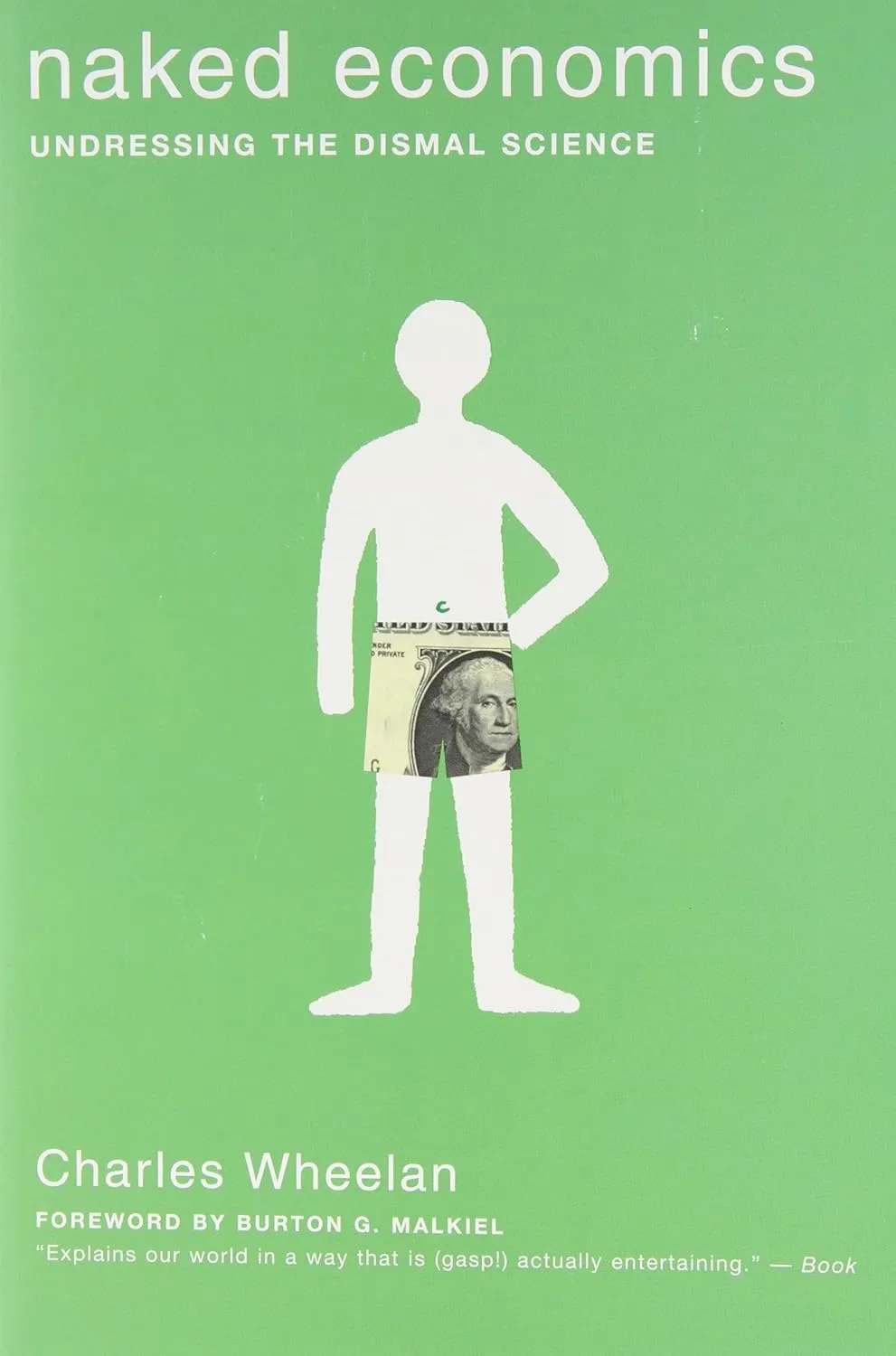
Charles Wheelan wrote Naked Economics for the person who wants to understand how economies work but will never take an economics course. He strips away the graphs, equations, and jargon to explain markets, incentives, monetary policy, trade, and government's role in plain English. First published in 2002 and updated in 2019, the book remains one of the most accessible economics primers available. The 2025 tariff shock, Federal Reserve rate decisions, and inflation data provide a real-time laboratory for testing the book's principles. Some hold up perfectly. Others need updating for a world where trade policy, monetary policy, and fiscal policy interact in ways Wheelan did not fully anticipate.
Book Details
| Attribute | Details |
|---|---|
| Title | Naked Economics: Undressing the Dismal Science |
| Author | Charles Wheelan |
| Publisher | W.W. Norton |
| First Published | 2002 (Revised edition 2019) |
| Pages | 352 |
| Reading Level | Beginner to Intermediate |
| Amazon Rating | 4.5/5 stars |
Get Your Copy
Paperback: Buy on Amazon
Kindle: Buy on Amazon
Audiobook: Buy on Amazon
About the Author
Charles Wheelan is a lecturer at Dartmouth College and a former correspondent for The Economist. He holds a PhD in public policy from the University of Chicago, where he studied under some of the leading economists of the era. His background in both journalism and academia gives him a rare combination: he understands the technical material deeply and can explain it without losing the reader.
Wheelan is not a Nobel laureate or a leading researcher. He is a communicator. This is a strength for the book's purpose. He does not advance original theory. He translates existing economic consensus into accessible language, with real-world examples that make abstract concepts stick.
How Markets Work: The Foundation
Wheelan opens with the most important idea in economics: markets coordinate the actions of millions of individuals without any central planner. The price system is the mechanism. Prices communicate information about scarcity, preferences, and production costs that no individual or government could gather on their own.
The key insight: when markets work, they allocate resources more efficiently than any alternative yet discovered. When markets fail, the failure is usually traceable to a specific, identifiable problem (externalities, information asymmetry, market power, public goods) that has a specific solution.
Wheelan uses the example of a pencil to illustrate how markets coordinate global supply chains without central direction. The wood comes from one country, the graphite from another, the rubber from another, the metal from another. No single person knows how to make a pencil from scratch. The price system coordinates all of it.
This is the Leonard Read insight ("I, Pencil") updated for a general audience. It remains the most important thing to understand about markets: they solve a coordination problem that no planner can solve.
The Importance of Incentives
Wheelan's second key theme: people respond to incentives. This sounds obvious. The implications are not.
When you change the incentives, you change behavior. This applies to individuals, companies, and governments. The challenge is that changing incentives often produces unintended consequences.
| Policy Change | Intended Effect | Actual Outcome |
|---|---|---|
| Rent control | Affordable housing | Reduced supply, deteriorating quality |
| Minimum wage increases | Higher earnings for low-wage workers | Mixed evidence; some job loss in some studies |
| Tariffs on imports | Protect domestic jobs | Higher consumer prices, retaliation, trade diversion |
| Sugar subsidies | Support U.S. sugar farmers | Higher food prices, environmental damage |
| Cash for clunkers | Stimulate auto sales | Borrowed sales from future months, minimal net effect |
The 2025 tariff experience provides a fresh case study. The U.S. raised average tariff duties from 2.4% to 9.6%, bringing protectionism to its highest level in eighty years. A Fed research note found that tariff pass-through to consumers was at least 30% for goods imported from China, with an 8.5% year-over-year price increase by December 2025. An NBER working paper estimates the net welfare impact at between -0.13% and +0.10% of GDP, with sizable consumption losses roughly offset by income and revenue gains.
Wheelan's incentive framework predicts this: tariffs change the relative prices of imported goods, which changes consumer and producer behavior in ways that extend far beyond the intended protection of domestic industries.
Market Failures: When Markets Need Help
Wheelan is not a market fundamentalist. He devotes significant space to market failures and the government's role in addressing them.
Externalities
An externality is a cost or benefit imposed on third parties who are not involved in the transaction. Pollution is the classic negative externality. Education and vaccination are positive externalities.
The solution: make the externality part of the transaction. A carbon tax internalizes the climate cost of emissions. Vaccination subsidies internalize the public health benefit of immunization.
Information Asymmetry
When one party to a transaction has better information than the other, markets can fail. Used cars (lemons), health insurance, and financial products all suffer from information asymmetry.
The solution: regulation that requires disclosure, minimum standards, or licensing. The SEC's requirement for public companies to file financial statements is a response to information asymmetry between corporate insiders and investors.
Public Goods
Goods that are non-excludable (you cannot prevent non-payers from benefiting) and non-rivalrous (one person's use does not diminish another's) are underprovided by markets. National defense, basic research, and clean air are examples.
The solution: government provision funded by taxation. The private sector will not produce enough of these goods because it cannot capture the full value.
Market Power
When one firm or a small group of firms dominates a market, they can restrict output and raise prices above competitive levels. Monopolies and oligopolies reduce economic efficiency.
The solution: antitrust enforcement and regulation of natural monopolies (utilities, infrastructure).
Human Capital: The Most Important Investment
Wheelan argues that human capital (education, skills, health) is the most important determinant of long-term economic outcomes for both individuals and nations.
The evidence is overwhelming. College graduates earn roughly 65-80% more than high school graduates over their careers. Countries with higher education levels have higher GDP per capita, better health outcomes, and more stable governments.
The implication for investors: a country's long-term economic trajectory is largely determined by its investment in human capital. Countries that underinvest in education, health, and skills face declining growth rates and rising inequality.
Trade and Globalization
Wheelan is a strong advocate for free trade, and this is where the 2025 data most tests his framework. His core argument: trade allows countries to specialize in what they do best, making all countries richer in aggregate. The statistical evidence supports this: countries with more open trade policies have higher GDP per capita.
The distributional effects are the problem. Trade creates winners and losers within countries. The winners (consumers who get cheaper goods, exporters who gain market access) are widely dispersed. The losers (workers in import-competing industries) are concentrated and visible.
The 2025 tariff episode illustrates Wheelan's framework and its limitations. The NBER paper confirms that the aggregate welfare effect of the 2025 tariffs was small (between -0.13% and +0.10% of GDP). But the distributional effects were large: consumers paid higher prices for imported goods, while some domestic producers benefited from reduced competition. The tariff revenue raised federal income. The trade deficit did not shrink (it actually expanded for the year, as exports slowed more rapidly than imports).
Wheelan's framework correctly predicts that tariffs impose net costs on the economy. What it underweights is the political economy: the concentration of losses among specific workers and communities creates political pressure that can override the aggregate economic logic. The 2025 tariffs were popular with significant portions of the electorate despite their economic costs, because the distributional effects felt more salient than the aggregate effects.
The Role of Government
Wheelan identifies what governments do well and what they do poorly.
| Government Does Well | Government Does Poorly |
|---|---|
| Providing public goods | Picking industrial winners |
| Addressing externalities | Managing productive enterprises |
| Enforcing property rights | Setting prices |
| Maintaining stable currency | Allocating resources efficiently |
| Providing social safety nets | Regulating without capture |
The key distinction: government should set the rules of the game (property rights, contract enforcement, competition policy, environmental standards) but should not play the game (owning businesses, setting prices, allocating capital).
Monetary Policy: The 2025 Laboratory
Wheelan's chapter on monetary policy is one of the book's most valuable sections. He explains the Federal Reserve's dual mandate (maximum employment and stable prices), the tools it uses (interest rates, reserve requirements, open market operations), and the trade-offs it faces.
The 2025 monetary policy cycle provides a real-time case study. The Fed cut rates three times in the second half of 2025:
| Date | Rate Decision | Target Range | Context |
|---|---|---|---|
| September 17, 2025 | -0.25% | 4.00-4.25% | Downside risks to employment rising |
| October 29, 2025 | -0.25% | 3.75-4.00% | Concluded balance sheet runoff |
| December 10, 2025 | -0.25% | 3.50-3.75% | Inflation still elevated, employment softening |
Source: Federal Reserve FOMC statements
The Fed's dilemma in 2025 illustrates the trade-off Wheelan describes. PCE inflation ran at 2.9% year-over-year in December 2025, above the 2% target. Core PCE was 3.0%, its fastest pace since early 2025. The three-month annualized pace reached 3.1%. Meanwhile, job gains had slowed significantly and the unemployment rate had edged up. The Fed cut rates to support employment while accepting that inflation remained above target.
Chair Powell acknowledged the tariff effect: "Higher tariffs are pushing up prices in some categories of goods, resulting in higher overall inflation. A reasonable base case is that the effects on inflation will be relatively short-lived, a one-time shift in the price level. But it is also possible that the inflationary effects could instead be more persistent."
The FOMC minutes reveal the internal debate: several participants noted that setting aside tariff effects, inflation was close to the 2% target. Others warned that overall inflation had been above target for some time with little sign of returning sustainably. This is the monetary policy trade-off Wheelan explains: the Fed cannot simultaneously maximize employment and minimize inflation when the two goals conflict.
Real GDP grew 2.1% in 2025, down from 2.8% in 2024. Q4 2025 GDP grew at only 0.7% annualized, partly due to a six-week federal government shutdown that subtracted an estimated 1.0 percentage point from growth. The economy slowed while inflation remained sticky. This is the textbook stagflation-lite scenario that makes monetary policy so difficult.
Economic Growth: What Makes Countries Rich
Wheelan identifies the key ingredients of long-term economic growth:
The countries that have these ingredients grow. The countries that lack them do not. The list is not controversial among economists. The political difficulty is implementing it.
Strengths & Weaknesses
What We Loved
Areas for Improvement
Who Should Read This Book
Highly Recommended For
Probably Not For
Comparison to Similar Books
| Book | Focus | Approach | Best For |
|---|---|---|---|
| Naked Economics | Full economics overview | Plain English, examples | Beginners wanting the whole picture |
| Basic Economics (Sowell) | Full economics overview | More detailed, systematic | Readers wanting more depth |
| Freakonomics (Levitt) | Economic thinking applied to odd questions | Case studies | Entertainment and intuition |
| The Wealth of Nations (Smith) | Foundational economics | Historical, dense | Historical interest |
| Economics in One Lesson (Hazlitt) | Seen vs unseen | Short, argumentative | Quick introduction to economic thinking |
Read Naked Economics for the accessible overview. Read Basic Economics for more depth. Read Freakonomics for how economic thinking applies to unexpected questions. Read Economics in One Lesson for the single most important principle in economics.
Implementation Guide
Using Economics to Make Better Financial Decisions
Step 1: Think at the margin
Step 2: Watch the incentives
Step 3: Understand the Fed's dual mandate
Step 4: Recognize externalities in your investment decisions
Step 5: Think long-term about human capital
Frequently Asked Questions
Q: Is Naked Economics or Basic Economics by Thomas Sowell better?
A: For complete beginners, Naked Economics. It is more engaging and accessible. For readers who want more systematic depth, Basic Economics. They cover similar ground at different levels of detail.
Q: Has the 2025 tariff episode invalidated the book's free trade argument?
A: No. The NBER analysis confirms that the aggregate welfare effect of the 2025 tariffs was small and potentially negative. The book's economic logic is correct. What the book underweights is the political economy: the distributional effects of trade create political pressure that can override aggregate economic logic. The 2025 tariffs are a case study in political economy, not a refutation of trade theory.
Q: Does the book cover cryptocurrency or digital assets?
A: No. The revised edition (2019) predates the mainstream adoption of crypto. The book's monetary policy framework (Fed controls money supply through interest rates and open market operations) remains the operative system, but readers should supplement with current sources on digital currencies.
Q: How does the book's monetary policy chapter hold up against 2025 Fed actions?
A: Very well. The Fed's 2025 dilemma (cutting rates while inflation remained above target) is exactly the trade-off Wheelan describes. The book explains why the Fed cannot simultaneously maximize employment and minimize inflation when the two goals conflict. The 2025 cycle is a real-time validation of the framework.
Final Verdict
Rating: 4.4/5
Naked Economics remains the best starting point for readers who want to understand economics without taking a course. Its explanations of markets, incentives, monetary policy, and trade are clear, accurate, and memorable. The 2025 tariff shock, Fed rate decisions, and inflation data validate the book's core frameworks while revealing areas where the treatment needs updating (distributional effects of trade, AI and labor markets, digital currencies). Read it for the foundation. Supplement with current sources for the developments Wheelan could not have anticipated.
Get Your Copy
Paperback: Buy on Amazon
Kindle: Buy on Amazon
Audiobook: Buy on Amazon
Prices current as of publication date. Free shipping available with Prime.