*Disclosure: This article contains affiliate links. If you purchase through these links, we may earn a commission at no additional cost to you. We only recommend books we genuinely believe in.
Quick Overview
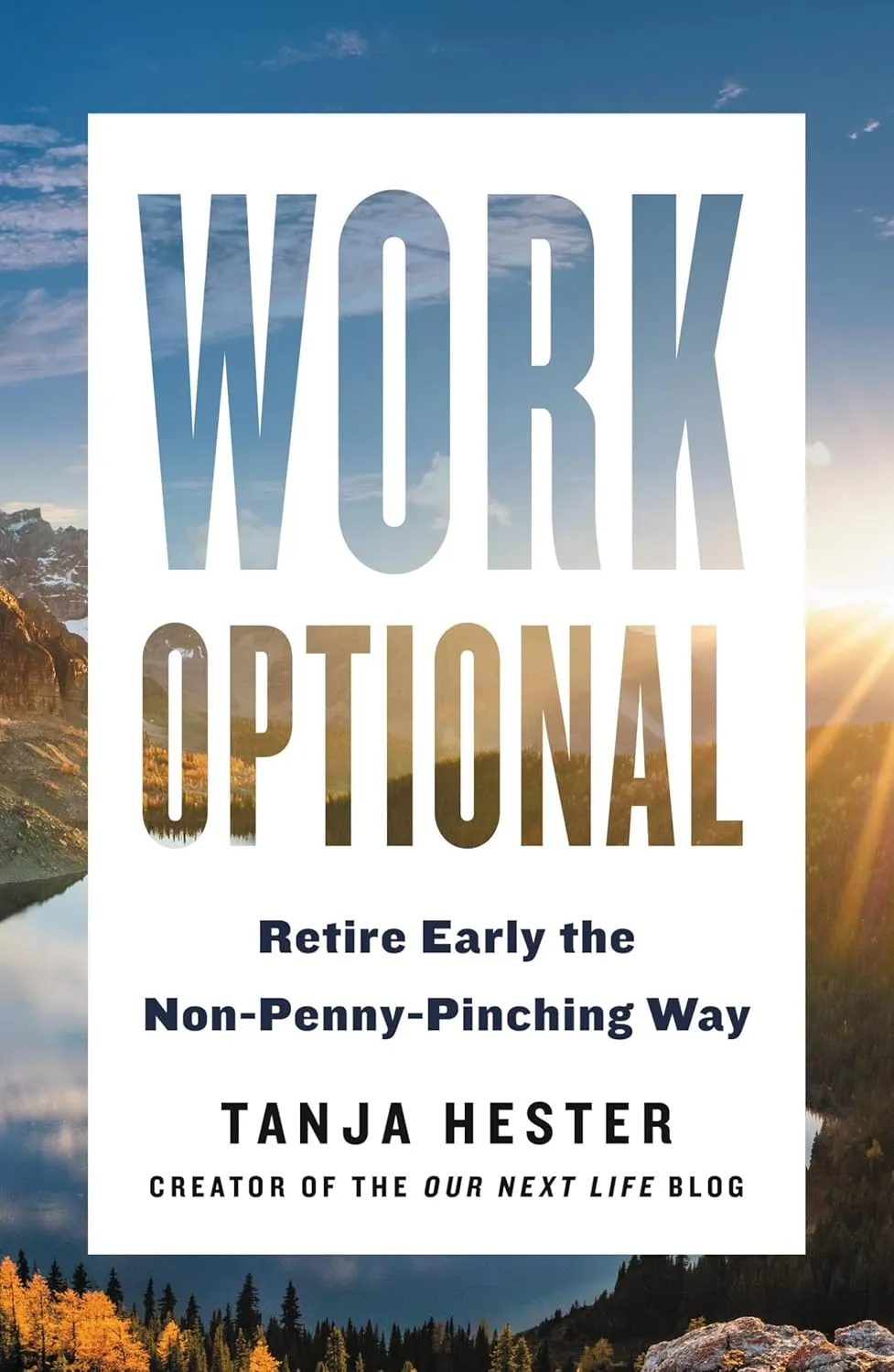
Tanja Hester and her husband Mark retired at 38 and 41 after a decade of deliberate saving, without extreme deprivation or unusual incomes. Work Optional is the FIRE book for people who want financial independence without the frugality obsession. It focuses first on defining what you actually want your life to look like, and only then on the financial mechanics of getting there. Its nuanced treatment of partial financial independence, healthcare, and identity makes it the most complete FIRE guide for people who want to retire early but are not willing to eat rice and beans for a decade.
The term "work optional" has entered the mainstream vocabulary since this book was published. A 2026 Business Insider article quoted Laura Sondy, a professor of organizational behavior at UNC Chapel Hill, saying that many FIRE followers today "identify more strongly with a term that was popularized by FIRE author Tanja Hester: 'work optional.'" The concept has evolved beyond the original FIRE movement's extreme frugality into a broader philosophy of using financial independence to gain autonomy over work and life. Hester's own blog, Our Next Life, eventually argued for "retiring FIRE" as a movement and splitting it into more nuanced categories, a perspective that the broader culture has now adopted.
I found this book uniquely valuable because it addresses the questions most FIRE resources skip: what do you actually do after you retire? How do you handle healthcare? How do you manage the identity shift? Hester answers these with the specificity of someone who has lived through them, not theorized about them.
Book Details
| Attribute | Details |
|---|---|
| Title | Work Optional |
| Author | Tanja Hester |
| Publisher | Little, Brown Spark |
| Published | 2019 |
| Pages | 272 |
| Reading Level | Beginner to Intermediate |
| Amazon Rating | 4.6/5 stars |
Get Your Copy
Paperback: Buy on Amazon
Kindle: Buy on Amazon
About the Author
Tanja Hester blogs at Our Next Life and The Fioneers and has written for The New York Times, Forbes, and Kiplinger's. She and her husband retired in their late 30s/early 40s after careers in political consulting and communications. Her FIRE journey focused on maintaining a comfortable lifestyle during accumulation while still reaching financial independence significantly earlier than traditional retirement age. In 2026, her concept of "work optional" has been adopted by mainstream financial media as the preferred term for the modern FIRE philosophy, which emphasizes autonomy over outright retirement.
The Work Optional Philosophy
Hester's central distinction: financial independence does not mean you must stop working entirely. "Work optional" means you have enough money that you choose your work based on meaning and preference rather than financial necessity.
The four work-optional scenarios:
| Scenario | Description | Required Nest Egg |
|---|---|---|
| Traditional early retirement | Stop working completely, live off savings | 25-30x annual expenses |
| Semi-retirement | Work part-time or on passion projects that cover some expenses | 15-20x annual expenses |
| Career change | Leave high-stress, high-pay career for meaningful lower-paid work | 10-15x annual expenses |
| Financial security | Job optional; stay employed by choice, not necessity | 10-15x annual expenses |
Most FIRE literature focuses on the first scenario. Hester argues the others are equally valid and often more appropriate. Reaching semi-retirement is achievable years earlier and provides more lifestyle flexibility than waiting for full retirement. Use our FIRE calculator to model different scenarios and see how partial financial independence changes your timeline.
Part 1: The Vision
Hester's most important contribution: forcing readers to define what they actually want before calculating numbers.
The Life Vision Exercise
Most financial planning starts with numbers (how much do I need?) and works backward to lifestyle. Hester reverses this:
Step 1: Map your current life
Step 2: Design your ideal future life
Step 3: Identify the gap
Why this matters:
Hester's observation from the FIRE community: many people who achieve full financial independence discover they were running toward a number rather than toward a specific life vision. They retire and feel lost. The vision work prevents this mistake.
Defining "Enough"
The concept of "enough" is central to Work Optional. Hester argues that clarity about what constitutes "enough" is both financially and psychologically necessary:
The hedonic treadmill problem:
Lifestyle inflation, spending more as income rises, is automatic unless actively resisted. Most people find that their expenses rise to match their income, regardless of how much that income is. The person earning $60,000 who saves 10% and spends $54,000 often becomes the person earning $120,000 who saves 10% and spends $108,000. The savings rate is the same; the absolute amount grows, but so does the lifestyle.
Hester's "enough" test:
For any spending category, ask:
Categories that fail this test are candidates for reduction without lifestyle sacrifice.
Part 2: The Numbers
The 4% Rule and Its Limits
The 4% rule (withdraw 4% of your portfolio in year one, adjust for inflation each year thereafter) is the standard FIRE withdrawal guideline. Hester provides the most balanced treatment of the rule's limitations available in a popular book:
The Trinity Study basis:
The 4% rule is derived from the 1998 Trinity Study, which found that a 4% initial withdrawal rate sustained a 30-year retirement with 95% historical success using a diversified stock/bond portfolio.
The limitations for early retirees:
| Limitation | Why It Matters for Early Retirees |
|---|---|
| 30-year horizon | Early retirees may need 50-60 year horizon |
| Historical U.S. returns | May not repeat; international evidence mixed |
| Static withdrawal rate | Does not account for sequence of returns risk |
| Does not include Social Security | SS income in later years reduces actual portfolio stress |
| Taxes not modeled | Affects sustainable withdrawal in taxable accounts |
Adjusted safe withdrawal rates by horizon:
| Retirement Horizon | Suggested Safe Withdrawal Rate |
|---|---|
| 30 years (traditional) | 4.0% |
| 40 years | 3.5% |
| 50+ years (early retirement) | 3.0-3.5% |
Hester's recommendation: Use 3.5% as the baseline for early retirees, and build in flexibility mechanisms:
The Healthcare Problem
For Americans retiring before Medicare eligibility at 65, healthcare is the dominant financial risk. The 2026 ACA marketplace environment continues to provide coverage regardless of pre-existing conditions, though subsidy thresholds and premium costs have shifted since the book was published.
The ACA marketplace (pre-Medicare):
The Affordable Care Act marketplace provides coverage regardless of pre-existing conditions. For early retirees with controlled income, ACA subsidies can dramatically reduce premium costs:
| Annual Income (2026) | ACA Premium Subsidy Eligibility |
|---|---|
| Below 138% FPL (~$21,000) | Medicaid eligible |
| 138%-250% FPL ($21,000-$39,000) | Large subsidies; premiums 2-9% of income |
| 250%-400% FPL ($39,000-$63,000) | Moderate subsidies |
| Above 400% FPL ($63,000+) | No subsidies; full market premiums |
The income management strategy:
Early retirees who can manage their taxable income (through Roth conversions, capital gain harvesting, and withdrawal sequencing) often qualify for substantial ACA subsidies. A couple with $1.5M in assets might manage their income to ~$40,000 for ACA subsidy purposes while living comfortably.
Healthcare cost projection:
| Scenario | Annual Healthcare Cost (couple, pre-Medicare) |
|---|---|
| Manage income for ACA subsidies | $5,000-$12,000 |
| Full market premiums (no subsidies) | $20,000-$30,000 |
| Unexpected major illness | Potentially $7,500-$15,000 in out-of-pocket costs |
Healthcare is the most significant variable in early retirement planning and deserves dedicated analysis before any date is set.
The Account Sequencing Strategy
Early retirees face a unique challenge: most tax-advantaged accounts (401(k), Traditional IRA) cannot be accessed penalty-free until age 59.5. This requires a bridge strategy.
The typical early retiree account structure:
| Account Type | Tax Treatment | Accessible |
|---|---|---|
| Taxable brokerage | After-tax; gains taxed | Anytime |
| Roth IRA contributions | After-tax contributions | Anytime (contributions, not gains) |
| Roth IRA earnings | Tax-free | Age 59.5 (or via 72(t)) |
| Traditional 401(k)/IRA | Pre-tax | Age 59.5 (or via 72(t)) |
The Roth conversion ladder:
The most powerful early retirement strategy for tax-deferred accounts:
This allows full access to tax-deferred savings before 59.5, while managing income to minimize ACA premiums and conversion taxes. A Roth IRA conversion ladder is one of the most powerful tools in the early retiree's toolkit, and Hester explains it more clearly than any other author I have read.
Part 3: The Transition
The Identity Challenge
Hester is unusually candid about the psychological challenges of early retirement, particularly for high-achieving professionals:
Work provides:
Early retirees who do not proactively build non-work versions of these needs often find themselves miserable in retirement. The financial freedom they pursued does not automatically translate to fulfillment.
The structure creation challenge:
Without work's imposed structure, early retirees must deliberately create their own:
The Social Scripts Problem
"What do you do?" is one of the most common social questions in professional America. Early retirees who answer "I'm retired" are met with:
Hester provides actual scripts for navigating these conversations gracefully, a practical resource that most FIRE books ignore entirely.
The Complete FIRE Planning Checklist
Hester provides one of the most comprehensive pre-retirement checklists in any personal finance book:
Financial Checklist
| Item | Status |
|---|---|
| Target annual spending calculated (not current spending) | |
| Healthcare costs modeled pre-Medicare | |
| Safe withdrawal rate calculated for intended horizon | |
| Account sequencing strategy designed | |
| Social Security optimization modeled | |
| Tax diversification across account types | |
| Estate documents: will, healthcare proxy, power of attorney | |
| Insurance coverage: life (if dependents), disability, umbrella | |
| Emergency fund: 1-2 years of expenses in accessible cash |
Life Vision Checklist
| Item | Status |
|---|---|
| Daily schedule designed for post-work life | |
| Social community identified (not work-dependent) | |
| Purpose and contribution plan | |
| Physical health: exercise, medical care plan | |
| Mental health: stimulation, learning, creativity | |
| Relationship with partner aligned | |
| Geographic flexibility assessed |
Strengths & Weaknesses
What We Loved
Areas for Improvement
Who Should Read This Book
Highly Recommended For
Probably Not For
Frequently Asked Questions
Q: Is this book better than Your Money or Your Life for FIRE planning?
A: Complementary. Your Money or Your Life provides the philosophical framework for reexamining work and consumption; Work Optional provides more specific financial planning mechanics. Read both.
Q: Do I need to be extremely frugal to implement this?
A: No, that is Hester's explicit message. She and her husband maintained a comfortable lifestyle throughout their accumulation phase. The key is clarity about spending that reflects your values vs. habitual consumption, and a high savings rate (they saved 50-70%), not extreme deprivation. Use our savings rate calculator to see where you stand.
Final Verdict
Rating: 4.6/5
Work Optional is the most nuanced and complete FIRE planning guide available. Its vision-first approach, comprehensive healthcare coverage, account sequencing strategy, and honest treatment of the identity challenges of early retirement make it uniquely valuable. In 2026, the term "work optional" has become the dominant framework for discussing financial independence, replacing the older FIRE emphasis on extreme early retirement. Every FIRE aspirant should read it alongside The Simple Path to Wealth for the complete picture. If you are serious about gaining control over your time and work, this is the book that will help you define what that actually looks like and build a plan to get there.
Get Your Copy
Paperback: Buy on Amazon
Kindle: Buy on Amazon
Prices current as of publication date. Free shipping available with Prime.