*Disclosure: This article contains affiliate links. If you purchase through these links, we may earn a commission at no additional cost to you. We only recommend books we genuinely believe in.
Quick Overview
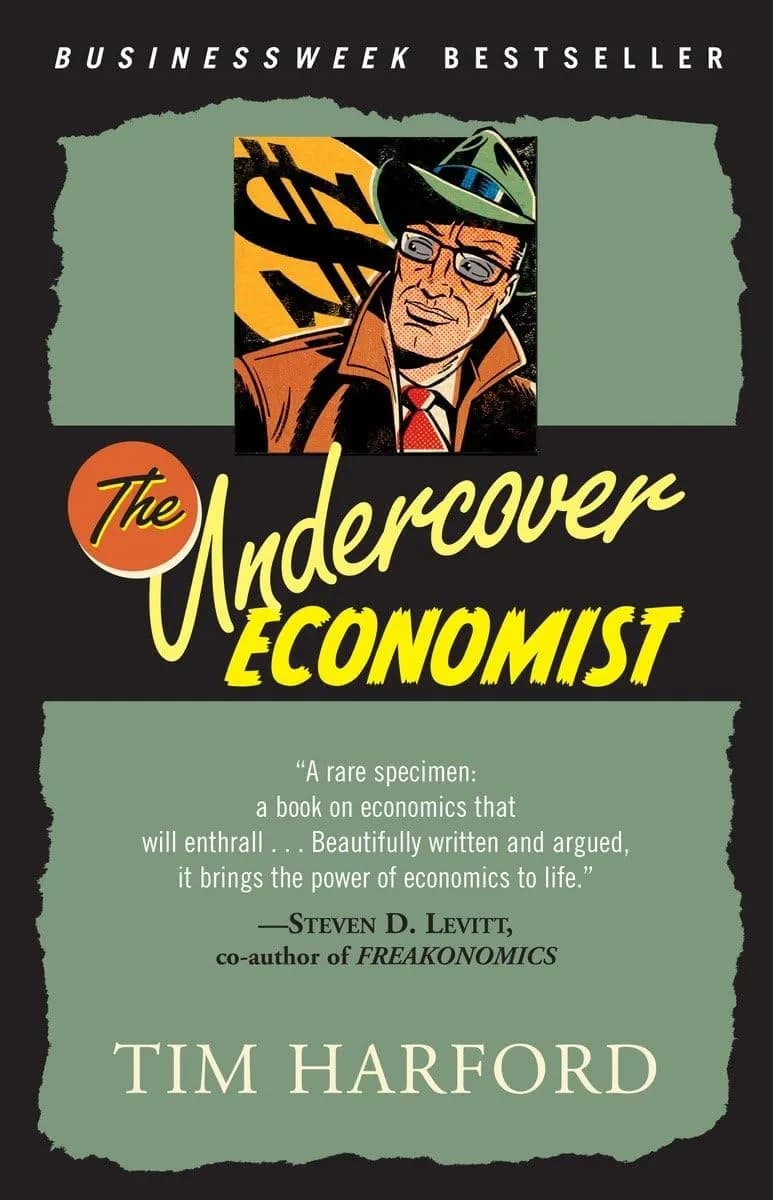
I picked up The Undercover Economist at an airport bookshop in 2017, expecting a light read for the flight. Three hours later I was still reading in the taxi. Tim Harford has a rare gift: he makes economics feel like a detective story rather than a textbook. His first book applies economic thinking to everyday situations, from coffee pricing and supermarket layouts to healthcare markets and global poverty, revealing the hidden mechanisms that shape prices, behavior, and outcomes. Where Freakonomics applies economic thinking to unusual questions, The Undercover Economist applies it to the familiar things all around us that we have never thought to analyze.
The book has sold over one million copies and been translated into more than 30 languages. A revised edition released in 2012 added a chapter on the 2008 financial crisis. The core arguments, however, remain as relevant in 2026 as they were in 2005, perhaps more so given the tariff wars, AI-driven labor disruption, and renewed debates about market structure that dominate current economic news.
Book Details
| Attribute | Details |
|---|---|
| Title | The Undercover Economist |
| Author | Tim Harford |
| Publisher | Random House Trade (revised edition 2012) |
| Published | 2005 (revised 2012) |
| Pages | 288 |
| Reading Level | Beginner |
| Amazon Rating | 4.4/5 stars |
Get Your Copy
Paperback: Buy on Amazon
Kindle: Buy on Amazon
About the Author
Tim Harford has written the "Undercover Economist" column for the Financial Times since 2003. He is also the presenter of the BBC podcast Cautionary Tales, which uses storytelling to explore historical disasters and the human errors that caused them. Recent 2026 episodes have covered the Windscale nuclear fire, the psychology of expert failure, and the economic implications of AI-driven automation. His FT columns in 2025 and 2026 have focused heavily on trade policy, tariffs, and the economic consequences of the U.S.-China trade tensions.
His other books include The Logic of Life, Adapt, The Data Detective, and How to Make the World Add Up. He is a senior columnist at the FT and a visiting professor at Nuffield College, Oxford. He is known for applying economic reasoning with wit and accessibility that makes abstract concepts immediately intuitive. His 2025 FT article "Seven Truths About Trade" is one of the clearest explanations of trade economics written for a general audience and is worth seeking out alongside this book.
The Scarcity Principle: Why Coffee Costs What It Does
Harford opens with a brilliant analysis of Starbucks pricing that reveals the fundamental economics of competitive markets, monopoly, and price discrimination. I have read a lot of economics books, and this opening chapter remains the single best introduction to how prices actually work that I have encountered.
Why the Coffee Cart Near the Train Station Charges More
The coffee cart positioned at the one exit from a busy train station has a captive audience. Commuters who want coffee cannot easily walk to a competitor. This locational advantage is a form of scarcity power. The seller controls access to a scarce resource, which is the convenient location.
The chain of scarcity:
The coffee seller is not extracting monopoly profits. The station owner is extracting them through rent. Competition among coffee sellers bids up the rent they pay until the profits are normal.
Investment application: When analyzing a high-margin business, identify who captures the rent. The company with apparent pricing power may actually be paying it to a landlord, a platform, a supplier, or a regulatory body. Sustainable high margins require genuine competitive advantage, not just apparent pricing power. This framework is directly applicable to analyzing asset allocation across sectors where rent extraction differs.
Starbucks and Price Discrimination
Starbucks sells coffee at dramatically different prices for apparently similar products. A tall drip coffee costs about $3. A Venti caramel macchiato costs about $7. The cost to produce them is not dramatically different.
Harford's insight: Starbucks is practicing price discrimination, charging different amounts to customers with different willingness to pay.
The complexity of the Starbucks menu is not accidental. It is an elaborate mechanism for sorting customers by willingness to pay:
| Customer Type | Likely Order | Price Paid |
|---|---|---|
| Price-sensitive student | Drip coffee, small | $3 |
| Convenience-focused professional | Standard latte | $5 |
| Indulgent premium-seeker | Custom Frappuccino | $7+ |
Each customer segment reveals their willingness to pay through their order. Starbucks captures maximum revenue across all segments.
2026 update: The price discrimination framework Harford describes has only become more sophisticated. Subscription models (Amazon Prime, Costco memberships), dynamic pricing (Uber surge, airline revenue management), and AI-driven personalized pricing have all extended the logic Harford described in 2005. Companies that can segment customers and charge each segment close to their maximum willingness to pay earn substantially higher revenues than those charging a single price. Software companies with tiered pricing for individuals, professionals, and enterprises are the clearest modern examples.
The Truth About Markets
The Invisible Hand Actually Works
Harford provides one of the clearest demonstrations of how price signals coordinate economic activity without central direction.
The market clearing mechanism:
When a coffee shop has too many customers and not enough tables:
This process happens continuously across all markets, coordinating millions of decisions without any central authority. The price system is an information processing mechanism of remarkable efficiency.
For investors: Understanding supply and demand dynamics is fundamental to commodities investing, real estate analysis, and understanding why certain businesses have durable pricing power.
When Markets Fail
Harford is balanced about market failures, situations where the price mechanism produces outcomes that are inefficient or inequitable:
Externalities:
When the full cost of a transaction is not borne by the parties to the transaction, markets overproduce the good:
| Externality | Who Bears the Cost | Market Result |
|---|---|---|
| Air pollution from factories | Third parties (public health) | Too much pollution |
| Traffic congestion | Other drivers | Too much driving in peak hours |
| Antibiotic overuse | Future patients | Too much antibiotic use |
| Carbon emissions | Global climate | Too much carbon |
The market underprovides goods with positive externalities (vaccines, basic research) and overprovides goods with negative externalities. This framework is directly relevant to 2026 policy debates about carbon pricing, AI safety regulation, and pharmaceutical patent reform.
Information asymmetry:
Used car markets (Akerlof's lemons problem) fail because sellers know more about quality than buyers. Healthcare markets fail because doctors know more than patients. Financial product markets can fail because product designers know more about risks than purchasers. The 2008 financial crisis, which Harford added to the revised edition, is a case study in information asymmetry at scale: mortgage-backed securities were priced as if their risk was well understood when it was not.
Market power:
Monopolists produce less and charge more than competitive markets. Cable TV, pharmaceutical patents, and utility monopolies all demonstrate how market power reduces welfare. In 2026, the same framework applies to debates about Big Tech platform dominance and AI model provider concentration.
Game Theory: The Prisoner's Dilemma in Real Life
Harford illustrates game theory through engaging examples that reveal why individually rational behavior can produce collectively poor outcomes.
The Prisoner's Dilemma
Two suspects are held separately. Each can cooperate with the other (stay silent) or defect (inform on the other):
| Player 1 / Player 2 | Cooperate | Defect |
|---|---|---|
| Cooperate | Both get 1 year | Player 1 gets 3 years, Player 2 goes free |
| Defect | Player 1 goes free, Player 2 gets 3 years | Both get 2 years |
If both players cooperate, total prison time is 2 years. But each player has an individual incentive to defect regardless of what the other does. The dominant strategy is to defect, leading to the worst collective outcome.
The prisoner's dilemma in business:
OPEC as a prisoner's dilemma:
OPEC members collectively benefit from restricting oil production to keep prices high. But each individual member has an incentive to produce slightly more than their quota, capturing extra revenue while others restrict. This is why OPEC agreements consistently break down. The prisoner's dilemma structure makes cheating individually rational even when cooperation is collectively optimal.
Investment application: Industries where prisoner's dilemma dynamics prevail (airlines, steel, commodity chemicals) tend to have poor long-run economics regardless of market growth. Industries where cooperation is enforced (pharmaceuticals with patent protection, regulated utilities) tend to have better economics.
Why Poor Countries Are Poor
The most thought-provoking section of the book addresses global poverty through economic analysis.
The Institutions Hypothesis
Harford examines why countries like Cameroon are poor despite having natural resources and agricultural potential. His conclusion: the problem is institutions.
The legal and property rights foundation:
In Cameroon (and many poor countries), the formal economy requires navigating:
The transaction cost explosion:
Hernando de Soto documented that starting a formal small business in Peru in the 1980s required 289 days and cost $1,231 in fees, equivalent to 31 months of minimum wage. The same process in the United States took 4 hours.
When the cost of the formal economy exceeds its benefits, economic activity moves to the informal sector. Informal businesses cannot access bank credit, enforce contracts through courts, scale beyond personal relationships, or attract foreign investment. The result is a poverty trap where the absence of institutions makes formal economic activity unviable.
Why institutions matter for investors:
Country risk analysis is fundamentally about institutional quality. The World Bank's Doing Business indicators measure institutional quality and correlate strongly with economic growth and investment returns. Countries with improving institutions (rule of law, property rights, contract enforcement) tend to produce improving investment returns over long horizons.
The Role of Trade
Harford makes the case for free trade using comparative advantage:
The factory in the field:
Rather than growing your own wheat and baking your own bread, you specialize and trade. The same principle applies between countries. Countries that specialize in their comparative advantage and trade benefit from the resulting gains, even if their comparative advantage is in low-value industries.
Why protectionism is tempting but costly:
Protecting an industry generates visible benefits (jobs saved in the protected industry) and invisible costs (higher prices for consumers, jobs lost in industries that use the protected input, retaliatory tariffs on exports). The visible benefits create political support. The invisible costs are diffuse and produce no organized political constituency.
2026 context: This trade framework has become painfully relevant. The U.S. tariff policies of 2025 and 2026, including Section 232 tariffs on steel and aluminum and the broad reciprocal tariffs on Chinese goods, have created exactly the dynamic Harford describes. Consumers face higher prices on imported goods. Retaliatory tariffs have reduced U.S. agricultural and manufacturing exports. The visible beneficiaries (domestic steel producers) are concentrated and politically organized. The invisible losers (consumers paying higher prices, export-sector workers facing retaliation) are diffuse. Harford's 2025 FT article "Seven Truths About Trade" updates this analysis for the current moment and is essential reading alongside this chapter.
Harford's honest treatment of trade's distributional effects:
Unlike some free-trade advocates, Harford acknowledges that trade creates both winners (consumers, export industries) and losers (import-competing workers). The aggregate gains exceed the losses, but that does not mean the losses are unimportant. Addressing the distributional consequences of trade through retraining, adjustment assistance, and healthcare security is a legitimate policy question. This nuance separates Harford from ideologues on both sides of the trade debate.
Healthcare: The Special Case
Healthcare is Harford's most complex market analysis, a market where standard price mechanisms fail in multiple ways simultaneously:
The asymmetric information problem:
Patients do not know what treatment they need. That is why they go to doctors. This undermines the standard consumer sovereignty model: the buyer cannot evaluate the quality of what they are buying.
The insurance-induced moral hazard:
When healthcare is insured, patients face zero or near-zero marginal cost at the point of use. This generates excessive consumption. People use more healthcare than they would if they faced the full cost.
The adverse selection death spiral:
In an unregulated health insurance market:
This is why unregulated health insurance markets tend to collapse. Adverse selection unravels the market.
The case for universal coverage:
Mandatory universal coverage (through government provision, mandate, or employer requirement) solves the adverse selection problem by forcing healthy and sick into the same pool. This explains why virtually all developed countries except the pre-ACA United States had some form of universal coverage. The economics of health insurance make it nearly impossible to provide efficiently through pure market mechanisms.
2026 relevance: The ACA's survival through multiple Supreme Court challenges has validated this analysis. Healthcare costs continue to consume approximately 18% of U.S. GDP, and the structural problems Harford identifies, information asymmetry, moral hazard, and adverse selection, remain unresolved. AI-driven diagnostic tools may eventually reduce information asymmetry, but the fundamental market structure he describes has not changed.
Investment application: Healthcare is structurally different from most markets. Pricing power in pharmaceuticals is driven by patent protection and information asymmetry. Hospital systems compete on quality and reputation, not price. Healthcare insurers face both adverse selection management and regulatory constraints. Understanding these structural features is essential for healthcare sector investing.
Strengths & Weaknesses
What We Loved
Areas for Improvement
Who Should Read This Book
Highly Recommended For
Probably Not For
Final Verdict
Rating: 4.5/5
The Undercover Economist is the most entertaining applied economics book since Freakonomics. Its Starbucks pricing analysis, prisoner's dilemma in business, and poverty-and-institutions chapters are each individually excellent. The trade chapter has become more relevant, not less, in the two decades since publication. Essential reading for investors who want to think more clearly about competitive dynamics and market structure. Pair it with Harford's ongoing FT columns for updated applications of the same framework to current events.
Get Your Copy
Paperback: Buy on Amazon
Kindle: Buy on Amazon
Prices current as of publication date. Free shipping available with Prime.