*Disclosure: This article contains affiliate links. If you purchase through these links, we may earn a commission at no additional cost to you. We only recommend books we genuinely believe in.
Quick Overview
In July 2026, Gildan Activewear shares tumbled 18% after Jehoshaphat Research published a forensic report accusing the company of improper channel stuffing. That same month, Brazilian police launched the second phase of Operation Disclosure, investigating a R$25 billion accounting fraud at retailer Americanas. And earlier in 2026, federal prosecutors charged the former CEO of iLearningEngines with fabricating virtually all of its $1.4 billion in reported revenue. These are exactly the patterns Howard Schilit has been documenting for three decades. Financial Shenanigans is the book that earned him the title "Sherlock Holmes of Accounting," and the techniques it exposes are alive and well in 2026. If you invest in individual stocks, this book is your defense mechanism.
Book Details
| Attribute | Details |
|---|---|
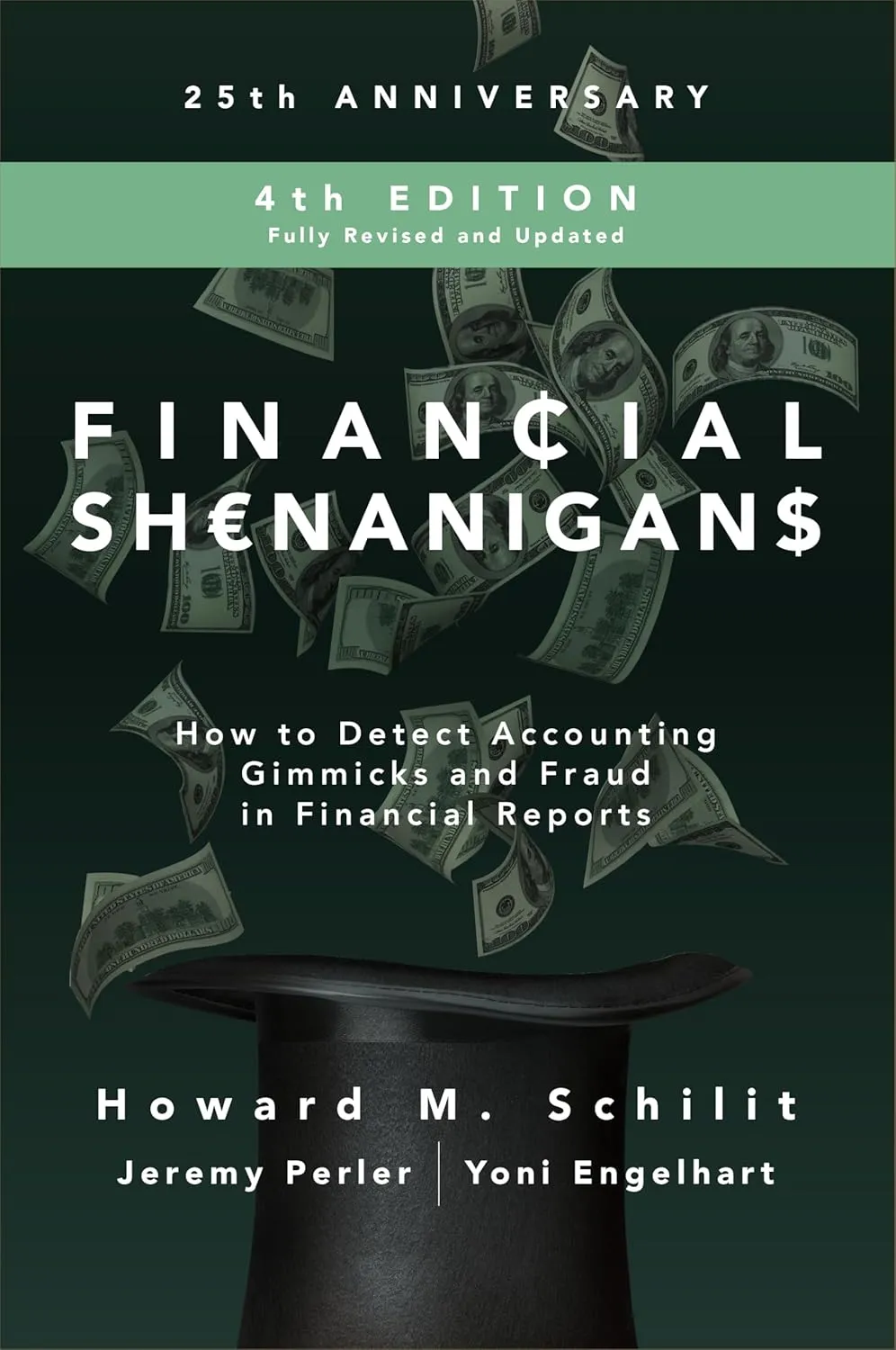
| Title | Financial Shenanigans (Fourth Edition) |
| Authors | Howard Schilit, Jeremy Perler, and Yoni Engelhart |
| Publisher | McGraw-Hill |
| First Published | 1993 |
| Fourth Edition | 2018 |
| Pages | 352 |
| Reading Level | Intermediate to Advanced |
| Amazon Rating | 4.6/5 stars |
Get Your Copy
Hardcover: Buy on Amazon
Kindle: Buy on Amazon
About the Author
Howard Schilit is the founder and CEO of Schilit Forensics, an investment research consultancy specializing in detecting accounting chicanery. He previously founded CFRA (Center for Financial Research and Analysis), which identified Enron's accounting irregularities before the scandal broke. He has testified before Congress and the SEC and is frequently called the "Sherlock Holmes of Accounting." In a February 2025 interview with Latticework, Schilit discussed how the fourth edition focuses on case studies from the past quarter century and brings readers up to date on accounting deception in global markets. Jeremy Perler and Yoni Engelhart are forensic accounting experts who have worked alongside Schilit for years.
Key Concepts & Frameworks
Why Financial Statements Lie
GAAP provides significant flexibility in how companies report results. This flexibility serves legitimate purposes: different industries have different economics that require different accounting treatment. But it also provides cover for manipulation.
The manipulation spectrum runs from conservative accounting (understate results) to aggressive accounting (overstate results) to fraudulent accounting (fabricate numbers). Most accounting manipulation is not outright fraud. It is aggressive use of legitimate accounting flexibility to paint an optimistic picture. GAAP allows this. Detecting it requires reading beyond the headline numbers.
| Statement | What It Shows | Manipulation Potential |
|---|---|---|
| Income statement | Revenue and expenses over a period | Very High, most manipulation focuses here |
| Balance sheet | Assets and liabilities at a point in time | High, asset inflation and liability hiding |
| Cash flow statement | Cash in and out | Lower, but not impossible |
The income statement is easiest to manipulate because it involves the most accrual accounting judgments. The cash flow statement is harder because cash is cash. Divergence between reported earnings and operating cash flow is one of the most powerful warning signs in financial analysis.
The Seven Earnings Manipulation Schemes
Scheme 1: Recording Revenue Too Soon or of Questionable Quality
Channel stuffing: a company ships more product to distributors than they can sell, recording the revenue immediately. Distributors later return the unsold product, but the original revenue is already recorded. This is exactly what Jehoshaphat Research accused Gildan of in June 2026, alleging the company compelled distributors to pull forward purchases at quarter-ends with extreme payment terms.
Warning signs:
The DSO calculation: (Accounts Receivable / Revenue) x 365. A company with $1 billion in revenue and $200 million in receivables has DSO of 73 days. If DSO rises to 90 days with revenue unchanged, $47 million of additional receivables are sitting uncollected. Potential channel stuffing.
Scheme 2: Recording Bogus Revenue
Related-party transactions: record revenue from entities the company controls or has undisclosed relationships with. Round-trip transactions: two companies agree to pay each other equal amounts, each recording the payment as revenue. Net economic effect: zero. Reported revenue for each: doubled.
The iLearningEngines case is a textbook example. Federal prosecutors charged the former CEO with fabricating virtually all customer relationships and revenues, inflating contracts and invoices to obtain financing. The company reported $1.4 billion in revenue before collapsing into Chapter 7 liquidation.
Scheme 3: Boosting Income With One-Time Gains
Record gains on the sale of business units or assets as if they were recurring operating income. The normalized earnings test: for each year's earnings, ask "If I remove all one-time items, what did this business actually earn from ongoing operations?" If one-time gains are recurring and growing, the underlying business may be deteriorating while reported earnings look stable.
Scheme 4: Shifting Current Expenses to a Later Period
Capitalize expense items that should be charged immediately, putting them on the balance sheet as assets and amortizing over future periods. WorldCom capitalized $3.8 billion in routine network maintenance costs as capital expenditures in 2001, inflating reported earnings by the same amount. When revealed, WorldCom filed the largest bankruptcy in U.S. history at the time.
Warning signs:
Scheme 5: Failing to Record or Improperly Reducing Liabilities
Cookie jar reserves: build up excessive reserves during good years, then release them into income during bad years to smooth reported earnings. The Americanas scandal in Brazil involved concealing over R$20 billion in supplier-financing obligations from financial statements, as reported in June 2026. Investigators found the retailer falsified cooperative advertising allowance agreements to report results that appeared significantly stronger than reality.
Scheme 6: Shifting Current Revenue to a Later Period
Companies use this when current earnings are unsustainably high and they want to create reserves for future periods. Record current-period revenue as "deferred" even when earned. Warning signs: deferred revenue growing faster than reported revenue, revenue recognition policy changes, subscription businesses changing recognition timing.
Scheme 7: Shifting Future Expenses to the Current Period
Big bath charges: take enormous write-downs and restructuring charges in a single bad year to clear the decks for future periods. Future reported earnings look good because the expenses were front-loaded.
| Year | Reported Earnings | "One-Time" Charges |
|---|---|---|
| Year 1 | -$500M | $800M restructuring charge |
| Year 2 | +$200M | None |
| Year 3 | +$250M | None |
| Year 4 | +$300M | None |
The company looks like it turned around. In reality, Year 1's overloaded charge artificially deflated that year and inflated all subsequent years.
The Six Cash Flow Shenanigans
Cash flow is harder to manipulate than earnings, but not impossible. Schilit documents six techniques:
Practical Applications
The Red Flags Checklist
Schilit's consolidated red flags for financial statement analysis:
Revenue Quality Red Flags
| Red Flag | Calculation | Threshold |
|---|---|---|
| Rising DSO | (AR / Revenue) x 365 | DSO rising more than 5 days year-over-year |
| Revenue growth outpacing cash collection | Revenue growth vs. cash collected | Cash growth below 80% of revenue growth |
| Related party revenue concentration | Related party revenue / total revenue | Above 5% requires investigation |
| Revenue recognized before delivery | Review revenue recognition policy | Any "bill and hold" language |
Expense Quality Red Flags
| Red Flag | Calculation | Threshold |
|---|---|---|
| Aggressive capitalization | Capex vs. peers | Materially above industry average |
| Declining depreciation rate | Depreciation / PP&E | Declining trend suggests extended asset lives |
| Goodwill growing without acquisition | Goodwill changes vs. acquisition price | Any growth not explained by acquisitions |
Cash Flow Quality Red Flags
| Red Flag | Calculation | Threshold |
|---|---|---|
| Earnings-cash flow divergence | Net income minus operating cash flow | Growing divergence over time |
| Declining cash conversion | Operating cash flow / Net income | Below 0.8x for multiple years |
| Capex exceeds depreciation by large margin | Capex / Depreciation | Above 2.5x for non-growth companies |
Real-World Cases
Enron (2001): Used special purpose entities to keep billions in debt off the balance sheet. Warning signs: accounts receivable growing dramatically faster than revenue, complex and impenetrable financial statement disclosures, mark-to-market accounting on long-duration contracts that were effectively guesses.
Groupon (2011): Went public reporting revenues that included the full value of vouchers sold, not just Groupon's commission portion. After SEC scrutiny forced restatement, reported revenues fell by approximately 50%. Warning signs: non-GAAP measures that excluded large recurring costs, revenue recognition policy that differed from industry practice, auditor change in the year before IPO.
Valeant Pharmaceuticals (2015-2016): Used acquisitions and price increases to generate "organic" growth that was neither organic nor sustainable. When the pharmacy network used to channel prescriptions was revealed, the stock fell 90%. Warning signs: acquisitions with immediate goodwill impairments, revenues from a small number of specialty pharmacy partners, adjusted earnings excluding goodwill amortization that was actually a real economic cost.
Gildan Activewear (2026): Shares tumbled 18% after a short seller accused the company of improper channel stuffing and revenue recognition. Former employees described mechanisms where distributors were compelled to bring forward purchases at quarter-ends. The allegations mirror Scheme 1 almost exactly.
Strengths & Weaknesses
What We Loved
Areas for Improvement
Who Should Read This Book
Highly Recommended For
Probably Not For
Comparison to Similar Books
vs. The Intelligent Investor by Benjamin Graham
| Aspect | Schilit | Graham |
|---|---|---|
| Focus | Detecting fraud | Value investing philosophy |
| Accounting depth | Deep | Moderate |
| Case studies | Extensive | Minimal |
| Best for | Stock pickers who read financials | Long-term value investors |
vs. Security Analysis by Graham and Dodd
| Aspect | Schilit | Graham/Dodd |
|---|---|---|
| Focus | Fraud detection | Valuation methodology |
| Difficulty | Intermediate | Advanced |
| Modern relevance | High (updated 2018) | Moderate (last updated 1962) |
| Best for | Detecting deception | Understanding intrinsic value |
Implementation Guide
The Pre-Investment Fraud Screen
Before investing in any individual stock, run Schilit's 15-minute screen:
Step 1: Check revenue quality (5 minutes)
Step 2: Check expense quality (5 minutes)
Step 3: Check cash flow quality (5 minutes)
If any screen triggers a red flag, read the 10-K footnotes before investing. The footnotes are where the details hide.
Frequently Asked Questions
Q: Do I need an accounting degree to understand this book?
A: No, but you need basic familiarity with financial statements. If you know what an income statement, balance sheet, and cash flow statement are, you can follow the book. If not, start with a basic accounting introduction first.
Q: Is the fourth edition worth buying if I have an earlier edition?
A: Yes, if you invest in individual stocks. The fourth edition adds cases from the past quarter century including Valeant, Groupon, and Lumber Liquidators, plus updated techniques for detecting modern fraud patterns.
Q: Are these techniques still relevant in 2026?
A: Absolutely. The Gildan channel stuffing allegations in June 2026, the Americanas R$25 billion fraud, and the iLearningEngines fabricated revenue case all fit patterns Schilit documented years ago. The specific companies change. The techniques do not.
Q: Can these techniques be applied to international stocks?
A: Yes, with adjustments for different accounting standards (IFRS vs. GAAP). The Americanas case demonstrates that the patterns Schilit identifies are universal, even if the specific accounting rules differ.
Final Verdict
Rating: 4.6/5
Financial Shenanigans is the essential guide to reading financial statements critically. Every investor who analyzes individual stocks should internalize the seven earnings manipulation schemes, six cash flow shenanigans, and red flags checklist before making any investment decision. The 2026 fraud cases at Gildan, Americanas, and iLearningEngines prove that the techniques Schilit documented decades ago are still being used today. The book requires accounting familiarity and is not light reading, but the payoff is the ability to spot the next Enron before it spots you.
Get Your Copy
Hardcover: Buy on Amazon
Kindle: Buy on Amazon
Prices current as of publication date. Free shipping available with Prime.