*Disclosure: This article contains affiliate links. If you purchase through these links, we may earn a commission at no additional cost to you. We only recommend books we genuinely believe in.
Quick Overview
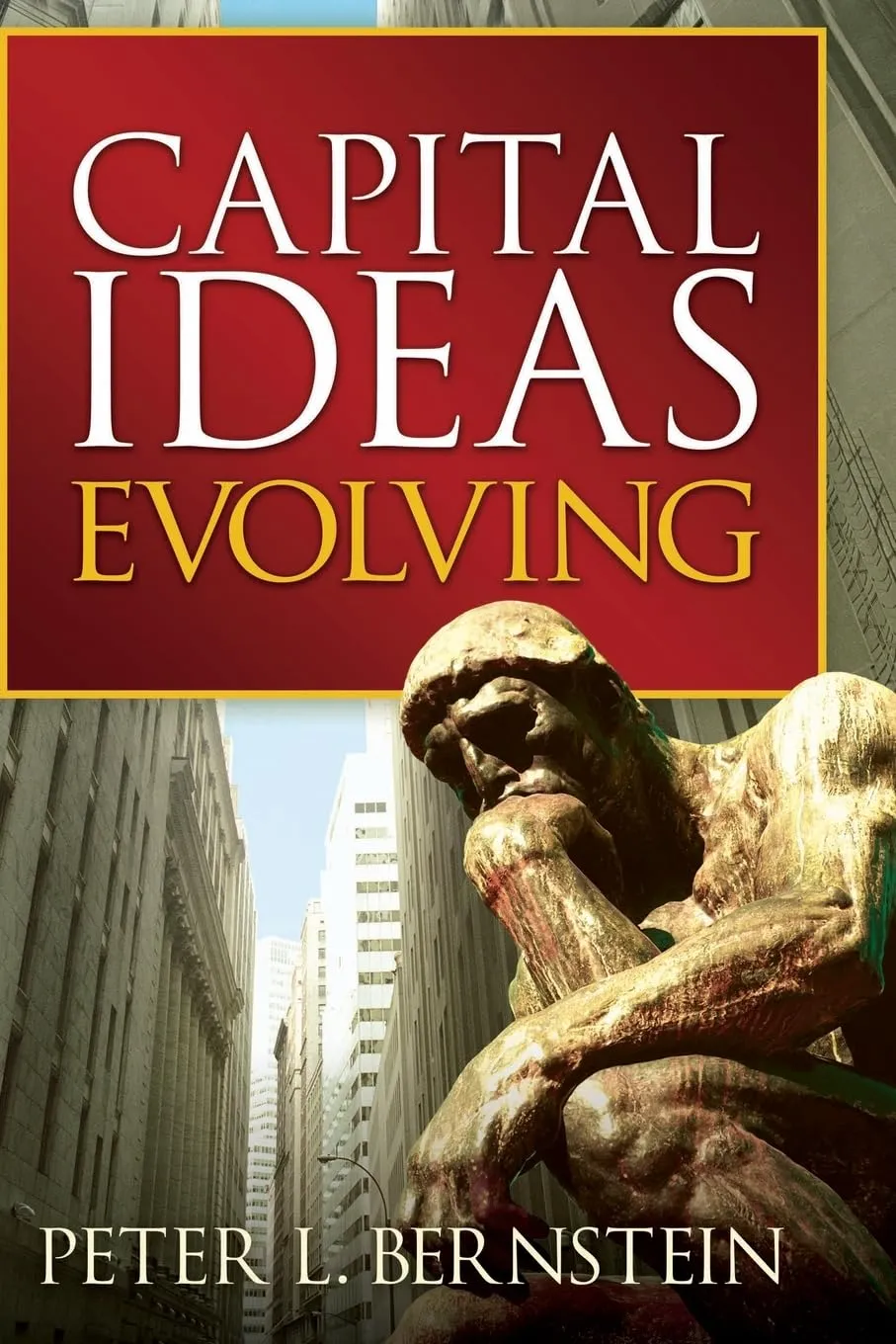
Every time you buy an index fund, check a stock's beta, or price an option, you are using tools invented by a handful of academics between 1952 and 1973. Peter Bernstein's Capital Ideas tells the story of how that happened. It traces the intellectual genealogy from Harry Markowitz's 14-page portfolio theory paper through William Sharpe's CAPM, Eugene Fama's efficient market hypothesis, Fischer Black and Myron Scholes's options pricing formula, and the behavioral finance revolution that challenged it all. This is narrative intellectual history that makes abstract financial theory come alive through the stories of the people who created it.
Book Details
| Attribute | Details |
|---|---|
| Title | Capital Ideas |
| Author | Peter L. Bernstein |
| Publisher | Wiley |
| First Published | 1992 |
| Pages | 340 |
| Reading Level | Intermediate to Advanced |
| Amazon Rating | 4.4/5 stars |
Get Your Copy
Paperback: Buy on Amazon
Kindle: Buy on Amazon
About the Author
Peter Bernstein (1919-2009) ran an investment counseling firm for decades while simultaneously writing some of the most important popular works on finance and economics. Capital Ideas and Against the Gods together constitute the finest popular history of financial thought available. He received the CFA Institute's Award for Professional Excellence and multiple honorary doctorates. His h-index of 20 and over 4,400 citations reflect a career spent bridging the gap between academic finance and practical investment management.
Bernstein knew many of the subjects in this book personally. That insider access gives Capital Ideas a texture that no textbook can match. He was present when these ideas were being fought over, rejected, and gradually accepted by an industry that initially wanted nothing to do with them.
The Intellectual Revolution That Built Modern Wall Street
Before 1950, investing was an art practiced by intuition, experience, and the careful reading of annual reports. It had no mathematical foundation, no formal theory of risk, no rigorous framework for portfolio construction, and no scientific models for pricing options. Within 30 years, a handful of academics working independently in Chicago, MIT, UCLA, and elsewhere built that foundation from scratch.
Bernstein's genius is in showing that this revolution was not inevitable, not well-funded, and not immediately welcomed by the financial industry it would transform. As he wrote in a later essay, "To say that this body of work is obsolete is to say that Aristotle and Euclid are obsolete." The ideas have been challenged, modified, and extended, but they remain the scaffolding upon which all modern finance is built.
Harry Markowitz and Modern Portfolio Theory
The 1952 Paper That Changed Everything
Harry Markowitz was a 25-year-old doctoral student at the University of Chicago when he submitted a 14-page paper titled "Portfolio Selection" to the Journal of Finance in 1952. The paper introduced two ideas that now seem obvious but were genuinely novel at the time.
Idea 1: Risk is not just the risk of losing money. It is variance of returns.
Before Markowitz, investors thought about risk intuitively. "Risky" stocks might go down. Markowitz formalized risk as statistical volatility: how much does the return vary from its expected value? A stock that reliably returns 5% has zero variance. A stock that returns -20% or +30% with equal probability has very high variance, even though its expected value (5%) is identical.
Idea 2: The relevant risk of an individual stock is not its standalone variance but its contribution to portfolio variance.
This is the key insight. Two stocks with high individual variances can, when combined in a portfolio, produce lower combined variance than either alone, if their returns are negatively correlated.
The math:
Portfolio Variance = w1^2 * s1^2 + w2^2 * s2^2 + 2 * w1 * w2 * s1 * s2 * p12

Where:
w = portfolio weight
s = standard deviation
p = correlation coefficient between the two assets
When p12 = -1 (perfect negative correlation), the portfolio variance can be reduced to zero. When p12 = +1 (perfect positive correlation), there is no diversification benefit. Real world correlations fall between these extremes.
The Efficient Frontier:
By combining assets in different proportions, you can trace an "efficient frontier" showing the maximum expected return available for each level of risk, or equivalently the minimum risk available for each expected return.
Expected Return
     |       *** Efficient Frontier
     |    ***
     | ***
     |*
     +----------------> Risk (Standard Deviation)
Any portfolio on the frontier is efficient. You cannot get more return for the same risk, or less risk for the same return. Portfolios below the frontier are suboptimal.
The Practical Revolution
Markowitz's framework transformed portfolio management from "buy good stocks" to "construct a portfolio with the best risk-return tradeoff." Every institutional investor today uses optimization algorithms derived from his work to construct portfolios.
When Markowitz presented his work to Milton Friedman for his dissertation defense, Friedman reportedly said: "This is not economics." The academic establishment was skeptical of applying statistical mathematics to investment. The practical financial community was equally resistant. The idea that their stock-picking expertise could be replaced by a mathematical formula was threatening. It took 15 years for the ideas to find serious institutional adoption.
William Sharpe and the Capital Asset Pricing Model (CAPM)
The Problem Markowitz Left Unsolved
Markowitz's framework required estimating expected returns, variances, and correlations for every pair of assets in the portfolio. For a portfolio of 100 stocks, this requires 100 expected returns, 100 variances, and 4,950 pairwise correlations. The computational burden was prohibitive even with early computers. William Sharpe, then a graduate student at UCLA, sought a simpler framework.
The CAPM
Sharpe published the CAPM in 1964. Its key insight: a stock's return can be decomposed into two components:
Return = Market Return x Beta + Idiosyncratic Return

Where Beta = Covariance(stock, market) / Variance(market)
Beta is the only risk that matters for the rational investor:
The idiosyncratic component (the part of a stock's return not explained by market movement) can be diversified away by holding a sufficiently large portfolio. Rational investors will always diversify away idiosyncratic risk. Therefore, the market will not compensate investors for taking idiosyncratic risk, only for bearing market risk (beta).
The CAPM prediction:
Expected Return = Risk-Free Rate + Beta x (Market Return - Risk-Free Rate)

Or: E[r] = Rf + B(Rm - Rf)
A stock with beta = 1.5 should earn 50% more excess return (above the risk-free rate) than the market, because it bears 50% more market risk.
The Practical Implications
For portfolio construction:
A portfolio's beta determines its systematic risk and expected return. Building a beta = 0.6 portfolio provides market exposure with less volatility. Beta = 1.4 provides amplified market exposure.
For performance evaluation:
A fund manager who earned 15% when the market earned 12% and the risk-free rate was 3% with a beta of 1.5 did NOT outperform:
Expected return = 3% + 1.5 x (12% - 3%) = 3% + 13.5% = 16.5%
Actual return = 15%
Alpha = 15% - 16.5% = -1.5% (underperformed on risk-adjusted basis)
The CAPM enabled rigorous performance evaluation by separating skill (alpha) from market exposure (beta). This was threatening to active managers whose "outperformance" was often just high beta.
The CAPM After 60 Years
A 2026 study by Paseda, Obademi, and Okanya published in Social Sciences & Humanities Open reviewed the CAPM after 60 years of testing. The authors found that while the CAPM's assumptions do not hold up empirically, the model remains the most widely used asset pricing model in practice. The Sharpe ratio, derived from CAPM, is still the standard metric for risk-adjusted returns worldwide. The study noted that newer approaches integrating machine learning with CAPM are emerging, but the core framework remains intact.
Bernstein himself addressed the CAPM's durability in a later essay: "It's in good health at its core. Most people's problems with it are at the edges." The model's conceptual clarity and practical utility have sustained it despite decades of academic criticism.
The CAPM's Limitations
Bernstein is honest about the CAPM's problems:
The single-factor limitation: The CAPM uses only one risk factor (the market). In 1992, Eugene Fama and Kenneth French published their three-factor model showing that size and value factors explain additional return variation. Later extensions added profitability and investment factors (the five-factor model).
The beta measurement problem: Beta is measured from historical data and is unstable over time. Past beta is an imperfect predictor of future beta.
The market portfolio problem: The theory requires using the "true market portfolio" including all investable assets. The S&P 500 is only a proxy.
Despite these limitations, the CAPM remains the most widely used asset pricing model in practice, a testament to its conceptual clarity and practical utility.
Eugene Fama and the Efficient Market Hypothesis
The Three Forms
Eugene Fama's efficient market hypothesis, formally stated in 1970, proposes that markets "fully reflect available information":
| Form | What Prices Reflect | Implication |
|---|---|---|
| Weak form | All historical price data | Technical analysis cannot consistently beat the market |
| Semi-strong form | All publicly available information | Fundamental analysis on public data cannot consistently beat the market |
| Strong form | All information including private | Even insiders cannot consistently beat the market |
The evidence as of Fama's initial work:
The Fama argument for index funds:
If markets are semi-strong efficient, fundamental analysis based on public information cannot systematically generate alpha. The only consistent winning strategy is to minimize costs, which means index funds.
Fama's work was deeply threatening to the investment management industry, which charged fees precisely for the ability to use information to select superior securities. The industry's response ranged from dismissal ("markets can't be efficient because we earn excess returns") to qualified acceptance.
Fischer Black, Myron Scholes, and Options Pricing
The Problem
Before 1973, no one had derived a closed-form equation for pricing options, financial contracts giving the buyer the right (but not obligation) to buy or sell an asset at a specified price by a specified date. Practitioners priced options by intuition and rule of thumb. The absence of a pricing formula prevented the development of a liquid, efficient options market.
The Black-Scholes Equation
In 1973, Fischer Black and Myron Scholes published the most important equation in finance:
C = S0 * N(d1) - K * e^(-rT) * N(d2)

Where:
d1 = [ln(S0/K) + (r + s^2/2)T] / (s * sqrt(T))
d2 = d1 - s * sqrt(T)

C = Call option price
S0 = Current stock price
K = Strike price
r = Risk-free interest rate
T = Time to expiration
s = Volatility of stock returns
N() = Cumulative normal distribution function
The intuition:
The formula says a call option is worth the current stock price times the probability (risk-adjusted) of the option ending in the money, minus the present value of the strike price times the probability of exercising.
What made it revolutionary:
The Black-Scholes formula requires no assumption about investors' risk preferences. It is derived entirely from arbitrage arguments. If options were priced differently, a risk-free profit could be constructed. This arbitrage-free pricing approach became the foundation for all derivative pricing.
The practical impact:
Bernstein tells the story of how Black and Scholes worked on the problem for years, submitted to two journals and were rejected, and finally published through the intervention of Merton Miller and Eugene Fama at the University of Chicago. The academic establishment initially dismissed the paper as too "applied."
Michael Jensen and the Attack on Active Management
The Mutual Fund Study
In 1968, Michael Jensen published a study of 115 mutual fund managers over a 20-year period, measuring their performance against a CAPM benchmark. The finding was devastating for active management:
The results:
The interpretation:
If active fund managers cannot consistently generate alpha, why pay them 1-1.5% annually in fees? The rational alternative: index funds with minimal fees.
The investment management industry largely ignored Jensen's findings for another decade. The passive investing revolution did not accelerate until index funds became widely available to retail investors (Vanguard's First Index Investment Trust launched in 1976), and did not become dominant until the 2000s. The S&P Dow Jones Indices SPIVA U.S. Scorecard has confirmed Jensen's findings repeatedly: roughly 88% of large-cap active funds underperform the S&P 500 over 15 years, and about 93% over 20 years. Read more about the active vs. passive debate in our guide to ETFs vs. mutual funds.
Robert Merton and Continuous-Time Finance
Extending Black-Scholes
Robert Merton (who shared the Nobel with Scholes in 1997) developed continuous-time mathematical finance, extending the Black-Scholes framework to price any derivative security, model interest rate dynamics, and analyze corporate bonds as options on the firm's assets.
The Merton model for corporate bonds:
A company's equity can be modeled as a call option on the company's assets:
This framework enabled rigorous pricing of corporate bonds as a function of firm asset value and volatility, directly connecting equity and debt markets through options theory.
The Behavioral Finance Challenge
Bernstein ends with the emerging challenge to the entire efficient markets framework: behavioral finance.
The Anomalies
By the late 1980s, researchers had documented persistent market anomalies that the efficient market hypothesis could not explain:
| Anomaly | Description | Challenge to EMH |
|---|---|---|
| Value premium | Low P/B stocks consistently outperform | Systematic mispricing or systematic risk? |
| Momentum | Past 12-month winners continue to win | Information not immediately incorporated |
| Small-cap premium | Small companies outperform large | Systematic mispricing or liquidity risk? |
| January effect | Small stocks outperform in January | Seasonal tax-loss harvesting? Irrational? |
| Post-earnings drift | Earnings surprises predict future returns | Under-reaction to information |
The rational vs. behavioral interpretation:
Efficient market defenders (Fama among them) argue these anomalies represent unidentified risk factors. The value premium, for example, may reflect the systematic risk of value companies performing worse in recessions. Behavioral economists (Thaler, Shiller) argue they reflect systematic investor irrationality.
The debate remains genuinely unresolved. A 2025 paper published in the Journal of Income Distribution tested Piketty's related hypothesis about wealth accumulation using a larger sample of countries and found that the "second fundamental law of capitalism" is not generalizable across economies. This mirrors the broader pattern in finance: elegant theories that work well in some contexts fail in others, and the debate between rational and behavioral explanations continues.
For a practical look at how behavioral biases affect your own investing, read our article on the psychology behind impulse buying and the sunk cost fallacy in finances.
The Investment Implications of Capital Ideas Theory
For Passive Investors
The intellectual foundation of passive investing comes directly from this book's subjects:
The logic chain leads directly to: hold a diversified portfolio of low-cost index funds, allocate between assets based on your time horizon and risk tolerance, and do not try to beat the market. This is exactly what the three-fund portfolio implements.
For Active Investors
Even active investors should understand CAPM and efficient market theory:
For Understanding Financial Products
Almost every financial product you encounter, from options and futures to structured products, convertible bonds, and callable bonds, is priced using derivatives of the models in this book. Understanding the intellectual foundations helps you evaluate whether you are paying fair value.
Strengths & Weaknesses
What We Loved
Areas for Improvement
Who Should Read This Book
Highly Recommended For
Probably Not For
Frequently Asked Questions
Q: Do I need to understand math to read this book?
A: The narrative sections are fully accessible without math. The equations are presented but Bernstein explains the intuition thoroughly enough that following the math is helpful but not required.
Q: How does this compare to Against the Gods?
A: Against the Gods covers the history of risk measurement from ancient probability theory to modern finance. Capital Ideas focuses specifically on 20th-century academic financial theory. Both are essential. Capital Ideas goes deeper on the specific models that transformed Wall Street.
Q: Is the CAPM still used in 2026?
A: Yes. A 2026 study confirmed that despite decades of criticism and the development of multi-factor models, the CAPM remains the most widely used asset pricing model in practice. The Sharpe ratio, derived from CAPM, is still the standard metric for risk-adjusted returns. Newer approaches integrate machine learning with CAPM rather than replacing it entirely.
Final Verdict
Rating: 4.5/5
Capital Ideas is the definitive popular history of modern financial theory. Its accounts of Markowitz's portfolio theory, Sharpe's CAPM, Fama's efficient markets, and Black-Scholes options pricing are among the best explanations of these ideas available in any non-technical book. A 2026 review of the CAPM after 60 years confirmed that the models Bernstein chronicled remain the backbone of professional finance. Essential for any investor who wants to understand the intellectual foundation beneath the tools they use.
Want to see how these theories play out in your own portfolio? Use our investment return calculator to model different allocations, and read our guide to dollar-cost averaging to see how Fama's efficient market hypothesis translates into practical investment behavior.
Get Your Copy
Paperback: Buy on Amazon
Kindle: Buy on Amazon
Prices current as of publication date. Free shipping available with Prime.